
跨境电子商务

Search documents
将改革举措上升为法律制度 新修订的《对外贸易法》含“新”量十足
Yang Shi Wang· 2026-01-09 07:53
Group 1 - The newly revised Foreign Trade Law of the People's Republic of China will officially take effect on March 1 this year, elevating several innovative systems and mature practices in China's foreign trade sector to legal status [1] - The new law explicitly supports new business models such as cross-border e-commerce and comprehensive foreign trade services, marking the first inclusion of digital trade and green trade in legislation [3] - The law promotes the use of electronic bills of lading and electronic invoices, and aims to advance international mutual recognition of digital certificates and electronic signatures, thereby fostering innovation in digital trade and accelerating the establishment of a green trade system [3] Group 2 - The inclusion of the negative list system for cross-border service trade in the law is particularly noteworthy, as it enhances the transparency of service trade opening rules [5] - Experts believe that the legal elevation of the trade policy compliance mechanism will create a fairer, more open, and transparent business environment for foreign enterprises, boosting their confidence and expectations for investment in China [7] - The new law is expected to play a more active and profound role in enhancing the level of trade liberalization and facilitation, as well as strengthening the resilience of foreign trade development as supporting policy measures are gradually implemented [7]


广东加快数字产业规模增长,年均复合增长率超15%
Huan Qiu Wang· 2025-11-21 00:59
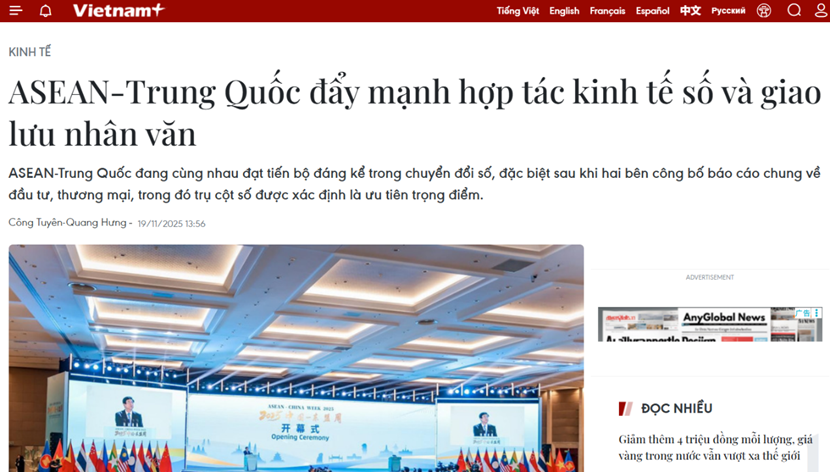
Group 1 - The core viewpoint is that Guangdong Province aims to accelerate the construction of a national digital economy innovation development pilot zone, targeting that by 2027, the core industry value of the digital economy will account for over 16% of GDP, with an annual compound growth rate of over 15% for the data industry, and the scale of the artificial intelligence core industry exceeding 440 billion yuan [1] - The Thai Foreign Ministry's official highlighted that digital transformation extends beyond trade and investment to include cross-border e-commerce, digital payment systems, artificial intelligence, smart healthcare, online education, multimedia communication, and high-tech in digital agriculture and agricultural production [1][4] Group 2 - The rapid development of the digital economy presents significant opportunities for the growth of small and medium-sized enterprises, enhancing productivity and building a regional digital ecosystem [4] - There is an urgent need for governance in artificial intelligence, cybersecurity, prevention of cybercrime, and online risk control due to the rapid growth of the digital economy, suggesting close cooperation between ASEAN and China to establish legal frameworks and unified standards [4]
持续放大数字贸易强劲动能
Jing Ji Ri Bao· 2025-05-13 21:47
Group 1 - The core viewpoint of the articles emphasizes the importance of digital trade as a new driving force for international trade recovery and economic growth, particularly in the context of increasing global economic uncertainty [1][2][4] - China's cross-border e-commerce import and export volume is projected to reach 2.63 trillion yuan in 2024, marking a year-on-year growth of 10.8%, highlighting its role as a major engine for foreign trade growth [1] - The development of digital trade in China is supported by advancements in digital technology, infrastructure, and a favorable business environment, with significant growth in areas such as big data, artificial intelligence, and cloud computing [1][3] Group 2 - The articles outline the need for a robust digital trade infrastructure, including the development of platforms utilizing blockchain technology and enhancing cross-border e-commerce services [2][3] - There is a focus on nurturing leading digital trade enterprises in sectors like cross-border e-commerce and artificial intelligence, aiming to create a comprehensive digital trade ecosystem [3] - Strengthening international cooperation in digital trade is crucial, with efforts to expand into emerging markets and actively participate in multilateral digital trade rule-making [4]