路网服务

Search documents
京沪高铁:一道复杂的算术题
虎嗅APP· 2026-01-04 00:08
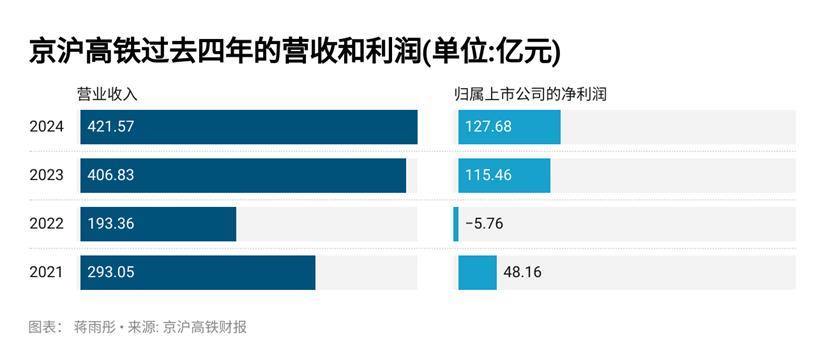
Core Viewpoint - After enduring three years of pandemic challenges, the Beijing-Shanghai High-Speed Railway is entering a rapid recovery phase in 2023 and 2024, but by 2025, revenue and profit growth show signs of stagnation, with net asset return rates around 6%, which is inconsistent with its "cash printing machine" image [5][6]. Group 1: Financial Performance Overview - The company was listed in January 2020, raising 30.7 billion yuan and incurring 20 billion yuan in debt to acquire 65% of the Anhui Jiufu company for a total of 50 billion yuan [7]. - Revenue growth from 2020 to 2022 was negative, with a peak revenue of 349 billion yuan in 2019 dropping by 44.7% to 193 billion yuan in 2022; net profit fell from 11.07 billion yuan in 2019 to a loss of 580 million yuan in 2022 [8]. - In 2023, revenue rebounded by 110.4% to 40.7 billion yuan, and net profit turned positive at 11.55 billion yuan; however, signs of peak performance emerged in 2024 with revenue and net profit growth of 3.6% and 10.6%, respectively [8][9]. Group 2: Business Segments - The main business segments include passenger transportation and network services, with passenger numbers remaining relatively stable pre- and post-pandemic, indicating a peak in passenger revenue [10][11]. - Network service revenue showed a consistent increase from 18.8 billion yuan in 2023 to 20.1 billion yuan in 2024, but growth stagnated in the first half of 2025, raising questions about future revenue potential [12]. Group 3: Acquisition Impact and Valuation - The acquisition of Anhui Jiufu has led to significant fluctuations in operational efficiency, with actual profits falling short of management's expectations, resulting in substantial losses from 2022 to 2024 [14]. - The financial reports indicate a simplified business model, with most operations outsourced, leading to minimal accounts receivable risk and a high proportion of cash and fixed assets [15][18]. - Current valuations suggest that the combined entity is overvalued, with adjustments indicating a net profit of approximately 13.3 billion yuan for 2024, leading to a net asset return rate of 8.4% and a price-to-earnings ratio of around 15.2 [19][21]. Group 4: Future Growth Potential - The company is positioned to benefit from upcoming high-speed rail projects, such as the Xiong'an-Shangqiu high-speed railway expected to open in September 2026, which could enhance revenue through increased capacity and potentially higher ticket prices [22][24]. - The growth in network revenue is primarily driven by new connections that increase passenger and freight traffic, with significant contributions expected from the completion of additional rail lines [25][26]. - The strategic location within the "Eight Vertical and Eight Horizontal" high-speed rail network suggests substantial future value enhancement opportunities, particularly as new lines are integrated [27].


中国最赚钱高铁:员工仅86人,收“过路费”比运人更赚钱
3 6 Ke· 2025-05-15 11:43
Core Viewpoint - The financial performance of Beijing-Shanghai High-Speed Railway (京沪高铁) shows a revenue of 42.157 billion yuan in 2024, a year-on-year increase of 3.62%, and a net profit of 12.768 billion yuan, reflecting a growth of 10.59% compared to the previous year. Despite a decrease in passenger flow, the profit growth outpaced revenue growth, indicating effective pricing strategies and operational efficiency [1][5][7]. Financial Performance - In 2024, the passenger volume was 52.016 million, a decrease of 2.31% year-on-year, while the revenue from passenger services was approximately 15.83 billion yuan, accounting for 37.5% of total revenue. Revenue from network services was about 25.95 billion yuan, making up 61.6% of total revenue [1][10][11]. - The company has adopted a flexible pricing mechanism with seven tiers of ticket prices during peak periods, which has contributed to the increase in profit despite the decline in passenger numbers [1][7]. Operational Model - The company operates under a "delegated management + asset operation" model, allowing it to maintain high efficiency with only 86 employees, resulting in a market capitalization of 290 billion yuan, which is double that of its closest competitor [2][9]. - The unique operational model enables the company to focus on asset ownership and quality supervision while outsourcing transportation management, significantly reducing operational costs [9][10]. Market Dynamics - The competitive landscape is changing, with increased competition from the aviation sector due to lower airfares and enhanced inter-airline cooperation, which is affecting the high-speed rail's business travel segment [5][14][15]. - The company is responding to these challenges by adjusting its operational strategies, including the introduction of new train services and enhancing its digital capabilities [17][18]. Future Outlook - Analysts remain optimistic about the company's future, citing potential for further revenue growth through market-driven pricing adjustments and operational improvements [18]. The company plans to enhance its smart operation capabilities and diversify its service offerings to attract a broader customer base [18].