车载显示系统

Search documents
美国政府关门之际,不妨碍这家中国公司继续提交纳斯达克IPO申请
Sou Hu Cai Jing· 2025-10-13 08:28
Core Viewpoint - Boundless Group, a Chinese developer of optical display modules for VR and other electronic applications, has filed for an IPO in the US, aiming to raise up to $18 million with a proposed stock price range of $4 to $5 per share, which would value the company at approximately $198 million [1] Company Overview - Boundless Group Limited controls Nanjing Baituo Visual Technology Co., Ltd., established in 2022, focusing on the design, R&D, and sales of optical display modules and complete products [3] - Nanjing Baituo is one of the few companies capable of mass-producing Pancake 3P optical engines, with superior product performance compared to competitors, and has established extensive relationships with domestic clients [3] - The company specializes in the automotive and high-speed rail sectors, developing targeted products for cabin applications, accumulating rich experience and technology [3] Market Presence - Boundless Group serves over 20 clients in China and international markets across various sectors, including new energy vehicles, color electronic paper displays, and low-altitude aerospace [4] - The product portfolio includes near-eye displays, VR-specific LCD modules, in-vehicle display systems, and color electronic paper displays [4] - For the 12 months ending June 30, 2025, Boundless Group reported revenue of $26 million [4]

来自南京的栢拓设定IPO条款,拟募资1800万美元,计划在纳斯达克上市
Sou Hu Cai Jing· 2025-10-13 07:35
Core Viewpoint - Boundless Group, a developer of optical display modules based in Nanjing, China, has filed for an IPO with the intention to raise up to $18 million, planning to list on NASDAQ under the ticker symbol BLTG [2][3]. Company Overview - Boundless Group specializes in optical display technology, designing, developing, and selling optical display modules and related products for virtual reality (VR), augmented reality (AR), consumer electronics, and other emerging industries [3]. - The company serves over 20 clients in China and international markets, providing comprehensive optical solutions that include design, engineering, and supply chain management [3]. Financial Performance - For the 12 months ending June 30, 2025, Boundless Group reported revenues of $26 million, a significant increase of 139.94% from $10.92 million in 2024 [7]. - The cost of revenues also rose to $24.48 million, up 137.5% from $10.30 million in the previous year [7]. - Gross profit increased to $1.72 million, reflecting a growth of 179.3% compared to $616,230 in 2024 [7]. - Total operating expenses rose to $3.37 million, a 59.3% increase from $2.11 million in 2024 [7]. - The net loss for the period was $1.79 million, which is a 6.27% increase from a loss of $1.69 million in the previous year [7]. IPO Details - The company plans to issue 4 million shares at a price range of $4 to $5 per share, which would give Boundless Group a market capitalization of approximately $198 million at the midpoint of the proposed range [3]. - The IPO application was initially submitted confidentially on March 14, 2025 [7]. Underwriting - Tiger Brokers is the sole bookrunner for this IPO transaction [8].
京东方精电再跌超4% 公司可能被剔除港股通 上半年利润增速低于营收增速
Zhi Tong Cai Jing· 2025-08-28 03:40
Core Viewpoint - BOE Technology Group (京东方精电) has faced a significant decline in stock price following its removal from the Hang Seng Composite Index, with ongoing challenges in profitability and market conditions impacting its outlook [1] Financial Performance - For the first half of the year, BOE reported revenue of HKD 6.671 billion, an increase of approximately 8% year-on-year [1] - The net profit attributable to shareholders was approximately HKD 180 million, reflecting a year-on-year increase of about 5% [1] - The net profit margin for the company stands at 2.7% [1] Market Reaction - Following the announcement of its removal from the index, BOE's stock price dropped over 4%, closing at HKD 6.12 with a trading volume of HKD 73.1746 million [1] - Citigroup has downgraded its investment rating from "Buy" to "Sell," reducing the target price from HKD 7.4 to HKD 5.5, citing weak profit margins and slow recovery in business [1] Investment Outlook - The company is experiencing increased R&D investments in its automotive display systems and additional investments in its Vietnam factory, which have impacted profit growth [1] - Management anticipates continued inventory destocking pressure in the domestic market for the second half of the year, with no significant improvement expected in operating profit margins over the next two years [1]


港股异动 | 京东方精电(00710)再跌超4% 公司可能被剔除港股通 上半年利润增速低于营收增速
智通财经网· 2025-08-28 03:37
Core Viewpoint - BOE Technology Group Co., Ltd. (京东方精电) has experienced a significant decline in stock price following its removal from the Hang Seng Composite Index, with a current trading price of 6.12 HKD and a trading volume of 73.17 million HKD [1] Financial Performance - For the first half of the year, BOE reported revenues of 6.671 billion HKD, representing an approximate 8% year-on-year increase [1] - The net profit attributable to shareholders was about 180 million HKD, reflecting a year-on-year increase of approximately 5% [1] - The net profit margin for the company stands at 2.7% [1] Market Reactions - Everbright Securities noted that the profit growth rate is lower than the revenue growth rate, primarily due to increased R&D investments in the automotive display system business, additional investments in the Vietnam factory, provisions for accounts receivable, and rising employee costs [1] - Citigroup indicated that BOE's profit margins have been weak due to investments in system businesses, and while the business is gradually recovering, the progress is slow [1] - Citigroup has downgraded its investment rating from "Buy" to "Sell" and reduced the target price from 7.4 HKD to 5.5 HKD, anticipating that the net profit margin will remain stable in the second half of the year amid inventory destocking pressures in the domestic market [1]
越内卷越要建厂扩张?创维数字利润下滑超6成
Guan Cha Zhe Wang· 2025-03-25 10:21
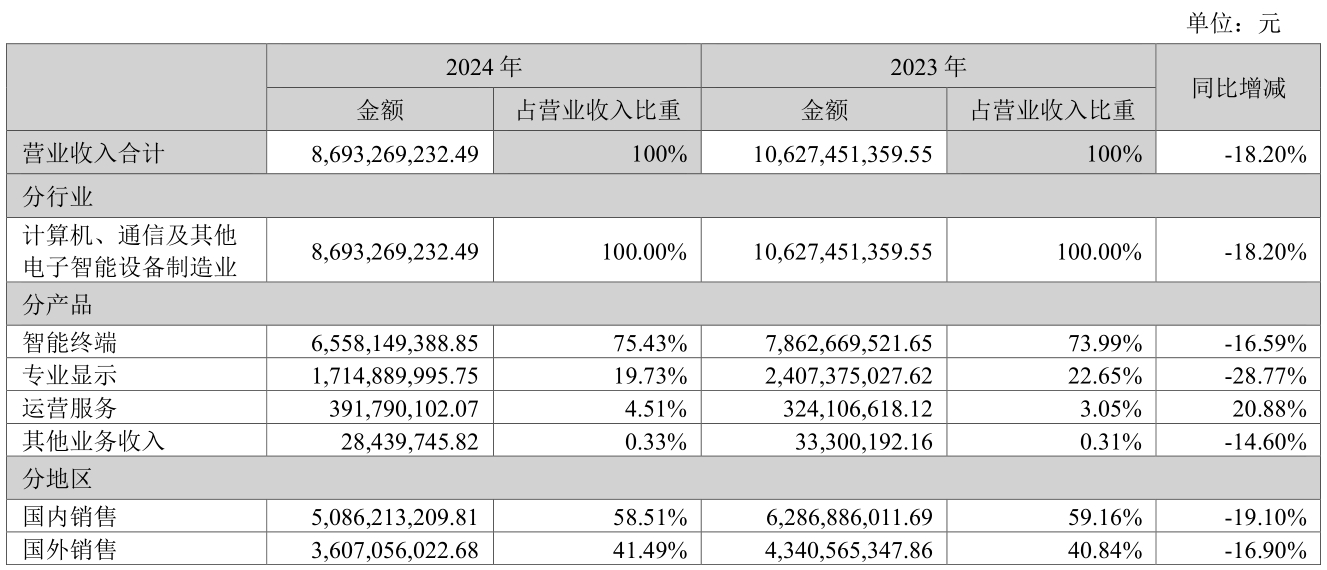
Core Viewpoint - The company, Skyworth Digital, has experienced a significant decline in both revenue and profit for the year 2024, primarily due to price wars in the smart terminal device market and insufficient consumer demand [1][2]. Financial Performance - In 2024, Skyworth Digital reported total revenue of 8.69 billion yuan, a decrease of 18.20% year-on-year [2]. - The net profit attributable to shareholders was 251 million yuan, down 58.34% compared to the previous year [1][2]. - The revenue from smart terminals, which includes set-top boxes and broadband devices, was 6.56 billion yuan, accounting for 75.43% of total revenue, and decreased by 16.59% year-on-year [1][2]. Market Position and Expansion - Despite the decline in performance, the company maintains its leading position in the industry and has secured multiple procurement projects from major telecom operators like China Mobile and China Telecom [2][3]. - The company is investing in expansion, with a total investment of 2.27 billion yuan planned for the construction of the Huizhou Industrial Park, which will enhance production capacity for smart terminals and network communication devices [4][5][6]. Product Development and New Growth Areas - The broadband network connection device business is benefiting from the acceleration of the domestic "dual-gigabit" network construction, with significant demand for 10G PON and Wi-Fi 7 products [3]. - The automotive display business and XR terminal products are expected to become new growth drivers, with the automotive display segment achieving revenue of 1.23 billion yuan, a year-on-year increase of 24.90% [7]. - The company is preparing for mass production of AI smart glasses, targeting outdoor scenarios, with plans for a 2025 launch [8]. Strategic Alliances and Future Outlook - Skyworth Digital anticipates a transaction volume of 587 million yuan with related parties by 2025, which may provide long-term growth momentum [9]. - The company faces challenges in maintaining long-term competitiveness due to rapid technological changes and market saturation in traditional appliance sectors [10].