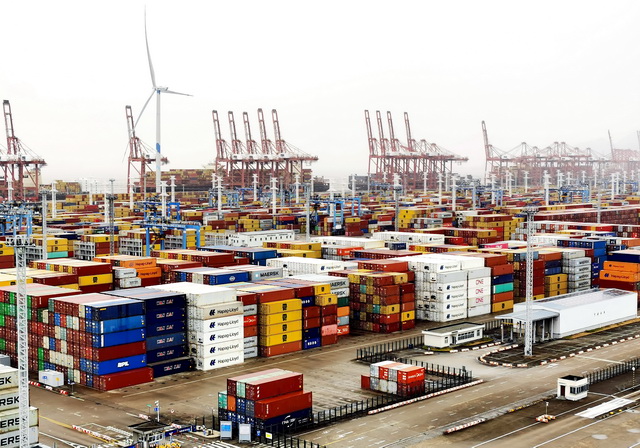
远控桥吊

Search documents
(新春走基层)“蓝领”变“智领” “全球第一大港”坚守者新貌
Xin Lang Cai Jing· 2026-02-18 03:55
Core Viewpoint - The article highlights the bustling activity at the Meishan Port area of Ningbo-Zhoushan Port during the Lunar New Year, showcasing the transformation of port operations through digitalization and automation, as well as the dedication of workers like Wu Qifei who have adapted to new technologies [1][10]. Group 1: Port Operations and Automation - Meishan Port has become the largest automated operation equipment cluster globally, featuring 38 remote-controlled bridge cranes, 116 remote-controlled gantry cranes, and 130 intelligent container trucks, achieving full-process collaborative operations [8][9]. - The port's container throughput has significantly increased, with a reported annual throughput of 13.19 million standard containers, marking a year-on-year growth of 17.9% [9]. - In January, Meishan Port set a record for single-month container operations, surpassing 1.3 million standard containers, reflecting the port's growing capacity and efficiency [9]. Group 2: Worker Transformation and Experience - Wu Qifei, a crane operator, transitioned from traditional high-altitude operations to remote control, enhancing safety and efficiency while reducing physical strain [4][8]. - The digital transformation initiated in 2016 involved the introduction of remote control equipment, which initially faced challenges but ultimately led to the development of a new operational method that improved performance [5][6]. - The commitment of workers during peak times, such as the Lunar New Year, emphasizes the importance of continuous operations in maintaining the flow of goods and supporting China's foreign trade [10].


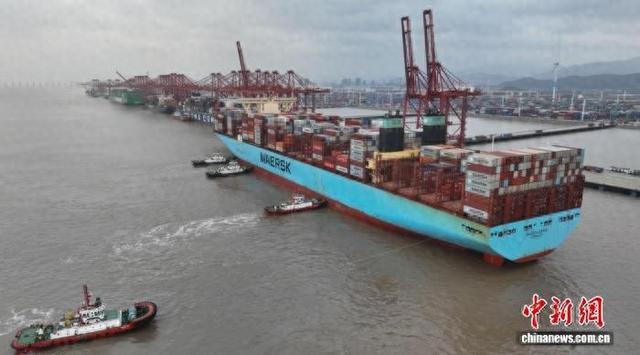
“硬核”港口,何以链接全球?
Zhong Guo Xin Wen Wang· 2025-11-24 09:45
Core Viewpoint - The article highlights the significance of Ningbo-Zhoushan Port as a crucial hub for China's trade and its role in the global supply chain, emphasizing its continuous growth and modernization efforts through smart technologies and enhanced connectivity [2][5][6]. Group 1: Port Performance and Achievements - Ningbo-Zhoushan Port has maintained its position as the world's largest port in terms of cargo throughput for 16 consecutive years since 2009, with container throughput consistently ranking among the top three globally [2]. - In 2024, the port is projected to handle approximately 1.38 billion tons of cargo and 39.3 million TEUs (Twenty-foot Equivalent Units) of containers, with two container terminals each capable of handling over 10 million TEUs [2]. - As of September 11, 2024, the port's container throughput for 2025 has already surpassed 30 million TEUs, setting a new historical record [2]. Group 2: Technological Advancements - The port is undergoing a "smart revolution" by integrating advanced technologies such as 5G and digital twin systems, enhancing operational efficiency through remote-controlled cranes and automated vehicles [4]. - The "2+1" smart terminal construction is being accelerated, with the Meishan Port area featuring the world's largest cluster of remote-controlled cranes [4]. Group 3: Global Connectivity and Trade - The successful launch of the "China-Europe Arctic Express" route has significantly reduced transit time to the UK, cutting it by about 20 days and halving carbon emissions for the journey [5]. - Ningbo-Zhoushan Port has established a comprehensive global shipping network, connecting major oceans including the Pacific, Atlantic, Indian, and Arctic Oceans [5]. Group 4: China's Open Policy - China is actively enhancing its openness by improving its foreign trade and investment frameworks, including reducing the negative list for foreign investment and expanding free trade agreements [6][7]. - The Central Economic Work Conference in 2024 emphasized the importance of orderly expansion of autonomous and unilateral openness, aiming to stabilize foreign trade and investment [6][7].
港口如何降本提质增效?宁波舟山港出了这些招|一线调研
Di Yi Cai Jing· 2025-03-31 04:46
Core Insights - Ningbo-Zhoushan Port achieved a cargo throughput of approximately 1.38 billion tons in 2024, maintaining its position as the world's largest port for 16 consecutive years, and handled a container throughput of 39.3 million TEUs, ranking third globally [1][2] Group 1: Port Infrastructure and Capacity - The port consists of 20 port areas with over 210 deep-water berths capable of accommodating vessels over 10,000 tons, and more than 130 berths for vessels over 50,000 tons, making it one of the largest ports in mainland China [1] - The Chuan Mountain Port Area is the second largest single container terminal globally and has been operationally efficient, achieving over 10 million TEUs annually for eight consecutive years from 2017 to 2024 [1] Group 2: Digitalization and Efficiency Initiatives - The "On-time Cost Reduction Plan" was implemented at Ningbo-Zhoushan Port to enhance shipping efficiency by integrating digital platforms across ports, shipping companies, and maritime departments, resulting in a 98% on-time rate for main channel vessels and a 35% increase in port entry and exit efficiency [2][5] - The average berthing time for Maersk's East America route was reduced from 30 hours to 6 hours, with the on-time rate improving from below 30% to 77% [5] Group 3: Environmental Impact and Cost Savings - The implementation of the on-time plan has led to a reduction of 30,700 tons in fuel consumption and a decrease of 99,000 tons in carbon emissions, equivalent to planting approximately 5.5 million trees [5] - In 2024, the pilot program reduced waiting time for vessels by over 9,000 hours, saving companies approximately 280 million yuan [5] Group 4: Innovation in Operations - The Meishan Port Area has become a demonstration zone for digital reform and the construction of a 5G green smart port, featuring the highest number of remote-controlled bridge cranes in a single terminal globally [6][7] - The port has developed a 24-hour green channel for the export of new energy vehicles, ensuring zero-waiting approval for hazardous goods [8] Group 5: New Standards and Cost Efficiency - The Ningbo Maritime Bureau has established a recommended standard for the safe operation of new energy vehicle loading, addressing the lack of existing safety standards [8][9] - New loading methods have increased container utilization for new energy vehicles, allowing for three to five vehicles per container, significantly reducing shipping costs by 33% to 60% compared to traditional methods [9]