远景天机

Search documents
远景科技与阿联酋未来能源公司Masdar达成战略合作,共同搭建全球AI能源系统
Xin Lang Cai Jing· 2026-01-17 04:59
Core Insights - The strategic partnership between Envision Group and Masdar aims to advance the large-scale application of AI energy systems and facilitate global energy transition [1][2] - Envision Group launched the world's first energy large model, "Envision Tian Shu," designed to create the largest physical AI system for energy [3][5] Group 1: Strategic Partnership - Envision Group signed a strategic cooperation agreement with Masdar during the 2026 Abu Dhabi Sustainability Week to promote AI energy systems [1] - The agreement was witnessed by key figures including Envision Group's Chairman Zhang Lei and Masdar's Chairman H.E. Dr. Sultan [1] Group 2: AI Energy System - "Envision Tian Shu" serves as the core of Envision's physical AI system, capable of analyzing vast amounts of real energy data to coordinate renewable energy generation, storage, grid dispatch, and energy demand in real-time [3][5] - The system aims to drive energy marginal costs close to zero and support the simultaneous scaling of energy systems and AI to meet unprecedented energy demands from AI infrastructure [3][5] Group 3: Weather Model Integration - "Envision Tian Shu" operates in conjunction with Envision's self-developed large-scale weather model, "Envision Tian Ji," which helps predict and manage energy fluctuations caused by weather conditions [5] - This integration ensures that the energy system can operate at scale, high efficiency, and reliability [5]

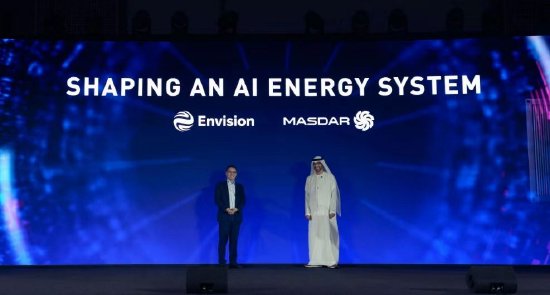
远景与马斯达尔签署战略合作协议
Zhong Zheng Wang· 2026-01-15 13:35
Core Viewpoint - Envision Group has signed a strategic cooperation agreement with Masdar to promote the large-scale application of AI energy systems during the Abu Dhabi Sustainability Week [1] Group 1: Strategic Partnership - The partnership aims to advance the integration of AI in energy systems, enhancing efficiency and reliability [1] - Envision Group showcased its energy model "Envision Tian Shu," which analyzes vast amounts of real energy data [1] Group 2: Technological Innovation - "Envision Tian Shu" coordinates renewable energy generation, storage, grid dispatch, and energy demand in real-time [1] - The model works in conjunction with Envision's self-developed weather model "Envision Tian Ji," which predicts and mitigates fluctuations caused by weather conditions [1]
首个能源大模型发布 远景与中东能源巨头马斯达尔达成战略合作
Zheng Quan Shi Bao Wang· 2026-01-15 11:22
Core Insights - Envision Technology Group and Masdar signed a strategic cooperation agreement to advance the large-scale application of AI energy systems and global energy transition [1] - Envision launched the world's first energy large model, "Envision Dubhe," aimed at creating the largest physical AI system globally [1] - "Envision Dubhe" analyzes vast amounts of real energy data to coordinate renewable energy generation, storage, grid dispatch, and energy demand in real-time [1] Group 1 - The collaboration aims to reduce marginal energy costs and support the synchronized large-scale development of energy systems and AI to meet unprecedented energy demands from AI infrastructure [1] - Envision believes the next technological leap will focus on physical AI, which can directly manage critical physical systems that support human survival and prosperity [1] - "Envision Dubhe" operates in conjunction with Envision's self-developed large-scale meteorological model, "Envision Tianji," to predict and respond to energy fluctuations caused by weather conditions [1] Group 2 - The chairman of Envision Technology Group, Zhang Lei, stated that this initiative represents not only an energy transition but also a potential upgrade of civilization [2]
以AI赋能筑牢能源转型“智能屏障”
Zhong Guo Neng Yuan Wang· 2026-01-11 03:25
Core Insights - The integration of artificial intelligence (AI) and energy is a strategic approach to ensure energy security, promote green transformation, and cultivate new productive forces in China, reflecting the country's commitment to solving development challenges through technological innovation [1] Policy Direction - Since the 18th National Congress, significant achievements have been made in China's energy sector, but the triple mission of ensuring safety, promoting transformation, and improving efficiency remains challenging. By 2025, China's total electricity consumption is expected to exceed 10 trillion kilowatt-hours, with new wind and solar power installations projected at approximately 370 million kilowatts [2] - The National Development and Reform Commission and the National Energy Administration have issued implementation opinions to promote high-quality development of "AI + energy," establishing a timeline and roadmap for deep integration [2] - The goal is to explore replicable and scalable comprehensive solutions and business models, creating a new paradigm for the integration of AI and energy [2] Practical Applications - AI is enhancing efficiency across the entire energy supply chain. In coal mining, AI inspection systems have significantly improved safety hazard identification, reducing underground personnel by 25% [3] - In thermal power generation, intelligent scheduling systems can reduce coal consumption by 0.8 grams per kilowatt-hour, leading to substantial CO2 emissions reductions [3] - AI applications in renewable energy, such as precise forecasting models in Inner Mongolia, are increasing the utilization rate of green electricity and addressing transmission challenges [3] Competitive Advantages - China possesses unique competitive advantages in energy intelligent transformation, with over 80% of major international oil and gas companies already investing in energy digitalization. The country has a vast energy market and diverse application scenarios, with the AI industry expected to exceed 700 billion yuan by 2024 [4] - The "East Data West Calculation" project is facilitating the migration of computing power to clean energy-rich areas, creating favorable conditions for China to take the lead in global energy transition [4] Challenges and Solutions - Despite initial successes, the integration of AI and energy faces multiple challenges, including the "black box" nature of large models affecting reliability in critical areas like grid scheduling and nuclear safety [5] - Data sharing is hindered by inconsistent standards and the "data island" phenomenon, particularly in the oil and gas sector due to confidentiality and management differences [5] - There is a shortage of interdisciplinary talent who understand both energy systems and AI algorithms, which is a bottleneck for industry upgrades [5] Future Development - The integration of AI and energy is becoming a crucial indicator of core competitiveness in the energy sector, transforming the industry from passive to proactive management [6] - The ongoing transformation must prioritize safety and address existing bottlenecks to ensure that AI becomes the core engine of energy transition [6]
以AI赋能筑牢能源转型“智能屏障”
中国能源报· 2026-01-06 05:33
Core Viewpoint - The integration of artificial intelligence (AI) and energy is a strategic approach to ensure energy security, promote green transformation, and cultivate new productive forces in China, especially under the "dual carbon" goals and the construction of a new energy system [1]. Policy Guidance - Since the 18th National Congress, significant achievements have been made in China's energy sector, but the challenges of ensuring safety, promoting transformation, and improving efficiency remain daunting. By 2025, China's total electricity consumption is expected to exceed 10 trillion kilowatt-hours, with an additional 370 million kilowatts of wind and solar power generation capacity [1]. - The National Development and Reform Commission and the National Energy Administration issued implementation opinions in September 2025 to outline a "timeline" and "roadmap" for the deep integration of AI and energy [1]. Practical Applications - AI empowerment spans the entire energy supply chain, significantly improving safety and efficiency. For instance, AI inspection systems in coal mining have increased safety hazard identification efficiency, reducing underground personnel by 25%. In thermal power generation, intelligent scheduling systems can reduce coal consumption by 0.8 grams per kilowatt-hour, leading to substantial CO2 emissions reductions [2]. - In Inner Mongolia, AI models have enhanced the utilization of renewable energy, addressing the issue of green electricity being generated but not transmitted effectively. The digital twin grid in Shenzhen has minimized fault repair times through virtual mapping and intelligent warnings [2]. Competitive Advantage - China's energy intelligent transformation possesses unique competitive advantages, with over 80% of international oil and gas companies already investing in energy digitalization. The country has a vast energy market and diverse application scenarios, with the AI industry expected to exceed 7 trillion yuan by 2024 [3][4]. Challenges and Solutions - Despite initial successes, the integration of AI and energy faces multiple challenges, including the "black box" nature of large models affecting reliability in critical areas, data sharing difficulties due to inconsistent standards, and a shortage of talent proficient in both energy systems and AI algorithms [4]. - Addressing these issues requires collaboration among policies, enterprises, and research institutions to innovate mechanisms and break down barriers [4]. Future Outlook - The integration of AI and energy is not just a technological application but a crucial indicator of the core competitiveness of the energy industry. It transforms wind and solar power from being unpredictable to controllable and shifts the grid from passive to proactive management [5].