
通用科研智能体SciMaster

Search documents
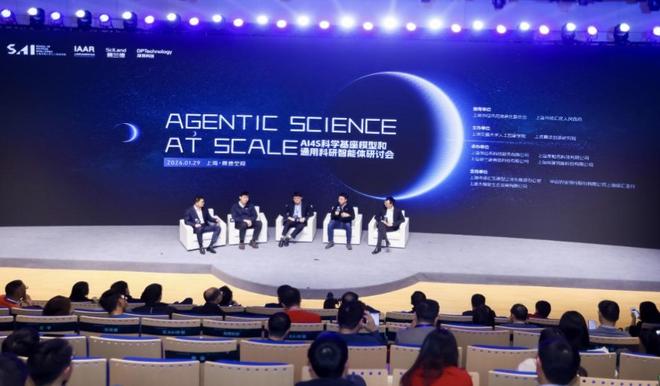
AI4S科研基础设施路线图亮相,打通科研智能化“最后一公里”
Di Yi Cai Jing Zi Xun· 2026-01-29 12:33
Group 1 - The key infrastructure for AI for Science (AI4S) is gradually taking shape, marking the maturity of large-scale, agent-driven scientific research [1][3] - The "Agentic Science at Scale" era has officially begun, as stated by the chief advisor of the Shanghai Jiao Tong University AI Institute during the opening report [3] - The conference introduced core achievements such as the Innovator scientific base model and the SciMaster research agent, aimed at bridging the last mile of intelligent and scalable scientific research through industry-academia-research strategic agreements [1][3] Group 2 - The SciMaster research agent is designed to achieve a closed-loop process in scientific research across all disciplines, providing an "autonomous driving" experience that can match the output of a senior theoretical physics PhD in just 6 hours of operation [3][4] - The Innovator base model achieves three goals: multi-modal scientific perception, scientific reasoning, and scientific tool invocation, supporting over 20 scientific modalities and demonstrating superior general visual understanding capabilities [4] - Strategic cooperation agreements were signed between Shanghai Sailande Intelligent Technology Co., Ltd. and other companies to collaborate on research computing power supply and data value mining [4]

AI+新能源,宜宾动力电池2.0如何进化?
高工锂电· 2025-11-11 12:29
Core Viewpoint - The article discusses how Yibin is positioning itself as a hub for advanced technologies such as all-solid-state batteries, AI for Science (AI4S), and embodied intelligence, aiming to create a sustainable ecosystem for innovation and industrial evolution [7][8][87]. Group 1: Technological Advancements - All-solid-state batteries signify a transition from liquid to solid energy systems, enhancing safety and energy density, and supporting comprehensive electrification [9][10]. - AI4S combines first-principles reasoning with deep learning to accelerate scientific discovery, particularly in complex fields like drug screening and new material generation [11][12][13]. - Embodied intelligence represents a critical transition for AI, moving from theoretical language models to practical applications in the physical world, addressing uncertainties and feedback [14][15][16]. Group 2: Yibin's Industrial Strategy - Yibin has established a complete industrial chain for power batteries, leveraging local resources and green electricity to enhance supply chain efficiency [21][22][29]. - The city is not creating a new industrial zone but is instead integrating existing resources to facilitate the next wave of technological evolution [23][24]. - Yibin's approach involves reusing materials and data from the 1.0 era to feed into the 2.0 technological advancements, creating a feedback loop for continuous improvement [25][28]. Group 3: Collaborative Ecosystem - The collaboration between local companies and research institutions is crucial for developing a self-learning system that integrates virtual and physical experimentation [42][43]. - Yibin's strategy includes a multi-route approach to technology development, allowing for parallel advancements in various materials and methods without betting on a single direction [72][75]. - The city is fostering a culture of innovation by allowing enterprises to define real needs and challenges, thus creating a dynamic and responsive industrial environment [68][70]. Group 4: Future Challenges and Opportunities - Yibin faces the challenge of maintaining a continuous cycle of high-quality innovation amidst rapid technological changes [88][92]. - The city is transitioning from being a mere industrial base to becoming an experimental production city, capable of adapting to new technological demands [108][110]. - The focus is on developing a platform that can iterate and adapt, ensuring that Yibin remains relevant in the fast-evolving technological landscape [94][102].


上交、深势联合发布全球首个通用科研智能体
news flash· 2025-07-26 11:26
Core Viewpoint - Shanghai Jiao Tong University, Shanghai Algorithm Innovation Institute, and DeepMind Technology jointly launched the world's first general-purpose scientific research AI, SciMaster, based on the Innovator model [1] Group 1 - SciMaster integrates numerous specialized scientific tools and can generate "in-depth research reports" [1] - The AI supports a thinking chain editing function, allowing researchers to actively intervene in SciMaster's execution logic [1] - Researchers can modify task logic and content to achieve more accurate and reasonable research needs [1] Group 2 - SciMaster is now connected to the DeepModeling open-source community [1]