
遥感微小卫星

Search documents
四川国企抛出12亿元卫星订单
Shang Hai Zheng Quan Bao· 2026-01-29 06:13
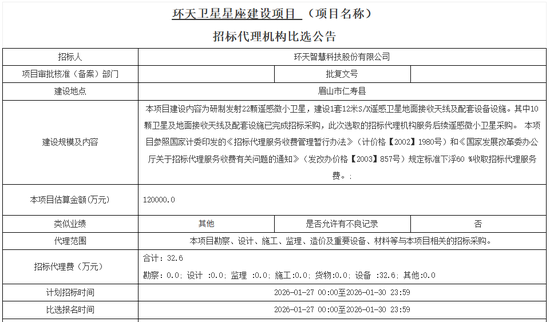
此前,这一星座建设项目已发布过金额为8.04亿元的招标。2025年5月,商业卫星企业微纳星空中标, 项目包含按计划完成10颗遥感微小卫星星座,其中包括4颗光学卫星、6颗SAR卫星的研制,并进行卫星 发射组网。 据公司官网介绍,环天智慧定位"星地时空数据运营商"。公司聚焦"星、云、物"(卫星应用、云服务、 物联网)三大新基建基础板块,以遥感应用、云计算、大数据、物联网、人工智能等新一代信息技术为 依托,创新推出"天空地一体化"与"星-云-网-端"的系统服务架构,并在此基础上构建了新型智慧城市业 务集群。公司已在全国多地广泛开展智慧教育、智慧医疗、智慧政务、智慧停车、智慧环保、智慧水 务、智慧执法、智慧安监、智慧农业园区等新基建项目。 作者:刘怡鹤 1月27日,四川省公共资源交易信息网发布"环天卫星星座建设项目"招标代理机构比选公告。招标人为 环天智慧科技股份有限公司(以下简称"环天智慧"),项目估算金额12亿元。 | | 环天卫星星座建设项目 (项目名称) | | --- | --- | | | 招标代理机构比选公告 | | 招标人 | 环天智慧科技股份有限公司 | | 项目审批核准(备案)部门 | 批复文号 ...

“减法”破壁垒,“加法”增活力——加快建设全国统一大市场一线观察之一
Xin Hua She· 2025-07-06 13:31
Core Viewpoint - The construction of a unified national market is essential for high-quality development and responding to changes in the global landscape, with various regions and departments actively implementing measures to enhance market vitality and economic circulation [1]. Group 1: Market Access and Reforms - Continuous improvement of market access systems is a necessary requirement for building a unified national market, with recent reforms reducing the negative list of market access from 151 items in 2018 to 106 items in the 2025 version [4]. - The reduction of administrative approvals has led to increased market vitality, allowing various business entities to engage in more sectors and enhancing their operational clarity and stability [4][5]. - The introduction of new policies and practices, such as the establishment of the Shenzhen-Hong Kong Cell Valley Medical Technology Company, demonstrates the commitment to allowing foreign investment in advanced medical technologies [5]. Group 2: Industry Growth and Investment Opportunities - The low-altitude economy is expanding, with over 80,000 related enterprises currently existing in China, driven by clearer standards and regulations that facilitate operational capabilities [3]. - Significant contracts, such as the 804 million yuan project awarded to Beijing Micro-Nano Star Technology Co., indicate the growing involvement of private enterprises in high-tech sectors like satellite development [4]. - The Zhejiang San'ao Nuclear Power Project and various high-speed rail projects highlight the increasing participation of private capital in critical infrastructure, enhancing investment opportunities [4]. Group 3: Breaking Down Barriers - Efforts to eliminate market barriers are ongoing, with initiatives like the "non-prohibited entry" principle and the establishment of supplier reserves for major projects, which have allowed companies to access new markets and increase revenue [7]. - The Guangxi Beihai City has opened its shared electric bike market, addressing previous monopolistic practices and promoting fair competition [8]. - The introduction of innovative measures, such as the testing of autonomous delivery vehicles in Hunan, reflects the commitment to lowering entry barriers for new technologies and products [9]. Group 4: Regulatory and Legal Framework - The establishment of a legal framework for market access, including the release of typical cases related to market access administrative litigation, aims to enhance the rule of law in market entry [12]. - The promotion of the private economy and the establishment of fair competition mechanisms are crucial for ensuring equitable market participation [12]. - Continuous reforms in service optimization and regulatory processes are being implemented to facilitate smoother business operations and enhance the overall market environment [11].
半年融资超10亿,有企业拿下8亿大单!热钱正涌入商业航天
Nan Fang Du Shi Bao· 2025-06-12 04:45
Core Insights - The Chinese commercial space industry is accelerating towards industrialization, with over 1 billion RMB in disclosed financing in the first five months of 2023 [1] - Significant investments are being made in both rocket development and satellite applications, indicating strong market confidence [2][3] Financing and Investment - In March 2023, Jiangsu Deep Blue Aerospace completed nearly 500 million RMB in new financing for its reusable rocket development [1][3] - Beijing Micro Nano Star Technology won an 804 million RMB contract for the "Huan Tian Satellite Constellation Construction" project, marking a significant achievement for a private aerospace company [1][3] Market Dynamics - The capital influx is not only directed towards rockets and satellites but also towards the emerging "low-altitude economy," particularly eVTOL (electric vertical takeoff and landing) vehicles [1][6] - The industry is experiencing a shift from technology validation to large-scale commercialization, driven by policy, capital, and market demand [2] Challenges and Opportunities - The industry faces challenges in achieving reliable rocket recovery and mass production, which are critical for scaling operations [7][8] - Companies must transition from experimental to industrial production models, requiring a rethinking of supply chains and manufacturing processes [8] Future Outlook - The next two to three years are expected to be crucial for reshaping the Chinese commercial space industry, with companies that can achieve operational reliability and sustainable business models likely to emerge as leaders [8]