酒海香型白酒

Search documents
消费新常态下,大众酒如何构建可持续竞争优势?
Sou Hu Cai Jing· 2026-01-12 10:41
Group 1 - The core viewpoint of the articles indicates that the Chinese liquor industry is experiencing price pressure, with high-end liquor prices dropping over 10% and mid-range liquor prices decreasing by 5%-10% during the New Year period, while the mass consumption segment shows resilience, particularly in regions like Sichuan and Anhui [1] - The mainstream products in the mass liquor price range are priced between 100-300 yuan per bottle, with the 100-200 yuan segment being the foundation for mass consumption and the 200-300 yuan segment representing high-end products from regional strong brands [2] - The shift from "price competition" to "value cultivation" is driving liquor companies to innovate products and create differentiated barriers, as evidenced by various innovative products showcased at the CWSA competition [3] Group 2 - Liquor companies are focusing on targeting specific consumer demographics and enhancing consumption scenarios to achieve brand repositioning, recognizing that different age groups and cultural backgrounds influence consumer choices [5] - Distributors are transitioning from being "movers" to "service providers," with a focus on the 100-300 yuan price range, which is expected to differentiate into "flow-oriented" and "value-oriented" segments [7] - The necessity for distributors to deepen their engagement in the mass liquor market is highlighted, with strategies including community marketing and experiential services to enhance consumer loyalty [10] Group 3 - The collaboration between manufacturers and distributors is emphasized as crucial for navigating market challenges, with a focus on building regional competitive advantages and implementing joint pricing protection policies [10] - The articles suggest that liquor companies need to shift from a "production mindset" to a "user mindset," while distributors should move from a "transaction mindset" to a "relationship mindset" to achieve long-term brand value amidst intense price competition [11]

中经酒业周报∣7月中旬全国白酒环比价格总指数保持稳定,《柔雅型白酒》团标通过评审,茅台、五粮液设立科技类子公司
Xin Hua Cai Jing· 2025-07-25 03:00
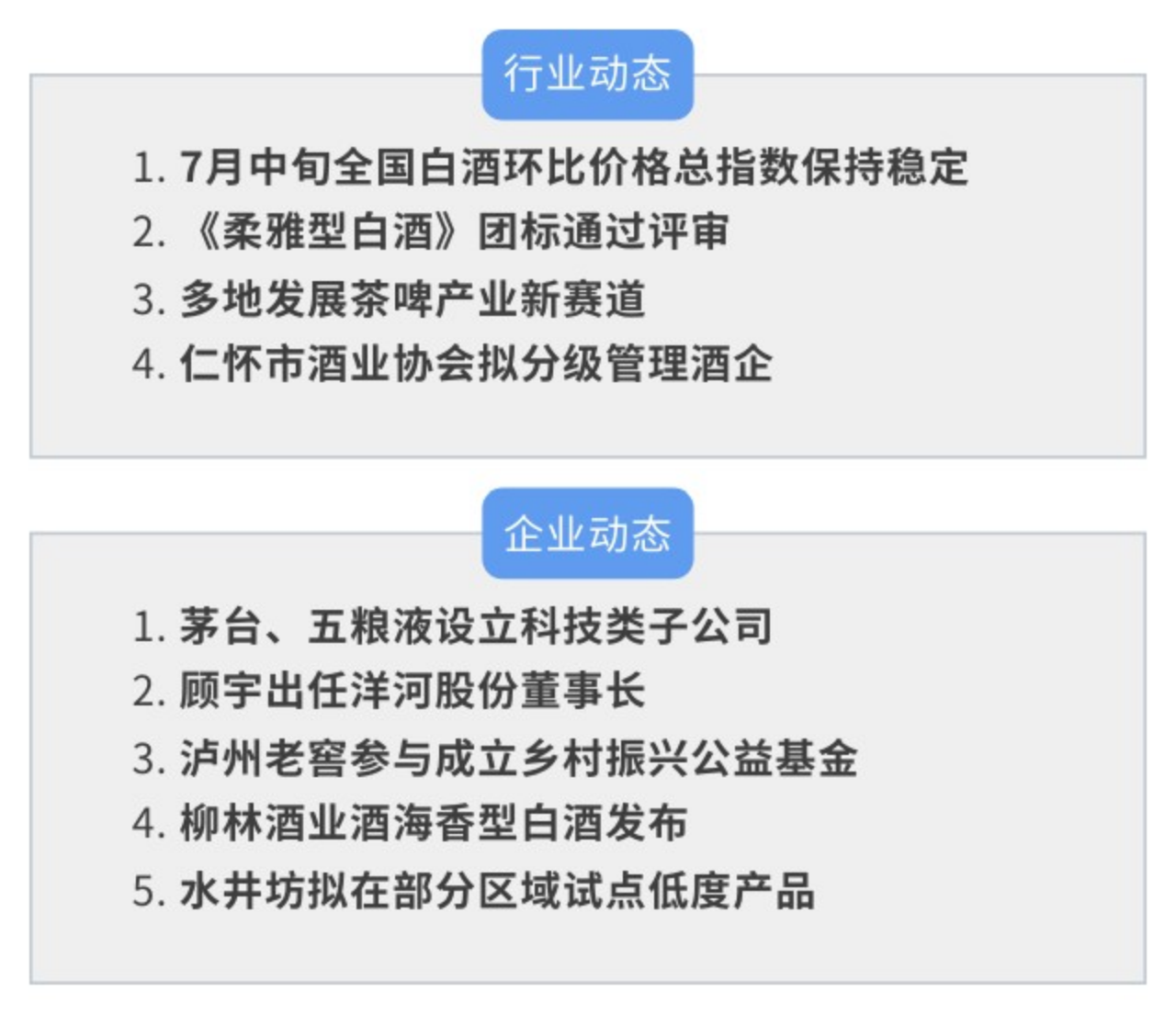
Industry Dynamics - The national white liquor price index remained stable at 100.00 in mid-July, with the famous liquor index also at 100.00, while local liquor saw a slight decrease of 0.01% to 99.99. The base price index for national white liquor wholesale prices increased by 8.34% to 108.34, with famous liquor up by 10.38% to 110.38, local liquor up by 3.74% to 103.74, and base liquor up by 10.21% to 110.21 [1] - The "Soft Elegant White Liquor" group standard was approved, defining the production process and style characteristics, which will help standardize production, inspection, and sales, promoting healthy industry development [1] - The tea beer industry is emerging, with strategic partnerships formed in Guizhou and Anhui to develop tea-infused beer products, aligning with consumer demand for low-alcohol and healthy beverages [2][3] - The Guizhou Renhuai City Liquor Industry Association introduced a tiered management system for liquor companies, categorizing them into "reliable," "basic compliance," and "high-risk" enterprises, with penalties for violations and rewards for outstanding performance [4] Company Developments - Wuliangye established a technology subsidiary with a registered capital of 100 million yuan, focusing on fermentation process optimization and technology research [5] - Kweichow Moutai announced the establishment of a scientific research institute with a registered capital of 1 billion yuan, aiming to enhance product quality and explore new growth areas [5] - Gu Yu was elected as the chairman of Yanghe Co., marking a leadership change [5] - Luzhou Laojiao announced a partnership to establish a rural revitalization public welfare fund with a total donation of 20 million yuan over three years [5] - Liulin Liquor launched a new fragrance type, "Jiu Hai Xiang," utilizing a unique fermentation process and a standardized production system [5] - Shui Jing Fang is testing low-alcohol products below 38 degrees in select markets [6]