
金钱树

Search documents
海南林业高质量发展绘就生态富民图景
Hai Nan Ri Bao· 2025-12-05 02:10
Core Viewpoint - The article discusses the high-quality development of forestry in Hainan, emphasizing its role in ecological protection and economic growth within the context of the Hainan Free Trade Port initiative [11][19]. Group A: Ecological Protection and Restoration - Hainan has established a comprehensive forest management system to enhance ecological protection, including monitoring rare bird species and implementing a "forest chief" system to address illegal land use and deforestation [13][12]. - The province has initiated a three-year action plan called "Green Beautiful Free Trade Port" to restore coastal protective forests and enhance the protection of ancient trees [14]. - The Hainan Tropical Rainforest National Park has improved its ecological environment, with the population of the Hainan gibbon increasing to 42 individuals, marking it as the only growing population of gibbons globally [15]. Group B: Economic Development through Forestry - Hainan is actively developing the under-forest economy, with various models such as planting ferns and raising earthworms under rubber trees, leading to significant income for local farmers [16][17]. - The total output value of the under-forest economy reached 9.3 billion yuan in the first three quarters of the year, indicating a strong growth trend [17]. - The province is also focusing on the development of specialty industries like tropical flowers and wood processing, with significant investments and production capabilities established [18]. Group C: Innovation in Resource Utilization - Hainan is exploring innovative ecological product value mechanisms, including the development of carbon trading projects related to mangroves and tropical rainforests, which are expected to generate substantial economic benefits [23][24]. - The province has initiated various educational and tourism projects that leverage wetland and forest resources, attracting significant public engagement and enhancing local economies [25]. - The establishment of national and provincial-level germplasm resource banks aims to protect and utilize local plant species, contributing to the sustainable development of Hainan's forestry sector [20][21].

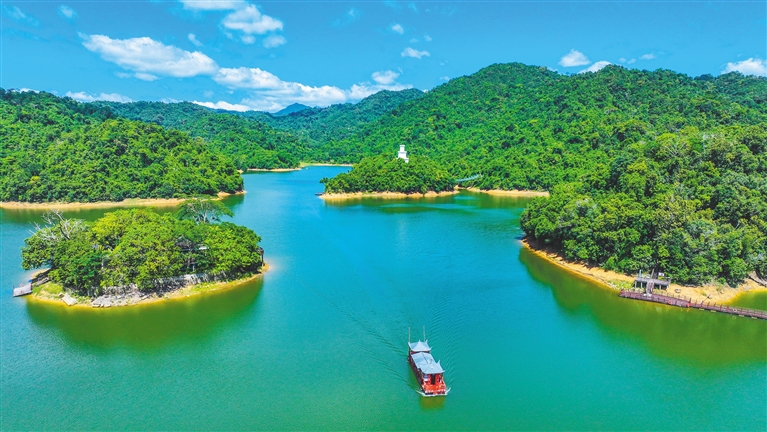
以“绿”生“金”,海南自贸港绿色账本“提现”了
Hai Nan Ri Bao· 2025-08-25 12:40
Group 1: Economic Contributions of Agriculture and Forestry - The integration of holly leaves cultivation under rubber trees in Hainan has generated over 8 million yuan in annual income for local farmers, with each household earning approximately 10,000 yuan per year [1] - Hainan's forestry production value reached 5.68 billion yuan in the first half of the year, marking an 18% year-on-year increase, contributing to a 0.7 percentage point growth in the province's agricultural sector [1] - The total area of flower and tree planting in Hainan reached approximately 140,100 acres, with a production value of about 2.58 billion yuan in the first half of the year [3] Group 2: Development of Specialty Industries - The establishment of 12 large-scale orchid planting bases in Hainan has made it the largest single area for orchid cultivation in the country, accounting for one-fourth of the national total [2] - Hainan's tropical flower industry is experiencing rapid growth, with the introduction of tax incentives under the free trade port policy significantly boosting innovation and research investments in the sector [3] Group 3: Underutilized Land and Economic Potential - Hainan has identified 8.766 million acres of land suitable for developing under-forest economies, indicating significant potential for agricultural diversification [5] - The area dedicated to under-forest economic development increased by 300,000 acres in the first half of the year, nearing the total output value of the previous year [5] Group 4: Ecological Restoration and Tourism - Hainan's ecological restoration efforts have led to the successful growth of red mangrove trees, enhancing coastal protection and biodiversity [6] - The province recorded 28.62 million visits to forest tourism sites, generating 2.241 billion yuan in revenue, while forest wellness tourism attracted 8.02 million visitors, contributing 780 million yuan [7] Group 5: Future Development Plans - Hainan aims to complete 430,000 acres of afforestation and 5.1 million acres of forest maintenance by the end of the year, while also focusing on the development of the forestry industry [8] - The province has planned 42 various forestry industry investment projects, achieving a signed investment amount of 1.51 billion yuan in the first half of the year, exceeding annual targets [8]
这4种常见植物有毒!别吃!家里有娃的,尤其要注意→
Zhong Guo Xin Wen Wang· 2025-08-14 01:26
Core Viewpoint - The article highlights the potential dangers of ornamental plants, emphasizing that certain species contain toxic compounds that can lead to poisoning if mishandled or ingested [1]. Group 1: Toxic Ornamental Plants - **Dieffenbachia (Dumb Cane)**: Contains calcium oxalate crystals and alkaloids; skin contact can cause irritation, and ingestion can lead to severe throat swelling and potential suffocation [2]. - **Money Tree (Pachira aquatica)**: Its sap can cause skin inflammation and allergic reactions; contact with eyes may result in conjunctivitis [3][4]. - **Nerium Oleander (Oleander)**: All parts are toxic due to the presence of cardiac glycosides; ingestion can cause nausea, vomiting, and potentially fatal heart issues [4][5]. - **Cycas (Sago Palm)**: Contains cycasin, which can cause vomiting and abdominal pain; long-term ingestion poses a cancer risk [6][7]. Group 2: Safety Tips - **Identification**: Consumers should familiarize themselves with the characteristics of plants before purchase or care [8]. - **Placement**: Plants should be kept out of reach of young children and pets to prevent accidental ingestion [8]. - **Protective Measures**: Use tools for maintenance and wash hands thoroughly after handling plants [8]. - **Emergency Response**: In case of contact or ingestion, immediate washing and medical consultation are advised [8].