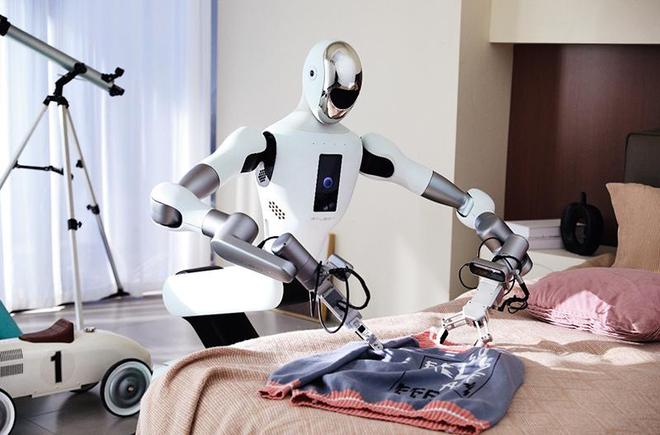
银河通用具身智能机器人Galbot

Search documents
机器人扎堆上“春晚” 从业者:“才艺表演”倒逼商业化进程加速
Mei Ri Jing Ji Xin Wen· 2026-02-23 11:56
Core Viewpoint - The 2026 CCTV Spring Festival Gala showcased a significant presence of robots, highlighting the industry's push for exposure and potential orders amidst unclear application scenarios [1][6][9] Group 1: Industry Trends - The robot industry is entering a commercialization phase, with humanoid robots being recognized as part of this new era, although it is still in its infancy [1][2] - There is a growing expectation from audiences for robots to perform beyond simple talent shows, reflecting a higher acceptance and understanding of robots in China compared to abroad [2][4] - The interaction between robots and human performers has evolved, with many performances now featuring deeper engagement rather than just solo acts [3][4] Group 2: Sponsorship and Exposure - Many robot companies invested heavily in sponsorship fees to appear on the Spring Festival Gala, indicating a strategic move to gain visibility and attract orders [6][7] - The presence of multiple robot brands at the gala is seen as a way to boost overall industry confidence and create a buzz around the sector [7][9] - Companies like EX Robotics emphasize the importance of establishing a unique identity in a crowded market to attract investment [9][10] Group 3: Challenges and Future Outlook - Despite the excitement, the industry faces challenges in finding viable application scenarios, with many companies still struggling to achieve profitability [10][11] - The industry is expected to undergo a "survival of the fittest" phase, where only those with unique technologies and operational capabilities will thrive [10][11] - The debate continues between the sustainability of performance-based robots versus those designed for practical applications in factories and homes [12][13] Group 4: Commercialization and Application - The commercialization of humanoid robots is seen as a pressing need, with companies exploring various business models, including performance and practical applications [12][13] - The integration of advanced AI and hardware is anticipated to enhance robots' capabilities, focusing on specific sectors that can yield quick commercial value [13][14] - The complexity of household service scenarios remains a significant barrier to widespread adoption, with industry consensus indicating that this will take longer to develop [15]

银河通用机器人亮相春晚:与沈腾、马丽同框
Xin Lang Ke Ji· 2026-02-16 15:17
Core Viewpoint - The Galbot humanoid robot by Galaxy General made its debut during the 2026 Spring Festival Gala, showcasing its capabilities in voice interaction, folding clothes, and grabbing items, indicating advancements in robotics technology and its application in retail environments [2] Company Highlights - The Galbot humanoid robot has been deployed in various unmanned convenience stores across the country, demonstrating its practical use in the retail sector [2] Industry Insights - The performance of Galbot during a major televised event highlights the growing integration of robotics in everyday life and retail, suggesting a trend towards automation in consumer services [2]


瞭望 | 以伦理治理建人机共生秩序
Xin Hua She· 2025-11-18 03:06
Core Viewpoint - The article emphasizes the need for a systematic and forward-looking ethical governance framework to guide the development of embodied intelligence, particularly in sensitive areas such as health, property, and ethics, to enhance social trust and technology acceptance [1][5]. Group 1: Ethical Concerns of Embodied Intelligence - The shift from "human-dominated" to "human-machine co-creation" necessitates adjustments in governance to address challenges such as blurred responsibility boundaries, privacy erosion from sensitive data, and labor market impacts due to job displacement [2][4]. - The "black box" nature of large models complicates the predictability and explanation of decision-making processes, creating a need for optimized responsibility recognition mechanisms in scenarios like autonomous driving and medical robotics [2][4]. - Current privacy protection laws are limited in their ability to regulate new data collection methods used by embodied intelligence, necessitating a balance between data utilization and privacy protection [4][8]. Group 2: Governance Framework Proposals - A tiered authorization governance model is suggested to manage the decentralized decision-making power of embodied intelligence systems, ensuring human oversight in high-risk scenarios [6][7]. - Social experiments are proposed as a method to explore effective governance models, particularly in addressing employment displacement through human-machine collaboration certification systems [7]. - The article advocates for China's active participation in international standard-setting for embodied intelligence governance, promoting principles such as fairness, transparency, and accountability [8].