锐龙AI嵌入式P100系列

Search documents
CES2026:AMD发布新一代P100嵌入式处理器
Xin Lang Cai Jing· 2026-01-07 01:51
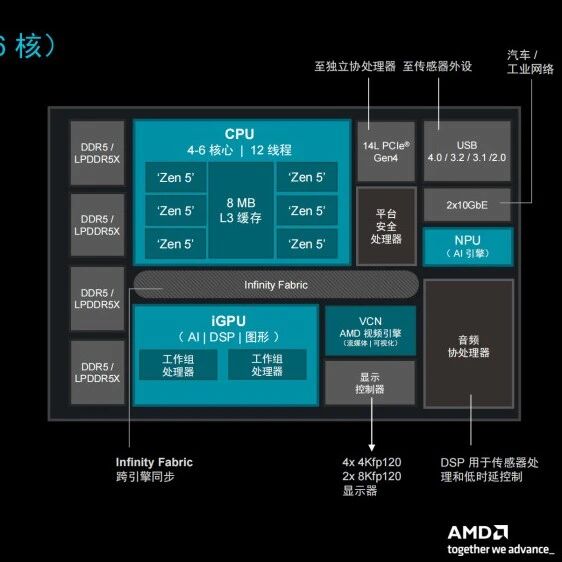
Core Insights - AMD introduced two new product lines at CES: the Ryzen AI Embedded P100 series and the Ryzen AI Embedded X100 series, targeting the edge AI market across various sectors including AI, automotive, healthcare, and robotics [1][5] Product Specifications - The Ryzen AI Embedded P100 series features a 4nm process technology, offering 4-6 CPU cores with 1MB L2 and 8MB L3 cache, supporting AVX-512 instruction set and VNN1/BF16 for AI computations, with a power consumption of 15-54W [1][6] - The CPU architecture is based on Zen 5, achieving over 2x performance improvement in single-threaded and multi-threaded tasks compared to the previous generation, suitable for automotive, industrial, and client applications [6][5] GPU and NPU Features - The GPU in the P100 series utilizes RDNA 3.5 architecture, providing a 35% increase in rendering performance, supporting 4K-8K high-fidelity displays and low-latency streaming [2][6] - The series includes an NPU core based on XDNA2 architecture, delivering 30-50 TOPS of dedicated AI computing power, compatible with applications like visual converters, CNN, and speech-to-text, and supports the open-source TensorFlow framework [2][6] Production Timeline - Mass production of the Ryzen AI Embedded P100 series is scheduled to begin in Q2 2026, with reference board production following in the second half of 2026 [5][8] Software Ecosystem - AMD's software ecosystem is built on open-source principles, supporting Yocto, Ubuntu, and other operating systems, while providing AI optimization libraries and tools to reduce customization costs for clients [4][7] Application Cases - In the automotive sector, AMD's embedded products will manage control logic with Zen 5 CPU cores, support dual 4K displays with GPU, and enable real-time voice and gesture interaction through the NPU [4][7] - For industrial applications, the Zen 5 CPU ensures deterministic performance, while the GPU supports 4K-8K visualization and the NPU provides device fault prediction and health status summaries [4][7]

AMD的第三大支柱
半导体芯闻· 2026-01-06 10:30
Core Viewpoint - AMD has achieved impressive financial results in Q3 2025, with GAAP revenue exceeding Wall Street expectations at $9.2 billion, driven by strong demand for high-performance computing products. Net profit increased by 61% year-over-year to $1.2 billion, with a gross margin of 52% due to a diverse product portfolio [1]. Group 1: Embedded Market Demand - The embedded systems market is evolving, with increasing demand for high-performance microprocessors driven by changes in end-user requirements, particularly due to the rise of artificial intelligence [3][5]. - AMD's CEO highlighted that active AI users surged from 1 million to 1 billion since the launch of ChatGPT, with projections of 5 billion by 2030, necessitating a 100-fold increase in global computing power [3][5]. Group 2: Challenges in Embedded Systems - Embedded systems face common challenges such as real-time response, mixed workloads, and scalability. These systems must ensure reliability and low latency without relying on cloud services [6][7]. - The complexity of software in embedded systems is unprecedented, requiring high performance, higher frequency, and reliability in hardware [7]. Group 3: AMD's Embedded Processor Offerings - AMD has introduced the Ryzen Embedded processors and EPYC processors, gaining over 7,000 embedded customers. Key features include long product life cycles of at least ten years, strict thermal requirements, fault tolerance, and proprietary connections [9][10]. - The newly launched Ryzen AI Embedded P100 series features high-performance "Zen 5" cores, RDNA 3.5 GPU for real-time graphics, and XDNA 2 NPU for low-latency AI acceleration [12][14]. Group 4: Software and Development Environment - The P100 series offers a unified software stack that includes optimized CPU libraries, open-standard GPU APIs, and native AI runtime through Ryzen AI software, built on an open-source virtualization framework [17][19]. - This framework allows multiple operating systems to run securely in parallel, supporting various applications while reducing costs and accelerating production processes [20]. Group 5: Market Opportunities and Competitive Advantage - The rapidly growing edge AI market presents numerous opportunities, with increasing demand for high-performance AI capabilities, particularly in robotics [23]. - AMD's established roadmap in CPUs, GPUs, NPUs, and custom accelerators provides a competitive edge, allowing the company to integrate high-end products into its embedded offerings to support diverse applications [23].