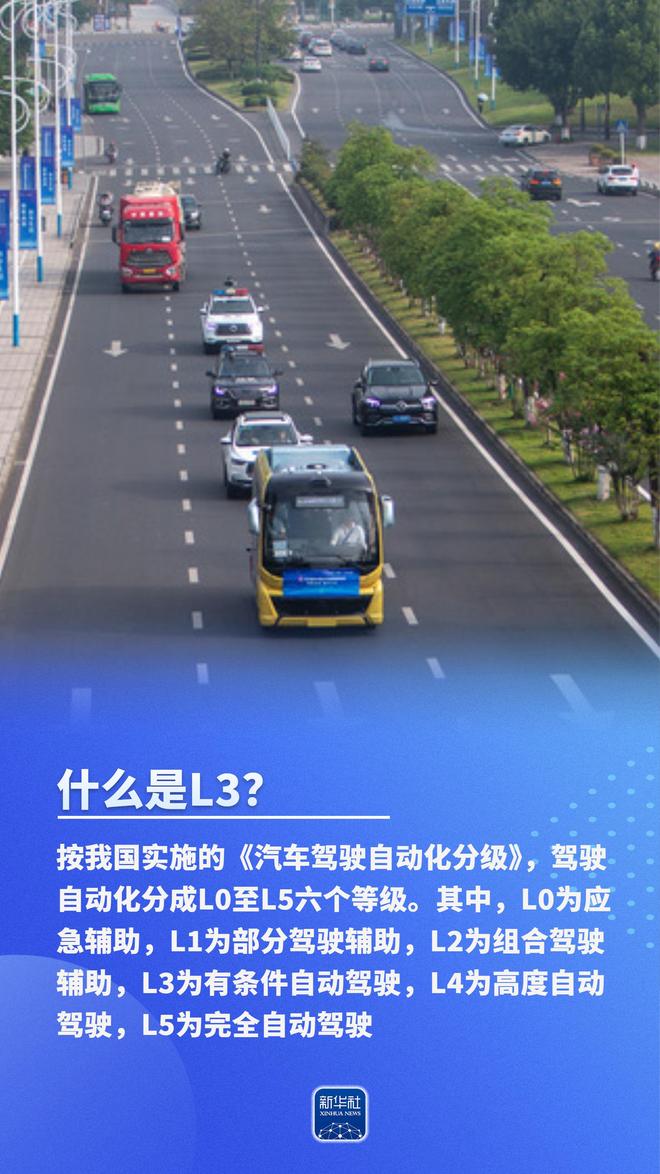
长安牌SC7000AARBEV型纯电动轿车

Search documents
L3级试点,为什么是北京、重庆?
Xin Hua Wang· 2025-12-19 01:55
Core Viewpoint - The Ministry of Industry and Information Technology has officially announced the first batch of L3 conditional autonomous driving vehicle permits in China, with two models set to pilot in designated areas of Beijing and Chongqing, marking a significant step in the development of autonomous driving technology in the country [1]. Group 1: Pilot Locations - Beijing and Chongqing were chosen for the pilot due to their advantages in data accumulation and diverse traffic scenarios, allowing for effective testing of the systems in different environments [7]. - The pilot in Chongqing involves the Changan SC7000AARBEV model, which can operate in congested traffic and on highways, limited to specific routes with a maximum speed of 50 km/h [7]. - The pilot in Beijing features the Arcfox BJ7001A61NBEV model, capable of similar functions but with a maximum speed of 80 km/h on designated highways [7]. Group 2: Vehicle Approval Process - The Ministry, in collaboration with relevant departments, conducted comprehensive assessments of the pilot production companies' R&D, testing, and emergency response capabilities [11]. - Third-party testing organizations and experts were involved to evaluate the expected functional safety and cybersecurity risks of the pilot models [11]. - The L3 level allows the system to act as a "temporary driver" under specific conditions, requiring the driver to be ready to take control when requested by the system [11][12]. Group 3: Implications for the Industry - The introduction of L3 level autonomous driving signifies a shift from technical validation to mass application, indicating that intelligent features are now essential for automotive companies [17]. - The advancement of intelligent connected vehicles will inject strong momentum into technological innovation and upgrades in the automotive sector, providing valuable practical experience for standard formulation [19]. - The commercial application of L3 autonomous driving models is expected to strengthen the position of domestic new energy vehicles in the market and accelerate their global expansion, positioning them as leaders in the intelligent connected vehicle sector [19].

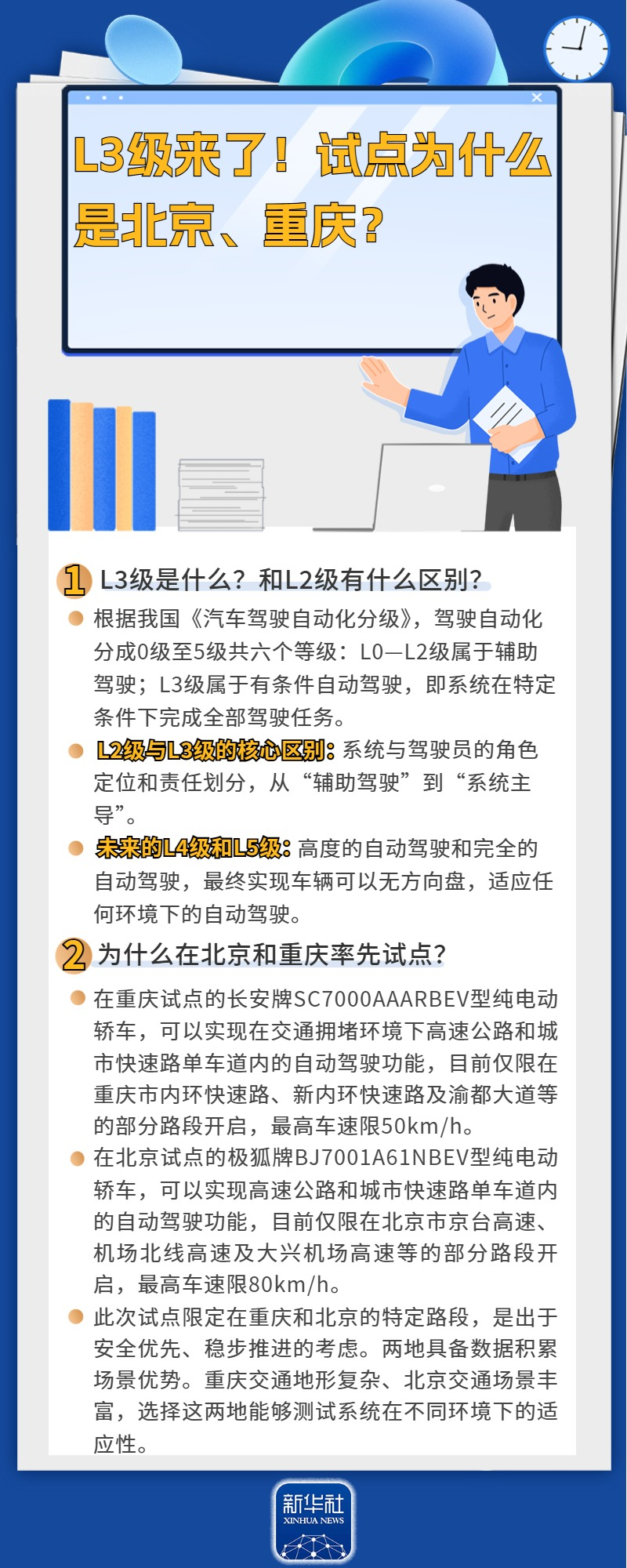
L3级来了!试点为什么是北京、重庆?
Xin Hua Cai Jing· 2025-12-19 01:43
Core Viewpoint - The Ministry of Industry and Information Technology has officially announced the first batch of L3 conditional autonomous driving vehicle permits in China, with two models set to pilot in designated areas of Beijing and Chongqing, marking a significant step in the development of autonomous driving technology in the country [1]. Group 1: Pilot Locations - The L3 autonomous driving models are being piloted in Beijing and Chongqing due to their unique traffic conditions and data accumulation advantages. Chongqing's complex traffic terrain and Beijing's rich traffic scenarios provide a diverse testing environment for the systems [7]. - The pilot in Chongqing involves the Changan SC7000AARBEV model, which can operate in congested traffic and on single lanes of highways, limited to specific routes with a maximum speed of 50 km/h [7]. - The pilot in Beijing features the Arcfox BJ7001A61NBEV model, capable of similar functions but with a higher speed limit of 80 km/h on designated routes [7]. Group 2: Vehicle Approval Process - The Ministry, in collaboration with relevant departments, conducted comprehensive assessments of the research, testing, and emergency response capabilities of the pilot production companies [11]. - Third-party testing organizations and experts were involved in systematic testing of the expected functional safety and cybersecurity risks associated with the pilot models [11]. - The approval process emphasized the management capabilities of the pilot cities and their emergency response capabilities, leading to the selection of two joint ventures for the pilot program [11]. Group 3: Implications of L3 Level - L3 conditional autonomous driving allows the system to act as a "temporary driver" under specific conditions and scenarios, although drivers must remain responsible for the vehicle [11][12]. - The pilot program is limited to specific low-risk scenarios to ensure safety and orderly advancement of autonomous driving technology [15]. - As the pilot progresses and the industry gains a better understanding of safety risks, restrictions may gradually be relaxed, allowing for broader public access to autonomous driving features [15]. Group 4: Industry Opportunities - The pilot signifies a shift from technical validation to mass production application in China's autonomous driving sector, presenting new opportunities for the industry [17].
海报|L3级自动驾驶车型获附条件准入许可!一起了解下
Xin Hua She· 2025-12-16 10:07
Group 1 - The Ministry of Industry and Information Technology has granted conditional approval for two automotive companies to submit applications for intelligent connected vehicles equipped with L3 level conditional autonomous driving functions [1] - L3 level refers to conditional automation, where the vehicle can handle driving tasks under certain conditions, but human intervention is still required in complex situations [4] Group 2 - The first approved product is the Changan SC7000AARBEV electric sedan, which can achieve autonomous driving in single lanes on highways and urban expressways under traffic congestion conditions [5][6] - The specific routes for the Changan vehicle's autonomous driving feature include Chongqing's inner ring expressway, new inner ring expressway, and Yudu Avenue [6] Group 3 - The second approved product is the Arcfox BJ7001A61NBEV electric sedan, capable of self-driving in single lanes on highways and urban expressways [8] - The designated routes for the Arcfox vehicle's autonomous driving feature include Beijing's Jing-Tai Expressway and Daxing Airport Expressway [8]