长江1000发动机

Search documents
“C919供应链持续改善,今年有望每10到15天生产一架”
Guan Cha Zhe Wang· 2026-01-27 02:56
Core Viewpoint - The commercial operation of China's C919 aircraft is steadily advancing, with production and delivery entering an accelerated phase, aiming for at least 28 deliveries in 2026, with a production rate of one aircraft every 10 to 15 days [1][3][4]. Production and Delivery - China Commercial Aircraft Corporation (COMAC) is improving the production and delivery pace of the C919 as supply chain issues are gradually resolved, with 15 aircraft delivered in 2025, an increase from 12 in 2024, although still below the initial target of 75 [1][4]. - In the last two months of 2025, 8 out of the 15 delivered C919s were completed, indicating a positive trend in production capacity [4][6]. - The company expects the supply chain situation to continue improving in 2026, with two C919s already entering the delivery process at the start of the new year [3][4]. Engine Supply and Political Factors - The reliance on Western-made LEAP-1C engines poses a challenge for COMAC, as political factors can disrupt engine procurement, making diversification of engine supply sources crucial for long-term supply chain security [4][6][5]. - Despite the political challenges, COMAC is working closely with Western partners to ensure a stable supply of engines, which is seen as the most feasible way to increase production in the short term [6][5]. Market Position and Future Prospects - The C919 has successfully transported over 4 million passengers since its domestic operation began in May 2023, and orders from major airlines are increasing, with plans for each of the three major Chinese airlines to purchase at least 100 C919s by 2031 [9][10]. - The aircraft's international certification process is ongoing, which is essential for competing with Boeing and Airbus in the global market [9][10]. - The entry of COMAC into the market is welcomed by competitors, who acknowledge that competition drives innovation and improvement across the industry [9].


C919生产开门红,“今年有望每15天内造一架”
Guan Cha Zhe Wang· 2026-01-26 07:35
Core Viewpoint - The commercial operation of China's C919 aircraft is steadily progressing, with production and delivery accelerating, aiming for a target of at least 28 deliveries in 2026, with a production rate of one aircraft every 10 to 15 days expected [1][4][5]. Production and Delivery - In 2025, COMAC delivered a total of approximately 15 C919 aircraft, including 6 to Air China, 4 to China Eastern Airlines, and 5 to China Southern Airlines, marking an increase from 12 deliveries in 2024 but falling short of the initial target of 75 [2][5]. - The supply chain issues that hindered production in the previous year are gradually improving, with 8 of the 15 aircraft delivered in November and December [2][5]. - The company anticipates that the supply chain situation will continue to improve in the new year, with two C919 aircraft already completed and entering the delivery process at the start of 2026 [4][5]. Engine Supply and Political Factors - The reliance on Western-made LEAP-1C engines poses a challenge for COMAC, as political factors can disrupt the procurement process, although the company is working closely with CFM International to ensure a steady supply [5][6][7]. - Analysts suggest that while the political interference in engine supply is unavoidable, strengthening cooperation with CFM International is the most feasible way for COMAC to increase production in the short term [7]. Market Position and Future Prospects - The C919 has already transported over 4 million passengers since its domestic operation began in May 2023, and the order backlog continues to grow, with major airlines planning to purchase at least 100 aircraft each by 2031 [10]. - The current share of domestically produced aircraft in China's civil aviation fleet has increased from 1.3% in 2019 to 4.7% [10]. - COMAC is actively pursuing international airworthiness certification for the C919, which is crucial for competing with Boeing and Airbus [10][11].

航空航天产业“星耀都市圈”
Xin Lang Cai Jing· 2026-01-01 17:42
Group 1: Aerospace Industry Development - The aerospace industry in Deyang has established a comprehensive supporting capability in core component manufacturing, covering processing of structural parts like aircraft frames, beams, ribs, and wall panels, as well as manufacturing and precision processing of aerospace engine forgings [1] - Sichuan Delan Aerospace, a representative in the high-end forging sector, has built an intelligent production line in Deyang, achieving controllable and digitalized manufacturing processes, with products applied in over 70 aircraft engine models, including the world's largest commercial aircraft engine, GE9X [1] - Deyang has developed a precision structural component research system centered around Wanhang Mould Forging and an airborne equipment research system centered around Aviation Industry Lingfeng, providing key core forgings for domestic aircraft like C909 and C919 [2] Group 2: Collaborative Development in Chengdu Metropolitan Area - Meishan and Ziyang are expanding their industrial dimensions in the Chengdu metropolitan area by focusing on satellite industry and aerospace equipment manufacturing, becoming important support points for collaborative industrial development [3] - The cooperation between HuanTian Wisdom and Xingyuan Space aims to enhance the aerospace information industry chain in the Chengdu metropolitan area through satellite joint launches and data applications, creating a complete closed loop from satellite launch to data collection and intelligent analysis [3] - The China Western Satellite Industry Park in Meishan is the first high-standard satellite industrial park in Southwest China, attracting 14 satellite-related enterprises and research institutions, forming an integrated satellite industry ecosystem [3] Group 3: Data Application and Economic Development - HuanTian Wisdom has established an aerospace data operation platform leveraging a cloud computing center, promoting the application of satellite data in areas such as smart cities, disaster warning, and energy management, facilitating resource sharing and collaborative governance in the Chengdu-Deyang-Meishan-Ziyang region [4] - Ziyang focuses on developing commercial aerospace and low-altitude economy as its leading industries, linking local intelligent manufacturing foundations and concentrating on rocket assembly and ground measurement and control [4]
张仲麟:黔驴技穷的特朗普,还能卡住C919脖子吗?
Guan Cha Zhe Wang· 2025-06-01 07:32
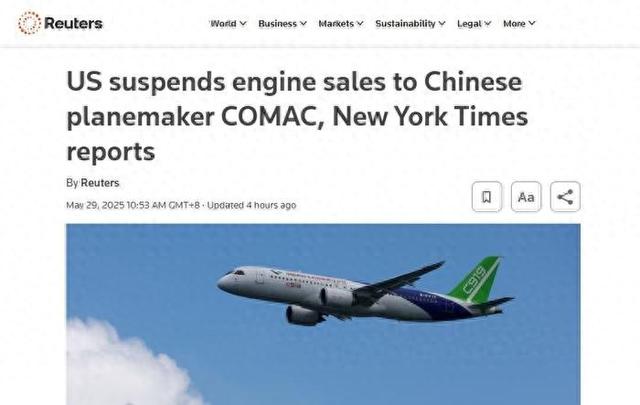
Core Viewpoint - The Trump administration has suspended licenses allowing U.S. companies to sell products and technologies to COMAC, effectively restricting exports of critical components like the LEAP-1C engine used in China's C919 aircraft, which may reignite trade tensions between the U.S. and China [1][3][4]. Group 1: Impact on C919 and Aviation Industry - The suspension of exports is seen as a retaliatory measure against China's restrictions on rare earth exports, which were in response to U.S. semiconductor limitations [1][3]. - The C919 aircraft is currently transitioning from low-speed production to full-scale production, and while the export ban may slow down progress, existing inventory can sustain production for a while [7][8]. - The ban affects various components and systems of the C919, including flight control, hydraulic, and avionics systems, but China has made significant advancements in these areas and can develop alternatives [8][10]. Group 2: Historical Context and Strategic Responses - The U.S. government's approach to trade and technology restrictions has been consistent, using sudden bans and tariffs as leverage while also hinting at negotiation opportunities [4][5]. - Previous sanctions, such as those against Huawei, did not cripple the targeted companies, suggesting that the impact of the current ban on C919 may be manageable [5][8]. - The C919 project has already initiated plans for a fully domestic configuration, which may accelerate in response to the current sanctions, reflecting a proactive strategy in the face of external pressures [11][12]. Group 3: Industry Sentiment and Future Outlook - The aviation industry in China is characterized by resilience and a commitment to developing indigenous capabilities, with significant investments in testing facilities and advanced technologies [10][12]. - The potential for retaliatory measures from China in the commercial aircraft sector is acknowledged, indicating a complex interdependence in the global aviation market [14][15]. - There is optimism regarding the long-term prospects of the C919 project, despite the immediate challenges posed by the U.S. export ban, as the industry adapts and evolves [15].
必须交出稀土?美国暂停对华输送航空技术,或要和中国“一换一”
Sou Hu Cai Jing· 2025-06-01 07:06
Core Viewpoint - The trade conflict between the US and China has intensified, with the US suspending export licenses for aviation products and technology to COMAC, aiming to pressure China to relax its export controls on rare earth elements [1] Group 1: Rare Earth Elements and Supply Chain Dynamics - The US's reliance on China for rare earth elements has become evident, especially after China imposed export controls on seven categories of medium and heavy rare earths, directly impacting the US military and aerospace industries [1][2] - China currently holds 90% of the global rare earth refining capacity and 85% of the permanent magnet manufacturing share, creating a complete industrial chain from mining to high-end applications [2][3] - The US's Mountain Pass mine has resumed operations but produces only 20,000 tons annually, with two-thirds of the ore still needing to be refined in China, highlighting the structural advantages China holds in this sector [1][2] Group 2: Aviation Industry and Technological Competition - The US's primary target is China's C919 aircraft, which competes with Boeing 737 and Airbus A320, having delivered 16 units and received over 1,000 orders since its commercial debut in 2023 [1][7] - The C919's reliance on the LEAP engine from CFM International exposes China's technological shortcomings, but US restrictions are accelerating China's development of domestic alternatives like the Changjiang 1000 engine [7] - China has established a complete strength verification system for its domestic engines, clearing technical hurdles for certification, paralleling the trajectory of Huawei's Kirin chip advancements [7] Group 3: Global Supply Chain Restructuring - The duopoly of Boeing and Airbus is being challenged, with over 8,000 backlogged orders prompting airlines to seek alternatives, including the C919, which could offer a 10% price advantage [9] - The US underestimated the reverse effects of its technology embargo, as limited rare earth exports from China are insufficient for the development of the sixth-generation fighter jets [9] - China plans to increase C919's annual production capacity to 200 units, countering the impact of US technology bans [9] Group 4: Strategic Implications and Challenges - The "rare earth for technology" negotiation reflects a deeper struggle for global supply chain dominance, with China learning from past mistakes of low-priced exports followed by high-priced imports [10] - Despite advancements, China still faces challenges in material technology and certification standards, needing to overcome generational gaps to gain global market acceptance for its engines [10] - Building confidence in technology beyond the International Civil Aviation Organization's certification system is crucial for China's aviation industry [10]