
间位芳纶

Search documents
泰和新材分析师会议-20260304
Dong Jian Yan Bao· 2026-03-04 14:49
Report Overview - The report is about a research on Taihe New Materials in the chemical fiber industry on March 4, 2026, with participation from institutions like Macquarie Securities [1][2][17] Report Core View - The company has potential for improvement in product prices, production rates, and cost reduction through technological upgrades, but the recovery degree is uncertain [25][26][34] Group 1: Research Basic Information - Research object: Taihe New Materials [17] - Industry: Chemical fiber industry [2][17] - Reception time: 2026 - 03 - 04 [17] - Company reception staff: Securities affairs representative Yu Liwei and board office staff [17] Group 2: Detailed Research Institutions - Institution: Macquarie Securities, with reception staff Feng Junjiao, Li Erpeng, and Miao Huaxin [20] Group 3: Main Content Data Product Capacity - The company has 16,000 tons of both meta - aramid and para - aramid capacities, ranking second globally in meta - aramid and third in para - aramid [22] Production Base - Production bases are in Yantai and Ningxia. Meta - aramid capacity is all in Yantai, while para - aramid is in both Yantai and Ningxia [23] Product Price - Last year, aramid prices were at a relatively low historical level, and the probability of price decline is low with potential for recovery, but the recovery degree is uncertain [24][25] Raw Materials - Aramid raw materials are mainly diamine and acid chloride, including m - phenylenediamine, p - phenylenediamine, m - phthaloyl chloride, and p - phthaloyl chloride, which are related to petroleum and supplied by fine - chemical companies [25] Production Rate - The company expects the spandex production rate to increase as the industry pattern improves. The aramid production rate depends on market demand [26] Gross Margin Maintenance - Aramid has high technical barriers, and the company is the only national aramid engineering technology research center in the industry [27] Technical Difficulty - Technical difficulty lies in a combination of market, industry, and technology aspects, and market and customer maintenance is also important [28] Business Expansion - Whether to expand the aramid sector depends on market demand, and there are no technical problems [29] Sales Pattern - Over 90% of para - aramid is supplied domestically, and the overseas proportion is not high. Spandex is mainly sold through agents [32][31] Spandex Situation - The industry's effective spandex capacity is about 1.3 million tons, and the company ranks fifth, with global capacity mainly concentrated in China [33] Product Improvement - The company is conducting R & D and iterative upgrades on spandex and para - aramid. If the verification is successful, it may increase capacity, reduce costs, and improve quality [34] Financial Leverage - The company's asset - liability ratio is in the 40s [36] Cost Reduction - Spandex cost reduction is mainly achieved through technological transformation in polymerization, spinning, and public works, with polymerization transformation almost completed and spinning transformation expected to finish by the end of the year [36]

泰和新材(002254) - 2026年3月4日投资者关系活动记录表
2026-03-04 07:24
Group 1: Production Capacity - The company has two types of aramid fibers: meta-aramid and para-aramid, each with a production capacity of 16,000 tons, ranking second and third globally, respectively [2][3] - Production bases are located in Yantai and Ningxia, with meta-aramid produced solely in Yantai and para-aramid produced in both locations [2] Group 2: Market Trends and Pricing - Last year, aramid prices were at historically low levels, but the company anticipates a recovery in prices, although the extent of recovery remains uncertain [2][3] - The company expects an increase in operating rates for spandex as the industry landscape improves, while aramid production rates will depend on overall market demand [3] Group 3: Raw Materials and Supply Chain - The main raw materials for aramid production are two types of diamines and acyl chlorides, which are influenced by oil prices [3] - Direct suppliers are companies involved in fine chemicals [3] Group 4: Financial Metrics - The company's asset-liability ratio is over 40% [4] - The company ranks fifth globally in spandex production capacity, with approximately 130,000 tons of effective industry capacity concentrated domestically [3][4] Group 5: Technological Advancements - The company maintains a high technical barrier in aramid production, being the only one with a national aramid engineering technology research center [3] - Ongoing engineering and technological upgrades for spandex and para-aramid are expected to reduce costs and improve quality, with potential capacity increases if validations are successful [4]
泰和新材(002254) - 2026年2月4日投资者关系活动记录表
2026-02-04 14:02
Company Overview - Taihe New Materials Group Co., Ltd. was established in 1987, originally producing spandex and is now a leader in various materials including aramid fibers and aramid paper [2][3] - The company has transitioned from spandex to aramid fibers, with key products including meta-aramid (second globally), para-aramid (third globally), and aramid paper (first domestically) [2][3] Production Capacity and Operations - Current spandex operating rate is estimated at 70-80% [3] - The company has a production capacity of 10,000 tons for spandex, which is not fully utilized due to industry challenges and internal issues [5] - The company is undergoing technical upgrades to improve efficiency and profitability [5][6] Market Trends and Demand - Spandex demand is projected to grow over 10% in 2024 and between 5-10% in 2025 [5] - The industry is experiencing a shift with increased use of nylon in clothing, impacting spandex demand [7] - The average spandex content in clothing is around 5% for polyester and approximately 10% for nylon [7] Product Development and Innovation - The company is developing T2T (Textile-to-Textile) recycling technology to meet European demands for sustainable materials [4] - Innovations in green dyeing technology are being explored to reduce environmental impact [4] - The company is also focusing on digital printing as a faster and more efficient alternative to traditional dyeing methods [4] Financial Considerations - The company is investing in technical upgrades with a favorable cost-benefit ratio [6] - The capital expenditure for 2026 includes project final payments and a new innovation center [6] Competitive Landscape - The aramid fiber market is competitive, with many players in the para-aramid segment, which is less than 20% of global capacity [6][8] - The company differentiates itself through self-developed technology and early market entry, leading to stable downstream applications [6][8] Future Outlook - The company aims to enhance its production capabilities and explore new markets, including composite materials, to leverage growth opportunities [8] - The focus on high-performance materials like aramid fibers and carbon fibers is expected to drive future growth [8]
泰和新材(002254) - 2026年1月16日投资者关系活动记录表
2026-01-16 08:18
Group 1: Company Overview - The company operates four business divisions, starting with spandex, which was first produced in 1989, making it the first domestic producer of spandex in China [2][3] - The company has developed various products, including meta-aramid and para-aramid fibers, with the former launched in 2004 and the latter in 2011, establishing itself as the first domestic producer of these products [2][3] Group 2: Product Applications - Spandex is primarily used in textiles and apparel, while meta-aramid is known for its flame retardant, high-temperature resistance, and insulation properties [3] - Para-aramid is utilized in high-strength applications such as optical cables and protective gear, including firefighting suits and industrial protective clothing [3] Group 3: Business Development and Innovations - The company is enhancing its chemical sector by supplying raw materials for aramid production, with projects for aniline and acyl chloride currently in the design phase [3] - Innovations in advanced textiles include green dyeing, digital printing, and fabric recycling to strengthen ties with downstream customers [3] Group 4: Financial Performance and Challenges - The spandex sector has faced profitability challenges, but recent improvements in quality and pricing have been noted, with a focus on technical upgrades to enhance efficiency [4] - The company aims to improve accounts receivable management, which has seen rapid growth, and plans to focus on this area in 2025 [5] Group 5: International Expansion - Overseas revenue accounts for over 20% of total income, with plans for internationalization including localizing sales and hiring local staff in key markets [5][6] - The company is considering investments to gradually expand its international presence, focusing on proximity to end-users [5] Group 6: Subsidiary Performance - Two key subsidiaries, focusing on aramid paper and deep processing, are performing well, with a management style based on delegation [6] - The aramid paper is used in electrical insulation and aerospace applications, while the other subsidiary produces aramid pulp and woven fabrics [6] Group 7: ESG and Future Outlook - The company adheres to national laws regarding safety, environmental protection, and labor practices, promoting products that align with social development goals [6] - There is a possibility of acquiring upstream or downstream enterprises to enhance business synergy [6]
泰和新材(002254) - 2026年1月13日投资者关系活动记录表
2026-01-13 14:30
Group 1: Product Overview - The company produces two types of aramid fibers: meta-aramid and para-aramid, with applications in flame retardant clothing, high-temperature filters, and insulation materials [2][3] - Current production capacity for both types of aramid fibers is 16,000 tons [3] - The price of meta-aramid has remained stable, while para-aramid prices have fluctuated significantly over the past two years [2][3] Group 2: Subsidiary and Market Dynamics - Minshida, a subsidiary with 67% ownership, primarily produces aramid paper and operates independently on the Beijing Stock Exchange [3][4] - The demand for aramid paper is driven by electrical grid upgrades, data centers, and the growing electric vehicle market [3][4] - Current production capacity for aramid paper is 4,500 tons, with a projected expansion to 6,000 tons by 2030 [4] Group 3: Product Quality and Competition - The value of aramid paper in transformers is only 3-5%, but its quality is critical for the overall performance of the transformer [3][4] - The transition to new suppliers requires long-term validation of product quality, which has been established over more than a decade [4] - The company faces competition in the transformer market, particularly from overseas suppliers [4] Group 4: Cost and Production Efficiency - The production lines for honeycomb and insulation materials were previously shared but are now being differentiated to improve efficiency [4] - There is a slight cost difference between honeycomb and insulation papers, with honeycomb requiring higher-grade para-aramid [4] - The company is focusing on quality improvement and load increase to reduce costs in its production processes [5] Group 5: Market Strategy and Future Plans - The low-end composite paper market is estimated to be around 2,000-3,000 tons, prompting the company to invest in this segment to maintain market share [5] - The company is exploring new business opportunities, including textile innovations and membrane production [5] - The management has implemented an employee stock ownership plan to incentivize performance across the group and its subsidiaries [4][5]
泰和新材(002254) - 2025年12月24日投资者关系活动记录表
2025-12-24 10:32
Group 1: Market Demand and Supply - The demand for para-aramid fibers in downstream optical fibers is currently strong, but this demand has not yet translated into the company's sales [2] - The overall supply of aramid fibers has slightly exceeded demand, particularly with new entrants in the market driving prices down [2][3] - The nominal capacity for both meta-aramid and para-aramid fibers is currently 16,000 tons each [3] Group 2: Industry Dynamics - The aramid fiber industry has been characterized by an oversupply situation since the company entered the market, with nominal capacity consistently exceeding demand [3] - The core issue in the market is determining which companies can capture market share, as downstream demand remains clear [3] - There are plans for future capacity investments in both meta-aramid and para-aramid fibers, with a particular emphasis on para-aramid [3] Group 3: Product Applications and Customer Base - Meta-aramid fibers are used in various applications, including industrial filtration and personal protective equipment, but there has not been a significant increase in demand for protective gear [3] - The company has received some orders for aramid coatings, with clients including data centers and power battery manufacturers [4] - Some customers are utilizing aramid fibers in lithium iron phosphate batteries due to their safety and performance advantages [4] Group 4: Production and Operational Insights - The current operating rate for para-aramid fibers is not high, partly due to ongoing technological upgrades aimed at reducing costs and enhancing competitiveness [4] - The production capacity for spandex fibers is reported to be 100,000 tons [4]
泰和新材(002254) - 2025年12月3日投资者关系活动记录表
2025-12-03 06:04
Group 1: Industry Overview - The spandex industry has confirmed a bottom, but recovery timing remains uncertain [2] - The operating rate of spandex in Ningxia is not at full capacity due to several factors, including production strategy and cost considerations [2][3] - The company plans to maintain the current production capacity in the Yantai area [3] Group 2: Production and Expansion Plans - There are currently no plans for further expansion in Ningxia spandex production [3] - The production line renovation is expected to be completed by mid-next year [3] - Full load operation is anticipated to gradually adjust starting next year based on production modifications and market conditions [3] Group 3: Market Dynamics - The spandex market is still growing, with a focus on high-quality and differentiated products rather than large-scale production [3] - The company is observing market changes, including potential exits of some industry players [3] - Industry self-discipline is crucial to counteract internal competition [3] Group 4: Aramid Fiber Insights - The aramid fiber market is experiencing some pressure, with a decline in demand [4] - The main downstream applications for aramid fiber include optical cables (40%), protection, industrial uses, and composite materials [4] - The company is currently not planning short-term expansion but is preparing for technological advancements and market opportunities [4]
行业聚焦:全球间位芳纶湿纺市场头部企业份额调研(附Top 5 厂商名单)
QYResearch· 2025-10-15 02:20
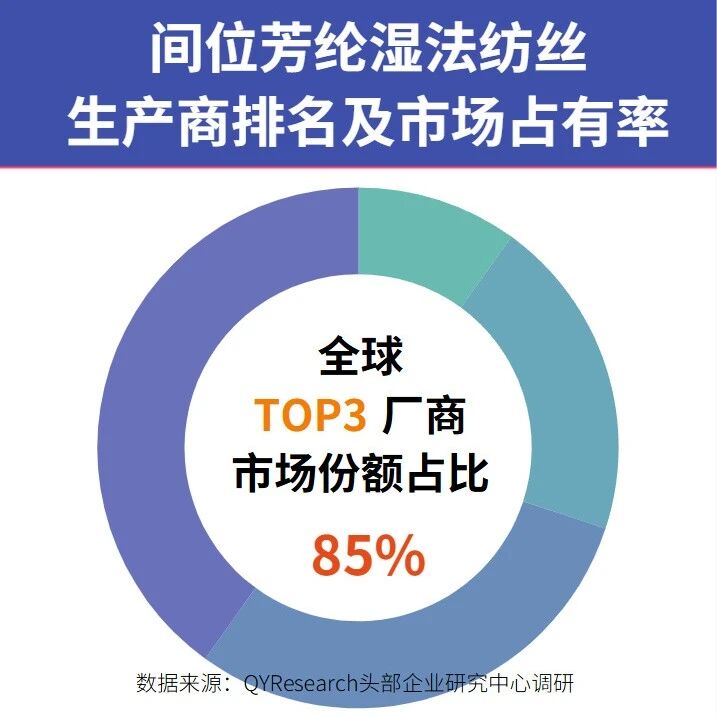
Core Viewpoint - The meta-aramid wet spinning market is a specialized segment within the advanced fiber industry, focusing on the production, application, and commercialization of fibers made from meta-aramid polymers through wet spinning technology. This market is characterized by unique properties of meta-aramid fibers, such as higher thermal stability and chemical resistance compared to para-aramid fibers, making them suitable for various industrial and protective applications [1][2]. Market Overview - The global market for meta-aramid wet spinning is projected to reach $850 million by 2031, with a compound annual growth rate (CAGR) of 6.5% in the coming years. Major manufacturers include Teijin, Huvis, Taiho New Materials, and Supermax New Materials, with the top three companies holding approximately 85% of the market share [4]. Key Players - **Teijin**: A leading manufacturer of high-performance aramid fibers, Teijin's meta-aramid products (Teijinconex®) are integrated into a broader product portfolio, emphasizing reliability and safety certifications. The company focuses on product innovation and sustainability, leveraging its extensive polymer chemistry expertise [5]. - **Huvis**: A large Korean fiber company, Huvis markets its meta-aramid products (METAONE) as high-temperature, high-safety fibers for industrial and protective markets. The company emphasizes its domestic technological leadership and aims to expand its application areas [6]. - **Taiho New Materials**: A Chinese manufacturer focused on rapid capacity expansion and supply chain integration, Taiho aims to meet the growing domestic and regional demand for meta-aramid fibers. The company emphasizes vertical integration to ensure raw material supply and maintain competitive pricing [8]. - **X-FIPER**: A smaller, specialized company focusing on meta-aramid and high-performance aramid paper production. X-FIPER's strategy revolves around niche markets, providing tailored solutions for specific applications [9]. Market Trends and Drivers - The primary driver for the meta-aramid wet spinning market is the sustained demand from safety-critical end applications requiring thermal stability and long-term heat resistance. This includes applications in firefighting gear, industrial protective clothing, and electrical insulation materials [10]. - Increasingly stringent safety and electrical standards in developed economies are enhancing the value proposition of materials that meet these regulations without complex assembly [11]. - Supply-side improvements are being driven by the limited but improving wet spinning capacity and the trend of manufacturers integrating upstream and downstream processes to enhance supply reliability [12]. - Sustainability and solvent management improvements are becoming increasingly important, with pressure from regulators and customers to reduce solvent consumption and improve recycling rates [13]. Challenges - The high capital intensity and technical complexity of wet spinning processes pose significant challenges, making market entry difficult and requiring ongoing capital investment for compliance and efficiency [14]. - Raw material security and volatility remain persistent challenges, as the supply of specific monomers and intermediates can be limited and subject to price fluctuations [14]. - Environmental regulations and community pressures complicate operations, as compliance with stricter discharge standards requires investment in advanced wastewater treatment systems [15]. - Competition from alternative materials and evolving product architectures presents another challenge, necessitating investment in differentiated products to maintain market position [16]. Future Outlook - The market is expected to experience steady incremental growth driven by safety-oriented end uses and strategic shifts influenced by capacity investments and sustainability pressures. Manufacturers demonstrating reliable supply and solvent management capabilities are likely to secure attractive contracts [16].

国产高性能纤维突围战:现状、差距与2035战略布局!
材料汇· 2025-08-12 13:45
Core Viewpoint - The high-performance fiber industry is crucial for national defense, aerospace, and emerging strategic industries, with significant growth potential in China due to government support and technological advancements [1]. Group 1: Carbon Fiber - Carbon fiber, with over 90% carbon content, is essential for aerospace and military applications, with usage in military aircraft ranging from 30% to 65% [2]. - In 2020, global carbon fiber demand was 10.6 kilotons, while China's operational capacity was approximately 3.6 kilotons, with an actual production of about 1.8 kilotons, ranking second globally [2]. Group 2: Aramid Fiber - Para-aramid fiber, developed by DuPont, dominates the market with a significant share, while China is emerging as a new market with a growth rate of around 10% [4][27]. - The global para-aramid fiber capacity was 83.7 kilotons in 2020, expected to reach 94.6 kilotons by 2022, with major production concentrated in DuPont, Teijin, and KOLON [4]. Group 3: Other High-Performance Fibers - Meta-aramid fiber, primarily produced by DuPont, accounted for over 50% of global usage in 2017, with a market size of 6.3 billion yuan in 2020, projected to grow to 10.3 billion yuan by 2026 [6]. - UHMWPE fiber, with a global production capacity of approximately 80 kilotons in 2020, is increasingly used in ballistic protection, with 45% of its total production dedicated to this application [9]. - Polyimide fiber is widely used in high-temperature protective clothing, with significant demand in various industries, including metallurgy and nuclear energy [11]. - PPS fiber, with a global market dominated by Japanese companies, has seen advancements in production technology, enhancing its competitive edge in high-temperature filtration applications [13][38]. Group 4: International Development Trends - The U.S., Japan, and Europe hold a significant advantage in high-performance fiber technology, with the U.S. leading in viscose-based carbon fiber and aramid fibers [24][25]. - The global market for high-performance fibers is characterized by oligopolistic competition, with major players like DuPont and Teijin maintaining a dominant position [4][27].


芳纶行业供需格局展望
2025-08-07 15:03
Summary of Key Points from the Conference Call Industry Overview - The global aramid fiber demand is expected to exceed 200,000 tons by 2025, with meta-aramid and para-aramid each accounting for approximately 100,000 tons, presenting market opportunities for related companies [1][3] - The Chinese aramid industry has a well-established supply chain, covering upstream raw materials (diamines, acyl chlorides) to midstream products (meta-aramid, para-aramid) and downstream applications (aerospace, new energy vehicles) [1][3] Core Insights and Arguments - Para-aramid fibers, known for their high strength and modulus, are primarily used in high-end applications such as cable reinforcement, bulletproof vests, and aerospace structural components, while meta-aramid fibers are more commonly used in mid to low-end markets like environmental filtration materials and construction materials [1][3][5] - Major domestic producers of para-aramid include Taihe New Materials and Sinochem International, with Taihe's capacity exceeding 10,000 tons and Sinochem's reaching 8,000 tons, indicating a high market concentration [1][3] - Taihe New Materials is the largest producer of meta-aramid in China, with total capacity exceeding 30,000 tons, while international players like DuPont also hold significant market positions [1][3][11] Market Dynamics - The aramid paper market is rapidly growing, with high-end aerospace-grade pure paper priced at 240,000 yuan per ton, reflecting strong demand in sectors like electric motors, transformers, and aerospace [1][15] - The profitability of aramid products varies, with protective equipment maintaining higher margins (selling for 130,000 to 140,000 yuan) compared to general composite aramid paper (around 180,000 yuan per ton) [15][17] Competitive Landscape - The domestic aramid industry faces challenges in upgrading technology to achieve high-end product localization, as DuPont currently dominates the high-end market due to established standards and supply chains [2][16] - Chinese companies are gradually expanding production capacities, with significant players like Sinochem Group and Taihe Group increasing their market shares [6][9] Applications and Innovations - Aramid materials are widely used in the automotive industry, replacing traditional materials in high-performance applications such as racing tires and friction materials [7][8] - The military sector's demand for aramid materials is significant but difficult to quantify due to confidentiality and international sanctions, particularly highlighted during the Russia-Ukraine conflict [23][24] Future Outlook - The aramid industry is expected to continue growing, driven by advancements in technology and increasing applications across various sectors, including aerospace and automotive [1][3][15] - Domestic companies are taking measures to mitigate risks associated with international sanctions, ensuring steady development while avoiding over-reliance on single markets [25]
