
阳光青臻盈7期(黄金挂钩策略)固定收益类理财产品

Search documents
国际金价屡创新高 含“金”理财产品收益如何?|财富眼
Sou Hu Cai Jing· 2025-09-13 07:53
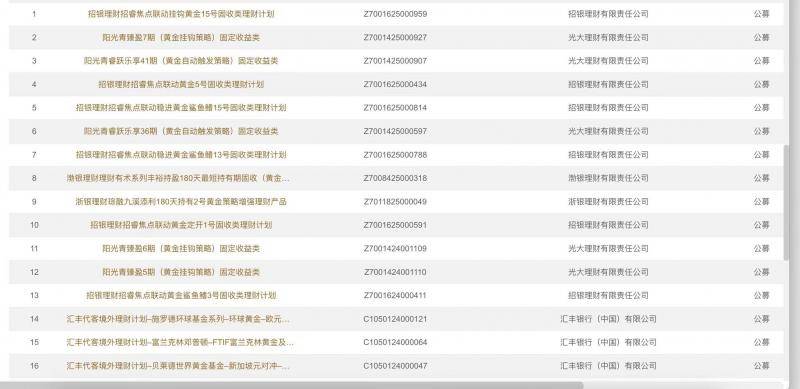
Core Viewpoint - The price of spot gold reached a record high of $3,674.27 per ounce on September 12, surpassing the previous peak of $850 per ounce set in January 1980, adjusted for inflation to approximately $3,590 [1] Group 1: Gold-Linked Financial Products - There has been a surge in the issuance of gold-linked financial products in China, with 47 existing products as of September 13, including 16 from bank wealth management subsidiaries [3][8] - Three new gold-linked financial products were issued in September, including the "Zhaorui Focus Linked Gold No. 5 Fixed Income Wealth Management Plan" by Zhaoyin Wealth Management and the "Sunshine Qingzhenying No. 7 (Gold Linked Strategy) Fixed Income Wealth Management Product" by Everbright Wealth Management [3][4] - The average annualized yield of gold fixed income products is reported to be between 2.00% and 4.00%, outperforming other fixed income products [14] Group 2: Market Trends and Predictions - The international gold price has increased by approximately 39% this year, with major financial institutions like UBS and Goldman Sachs raising their gold price targets significantly for the coming years [15][16] - UBS has adjusted its gold price target for the end of 2025 to $3,800 per ounce and for mid-2026 to $3,900 per ounce, citing expected monetary policy easing by the Federal Reserve and geopolitical risks [15] - The global gold ETF holdings are expected to exceed 3,900 tons by the end of 2025, approaching the record of 3,915 tons set in October 2020 [15] Group 3: Investment Considerations - Experts recommend that consumers interested in gold financial products should understand the characteristics, yield methods, and risk levels of these products, and invest based on their risk tolerance [16] - It is advised to maintain a rational investment approach, focusing on long-term asset preservation and value appreciation, especially in a volatile gold price environment [16]

金价再创新高 黄金理财借势“升温”
Zhong Guo Jin Rong Xin Xi Wang· 2025-09-10 07:09
Core Viewpoint - International gold prices have recently surged, reaching a historical high of $3,659.10 per ounce on September 9, driven by multiple factors, prompting banks to issue more gold-linked wealth management products [1] Group 1: Market Trends - The rapid increase in gold prices has led to a significant uptick in the issuance of gold-linked wealth management products by bank wealth management subsidiaries, indicating a response to market trends and a strategic shift in the asset management industry [1] - As of September 5, there are 47 existing wealth management products with "gold" in their names, of which 16 are from bank wealth management subsidiaries [2] Group 2: Product Types - The gold-linked wealth management products from bank subsidiaries primarily fall into two categories: "fixed income + gold," which combines fixed income assets with gold, and structured products linked to gold, mainly investing in gold-related derivatives [2] - Despite the rising interest in gold-linked products, the number of subsidiaries participating remains limited, and the overall scale of issued gold wealth management products is relatively small [2] Group 3: Expert Insights - Experts emphasize that gold serves as a long-term investment with hedging properties against inflation and geopolitical uncertainties, highlighting the importance of regulatory compliance in product design and risk management [3] - The anticipated increase in demand for gold as a hedge and the relaxation of insurance investment policies are expected to encourage more wealth management subsidiaries to explore gold investment strategies [2][3] Group 4: Investor Guidance - Experts advise ordinary investors to approach the rising gold prices with caution, emphasizing the need for a rational assessment of risk tolerance and the importance of understanding the underlying assets and yield structures of products [4] - It is recommended that gold be viewed as a long-term asset allocation rather than a tool for short-term gains, with different products suited for varying risk profiles [4]
金价持续走高 银行理财子公司借势发力黄金理财
Zheng Quan Ri Bao· 2025-09-08 03:03
Core Viewpoint - The recent surge in gold prices has led to an increase in the issuance of gold-linked wealth management products by bank wealth management subsidiaries, driven by the growing investment value of gold and the rising demand for stable return products [1][2]. Group 1: Market Trends - As of September 5, the price of gold reached $3,552.701 per ounce, surpassing the critical $3,500 mark, prompting banks to issue more gold-related financial products [1]. - Multiple banks, including 招银理财 and 光大理财, have launched gold-linked wealth management products in response to the rising gold prices, indicating a trend towards gold investment [2]. - There are currently 47 wealth management products in the market that include "gold" in their names, with 16 of these being issued by bank wealth management subsidiaries [2]. Group 2: Product Structure - The gold-linked wealth management products primarily adopt a closed-end operation model, focusing on fixed-income investments [2]. - These products can be categorized into two types: "fixed income + gold" products that combine fixed-income assets with gold investments, and structured products linked to gold derivatives [2]. Group 3: Future Outlook - The number of bank wealth management subsidiaries participating in gold investment is currently limited, but demand for gold as a hedge against risk is expected to grow, leading to more banks exploring gold investment strategies [3]. - The ongoing rise in gold prices is anticipated to continue in the medium to long term, driven by factors such as geopolitical risks, strong central bank demand for gold, and persistent market expectations for interest rate cuts [4]. Group 4: Investor Guidance - Investors are advised to carefully assess their risk tolerance and investment goals when selecting gold-linked products, as these products are better suited for long-term asset allocation rather than short-term speculation [5][6]. - Key considerations for investors include matching investment objectives with product risks, understanding product structures, and being aware of fees and operational rules associated with these products [6].
银行理财子公司借势发力黄金理财
Zheng Quan Ri Bao· 2025-09-07 16:10
Core Viewpoint - The recent surge in gold prices has led to an increase in the issuance of gold-linked wealth management products by bank wealth management subsidiaries, driven by the growing investment value of gold and the rising demand for stable return products [1][2]. Group 1: Market Trends - As of September 5, the price of gold reached $3,552.701 per ounce, surpassing the key level of $3,500, prompting banks to issue more gold-related wealth management products [1]. - Several banks, including 招银理财 and 光大理财, have launched gold-linked wealth management products in recent weeks, contributing to the growing popularity of gold investment [2]. - Currently, there are 47 wealth management products in the market that include "gold" in their names, with 16 of these being issued by bank wealth management subsidiaries this year [2]. Group 2: Product Structure - The gold-linked wealth management products primarily adopt a closed-end operation model, focusing on fixed-income investments [2]. - There are two main types of gold-linked products: one combines fixed income with gold assets, while the other is structured products linked to gold derivatives [2]. Group 3: Future Outlook - The number of bank wealth management subsidiaries participating in gold investment is currently limited, but demand for gold as a hedge against risk is expected to rise, leading to more exploration of gold investment strategies [3]. - The ongoing increase in gold prices is attributed to factors such as geopolitical risks, strong central bank interest in gold, and persistent market expectations for interest rate cuts [4]. Group 4: Investor Guidance - Experts advise investors to approach the rising gold prices with caution and to consider the suitability of gold-linked products for long-term asset allocation rather than short-term speculation [5][6]. - Key considerations for investors include matching investment goals with product risks, understanding product structures, and being aware of fees and operational rules [5][6].