
理财行业

Search documents
2026 年,机构行为的新变化:交易增强,配置重构
Changjiang Securities· 2026-01-30 11:44
1. Report Industry Investment Rating - No relevant content provided. 2. Core Viewpoints - In 2026, the strategy differentiation of major financial institutions will reshape the bond market landscape. The trading attributes of banks will be enhanced, and the pressure to exchange floating profits will be reduced. If the regulatory constraints on interest - rate sensitivity indicators are relaxed, it may provide long - term bond allocation space for banks. Securities firms' proprietary trading will continue the aggressive strategy of "bond foundation, equity enhancement" with regulatory support. Wealth management will fully enter the "true net - value" era, with product closure and defensive allocation becoming the mainstream. Public funds are expected to repair the liability side through the new fee regulations, the duration strategy may be reopened, and the use of hedging tools will increase. Insurance institutions will focus on long - term allocation, increasing their allocation of long - duration interest - rate bonds and high - dividend assets. The overall trading attributes of the market will be enhanced, and the allocation strategies will gradually diversify [3]. 3. Summary by Related Catalogs 3.1 Bank - Overall, it shows the characteristics of "configuration adjustment and trading enhancement". In 2026, if China follows the Basel regulatory new rules, large banks are expected to release about 1 trillion yuan of government bond allocation space, and the ability to undertake long - term bonds will be marginally improved. The trading attributes of state - owned large banks are gradually strengthening, and they will continue to maintain high trading activity in 2026. If the cost - performance of inter - bank certificates of deposit rises in the future, the bond - allocation strength of rural commercial banks may moderately recover [15]. - Constrained by the deepening of the asset - liability term mismatch, the ability of large banks to undertake long - term bonds is limited. However, if China implements the adjusted international regulatory standards, it is estimated that about 1 trillion yuan of bond - allocation capacity will be added for large banks. In 2025, the AC account proportion of various banks decreased, and the OCI account proportion increased. In 2026, although the pressure on banks to make up for the performance gap by realizing floating profits will weaken, there are still incentives to realize floating profits [16][21]. - State - owned large banks' trading volume of 7 - 10Y treasury bonds and policy - financial bonds in 2025 increased, and the proportion of trading volume also increased compared with the previous two years, showing an active trading strategy. It is expected that this high trading activity will continue in 2026 [29]. - Since the beginning of 2025, affected by the new capital regulations and the decline in the cost - performance of certificates of deposit, the bond - allocation behavior of rural commercial banks in the secondary market has significantly shrunk. If the cost - performance of certificates of deposit recovers and the capital occupation pressure eases in 2026, the bond - allocation strength may moderately recover [32][33]. 3.2 Wealth Management - In 2026, wealth management will fully enter the "true net - value" operation mechanism. In terms of products, "fixed - income +", closed - end and minimum holding - period products will be used to deal with net - value fluctuations; in terms of operation, the management requirements for duration, leverage and liquidity will continue to increase, and the asset allocation will focus on stability and term matching [40]. - In 2026, in the context of low - interest rates and the full - completion of valuation rectification, the scale and number of "fixed - income +" products are expected to continue to grow. The proportion of "fixed - income +" products in fixed - income wealth management is expected to rise steadily [41][42]. - After the full - completion of valuation rectification, the net - value stability constraint of wealth management products has been significantly enhanced. The closed - end and quasi - closed - end operation characteristics of new products are expected to be further strengthened in 2026 [44]. - In 2026, wealth management institutions will pay more attention to the liquidity safety cushion. The proportion of high - liquidity assets in wealth management asset allocation is likely to remain relatively high [50]. - In 2026, wealth management drawdown is expected to be controllable and will change around interest - rate fluctuations. Wealth management institutions may deepen the application of multi - asset allocation strategies to reduce the impact of bond - market fluctuations on net value [52]. - In 2026, the allocation value of amortized - cost bond funds will be further highlighted. The re - investment demand of the expired funds of amortized - cost bond funds is expected to support the short - end credit - bond market [58]. 3.3 Public Funds - In 2026, with the implementation of the new fee regulations for public funds, the bond - market sentiment is expected to be moderately repaired, and the stability improvement of the liability side may create conditions for reopening the duration strategy. The development of innovative tools such as stock - bond constant ETFs is expected to introduce incremental funds, and the number of funds using the negative - duration strategy may increase. The supervision of customized funds and dividend mechanisms will continue to be optimized [65]. - In 2025, the leverage ratio of bond funds decreased, and the duration fluctuated greatly. In 2026, the liability - side and asset - side durations of public funds are expected to increase [66]. - The implementation of the new fee regulations for public funds in 2026 is expected to promote the moderate repair of the bond market and the internal optimization of the bond - fund pattern [71]. - In 2026, the pure - bond fund market may face product - pattern adjustment. The smooth development of stock - bond constant ETFs may bring incremental funds to the equity and interest - rate bond markets and weaken the traditional "stock - bond seesaw" effect in the short term [76]. - In 2026, the number of funds using the negative - duration strategy may increase to manage risk exposure in the context of low - interest rates and high volatility in the bond market [79]. - In 2026, there is still room for optimization of customized funds and dividend mechanisms in the public - fund industry. The regulatory authorities may put forward rectification requirements for customized funds with a high institutional - holding ratio and optimize the dividend mechanism [82][84]. 3.4 Insurance - In 2026, the investment strategy of insurance institutions is expected to shift from "trading" to "allocation - based". The turnover rate of interest - rate bonds such as treasury bonds has declined, and the asset - allocation structure will be further optimized [87]. - In 2025, affected by the regulatory reduction of the liability - side pricing ceiling, new - policy attractiveness weakened, and premium growth slowed down. Insurance funds preferred a Carry - based strategy, with a decline in the turnover rate of interest - rate bonds and a stable or rising allocation weight [88]. - As of Q3 2025, bonds still accounted for more than 50% of insurance - fund asset allocation, but the growth rate of equity investment was relatively fast. In 2026, if the new fee regulations weaken the cost - performance of bond funds, some insurance funds may shift to equity assets, but it will not significantly affect their bond - market allocation [94]. - In 2026, under the dual - system drive of the new asset - liability regulations and new accounting standards, insurance institutions will significantly increase their allocation of long - duration interest - rate bonds and high - grade general credit bonds and reduce the allocation of bank Tier 2 capital bonds. The proportion of participating insurance is expected to continue to increase, and the equity - asset allocation will focus on high - dividend and low - valuation stocks [100][101]. 3.5 Securities Firms' Proprietary Trading - In 2026, the bond - allocation of securities firms' proprietary trading will continue to focus on interest - rate bonds and high - grade credit bonds, and the equity - allocation is expected to achieve "both quantity and quality improvement" under regulatory encouragement, with a preference for standardized products such as broad - based index constituent stocks and liquid ETFs [103]. - From March 2021 to November 2025, the bond - holding scale of securities firms' proprietary trading increased, and the proportion of interest - rate bonds rose. In 2026, the bond - holding scale is expected to continue to grow, and the credit - bond allocation will continue to concentrate on high - grade bonds [104][105]. - In 2025, the floating - profit scale of securities firms' proprietary trading turned from negative to positive, and they showed advantages in stop - profit operation and holding - cost control [109]. - Regulatory support for securities firms' proprietary trading to increase equity - asset allocation has increased. In 2026, securities firms may further increase their equity - asset allocation, with a possible preference for standardized products [114].

近百只理财产品提前终止,啥情况?
Jin Rong Shi Bao· 2025-12-30 10:21
Core Viewpoint - Recent fluctuations in the bond market have led to concerns among investors regarding the performance of wealth management products, with many experiencing net value declines and early terminations [1][2][3] Group 1: Bond Market Performance - The bond market has been weakening, with the 30-year government bond futures down 3.72% and the 10-year government bond futures down 0.54% as of December 8 [1] - The decline in bond prices has directly impacted the net value of wealth management products, particularly fixed-income products [1] - A significant number of wealth management products have announced early terminations, with nearly a hundred products terminating between November 1 and December 9 [1][2] Group 2: Institutional Responses and Market Analysis - Analysts attribute the bond market's weakness to a combination of tightening liquidity and adjustments in policy expectations, with the central bank's shift to net absorption of liquidity contributing to the situation [3] - Concerns over new public fund fee regulations have also affected market sentiment, potentially leading to redemptions in bond funds [3] - Despite current market volatility, many analysts believe the adjustments are short-term, with no significant negative changes in the fundamental or policy landscape [3] Group 3: Investment Strategies - In light of the bond market fluctuations, maintaining asset stability and liquidity is crucial, with cash management products being recommended as a defensive strategy [4] - Investors are advised to focus on underlying assets, management capabilities, and product liquidity, rather than solely on returns [4] - Clear financial planning and appropriate product selection are emphasized as key to achieving investment goals amidst market volatility [4]

为什么利率这么低,人们反而更爱存钱了?这背后的真相是什么?
Sou Hu Cai Jing· 2025-12-21 04:36
Core Insights - Despite declining deposit interest rates, household savings in China have continued to grow, reflecting a cautious approach to wealth management amid economic uncertainty [1][3][5] Group 1: Household Savings Trends - As of the end of Q3 2025, household deposits reached 164.03 trillion yuan, a year-on-year increase of 10.2%, with new deposits in the first three quarters exceeding 12.73 trillion yuan, accounting for over 56% of the total increase in RMB deposits [1] - From 2022 to 2024, new household deposits approached 50 trillion yuan, surpassing the total from the previous six years (2016-2021) [3] - The average per capita deposit balance reached 130,000 yuan by the end of 2024, with an annual increase of 12,000 yuan, indicating that savings have become the primary strategy for most families to cope with uncertainty [3] Group 2: Changes in Deposit Structure - The proportion of fixed-term deposits has risen significantly, reaching 72.7% by 2024, compared to a historical average of 60% for fixed versus current deposits, indicating a preference for locking funds in long-term deposits despite lower liquidity [3][5] - Deposit interest rates have been declining, with one-year fixed deposit rates dropping from 1.65% in 2022 to 0.95% in 2025, and three-year rates falling from 2.6% to 1.25% during the same period [3][5] Group 3: Behavioral and Economic Factors - The increase in savings is attributed to a long-term "scar effect" from the pandemic, leading to reduced consumer spending and a shift towards preventive savings due to concerns over income stability and employment [5] - The narrowing of investment channels has also contributed to the return of funds to banks, as high-yield trust and real estate products have declined, and the real estate market has faced significant adjustments [5] Group 4: Global Comparisons and Lessons - Japan's experience in the 1990s, where savings rates increased despite low or negative interest rates, serves as a reference point, highlighting a shift in public trust towards cash and deposits amid economic uncertainty [6] - The aging population and incomplete social security systems in China are similar to Japan's challenges, further motivating residents to save [6] Group 5: Financial Market Developments - In the latter half of 2025, a noticeable "deposit migration" occurred, with a decrease of 1.34 trillion yuan in household deposits in October, while non-bank financial institutions saw an increase of 1.85 trillion yuan, indicating a shift towards stable assets like bank wealth management and insurance products [8] - The scale of the bank wealth management market reached 32.13 trillion yuan by the end of Q3 2025, growing by 7.28% since the beginning of the year, with R2-level (medium-low risk) fixed-income products becoming the mainstay [8][9] Group 6: Evolution of Wealth Management - Wealth management companies have become dominant players, with their product scale reaching 29.28 trillion yuan, accounting for 91.13% of the market, reflecting growing trust in their expertise and product design [9] - The number of accounts holding wealth management products reached 139 million, a year-on-year increase of 12.7%, indicating a shift from a niche choice to a more widespread investment strategy [9]


一买就跌 谁在制造“高收益幻觉”?
Nan Fang Du Shi Bao· 2025-11-24 23:11
Core Viewpoint - The recent emergence of a new "ranking" method in wealth management products has raised concerns about the manipulation of performance metrics to create an illusion of high returns, leading to scrutiny from regulatory bodies [4][7]. Group 1: New "Ranking" Method - The "ranking" behavior involves financial institutions artificially inflating short-term performance to attract investors and enhance product visibility in the market [4]. - Some wealth management companies are reportedly using trust accounts to exploit T-1 valuation rules, facilitating value transfer between new and old products [4][6]. - This "valuation arbitrage" allows fund managers to manipulate returns by timing purchases and redemptions based on market movements, effectively redistributing profits from older products to new ones [4][5]. Group 2: Impact on Investors - The "ranking" practices not only harm the interests of existing product holders but also create a misleading perception of returns for new investors, leading to a "return gap" [5][6]. - Many investors express frustration over the disparity between advertised returns and actual performance, often feeling misled by the presentation of data [5][6]. - The average annualized return for open-ended fixed-income wealth management products is significantly lower than the high returns displayed by some products, with recent data showing an average of 3.15% for the past month [6]. Group 3: Regulatory Response - Regulatory bodies have begun to address the issue of performance manipulation, with guidelines established to ensure that past performance does not mislead investors regarding future returns [7][8]. - The China Banking Association has released standards for displaying past performance, emphasizing the need for clear communication about the risks associated with wealth management products [7]. - New regulations set to take effect in 2026 will prohibit misleading practices in the promotion and sale of financial products, aiming to protect investors from deceptive marketing [7][8].

央行重启国债买卖 长端利率债、“固收+”理财有望受益
Zhong Guo Ji Jin Bao· 2025-11-10 07:22
Core Viewpoint - The resumption of public market treasury bond trading by the central bank in October signals a positive outlook for the bond market, with expectations for long-term interest rates to decline and related investment products to benefit [1][2][3]. Group 1: Market Signals and Economic Impact - The central bank's resumption of treasury bond trading is seen as a signal for stabilizing growth, which is expected to boost confidence in the bond market [2][3]. - The People's Bank of China (PBOC) indicated that the overall operation of the bond market is good, with current interest rates in a policy-consistent range, which supports market expectations [2][3]. - The operation size of 20 billion yuan, while modest, carries significant signal value, enhancing confidence in the bond market, particularly for medium to long-term interest rate bonds [2][3]. Group 2: Interest Rate Trends and Investment Opportunities - Long-term interest rates for treasury bonds have begun to decline since late October, with expectations for further decreases, presenting investment opportunities in related financial products [3][4]. - The resumption of bond purchases by the central bank is expected to create a favorable environment for long-term interest rates to decline, benefiting bond-related investment products [4][5]. - Investors are advised to focus on bond products with longer durations and stable historical returns, as these are likely to benefit from the anticipated rise in bond prices [5][6]. Group 3: Strategic Investment Approaches - Institutions suggest increasing allocations to medium and short-term credit bonds, as the central bank's actions are expected to improve liquidity and compress credit spreads [6]. - Investment strategies should include optimizing portfolio structures, increasing liquidity through open-end or short-term products, and diversifying into "fixed income plus equity" products to balance risks [6][5]. - The current market environment allows for the inclusion of reasonably valued equity assets in investment strategies, leveraging "fixed income plus equity" products for better returns [6].
理财遇冷?股强债弱、黄金大涨,三季度理财规模减少千亿
Nan Fang Du Shi Bao· 2025-10-17 10:04
Core Insights - The bank wealth management market experienced significant fluctuations in Q3 2025, with the total outstanding scale decreasing to 30.82 trillion yuan, a reduction of 151.47 billion yuan from the end of June [2][3] - The average annualized yield of wealth management products fell to 2.47%, down 0.18 percentage points from the end of June, influenced by bond market volatility [3][4] - In contrast, the A-share market showed strong performance, with the Shanghai Composite Index surpassing 3,800 points, and gold prices exceeding $4,000 per ounce during the National Day period, leading to a migration of funds among different asset classes [2][3] Wealth Management Market Overview - As of the end of September, the wealth management market saw a total of 7,865 new products launched in Q3, a decrease of 58 products compared to the previous quarter [3] - The market exhibited a "rise then fall" trend, with growth in July and August followed by a decline in September [3] - Seasonal factors contributed to the decline in September, as wealth management companies typically align product maturities with quarter-end liquidity assessments [3][6] Product Performance - Cash management and fixed-income wealth management products saw average annualized yields of 1.45% and 2.48%, respectively, both declining from June [4][5] - Conversely, mixed and equity-based wealth management products achieved average annualized yields of 5.03% and 13.72%, respectively, with significant increases of 1.89 and 9.97 percentage points from June [5][6] - Notable high-performing products included those linked to gold and technology sectors, with some achieving returns exceeding 100% [5][6] Asset Class Characteristics - The report emphasizes that no asset class can be deemed a "constant winner," highlighting the unique characteristics and cycles of each asset type [6][7] - Stocks are characterized as high-elasticity assets, while bonds are viewed as low-risk assets with limited yield potential [6][7] - Gold is identified as a safe-haven asset, influenced by various factors including the dollar's performance and geopolitical events [6][7] Investment Strategies - The "fixed income plus" products have gained popularity as they combine stable fixed-income assets with a small allocation to equities, allowing for potential enhanced returns [8] - A simulated portfolio consisting of 80% fixed income and 20% equity has shown superior performance during bullish markets while minimizing losses during downturns [8]

黄金投资再升温!银行借“金豆”圈粉年轻人 理财公司也来抢滩
Bei Jing Shang Bao· 2025-09-17 15:21
Core Viewpoint - The recent surge in spot gold prices has reignited interest in gold investment, particularly among young investors who are favoring low-weight gold products like "gold beans" for their accessibility and flexibility [1][2][7]. Group 1: Gold Investment Trends - "Gold beans" have become a popular choice for young investors, with discussions on social media platforms like Xiaohongshu increasing significantly [2][3]. - The price of 1 gram of gold beans is approximately 880 RMB, making it a low-pressure investment option compared to purchasing heavier gold bars [2][3]. - Banks are responding to this trend by launching "gold bean" marketing campaigns, allowing flexible purchasing options [2][3]. Group 2: Performance of Gold-Linked Financial Products - The market for gold-linked financial products has expanded, with many institutions launching new offerings [4][5]. - Recent data shows that the annualized yield for most gold "fixed income+" products is in the range of 2% to 4%, outperforming other fixed-income products [4][5]. - The introduction of structured products linked to gold, such as options and ETFs, is becoming more common among financial institutions [6][5]. Group 3: Market Outlook and Economic Factors - Spot gold prices have recently reached historical highs, with a peak of 3702.93 USD per ounce [7][8]. - Analysts predict that if the Federal Reserve initiates interest rate cuts, gold prices could strengthen further, potentially reaching 3800 USD per ounce [8]. - Despite potential short-term fluctuations, the overall trend for gold prices is expected to remain upward, with recommendations for investors to adopt a long-term investment strategy [8][7].
国际金价屡创新高 含“金”理财产品收益如何?|财富眼
Sou Hu Cai Jing· 2025-09-13 07:53
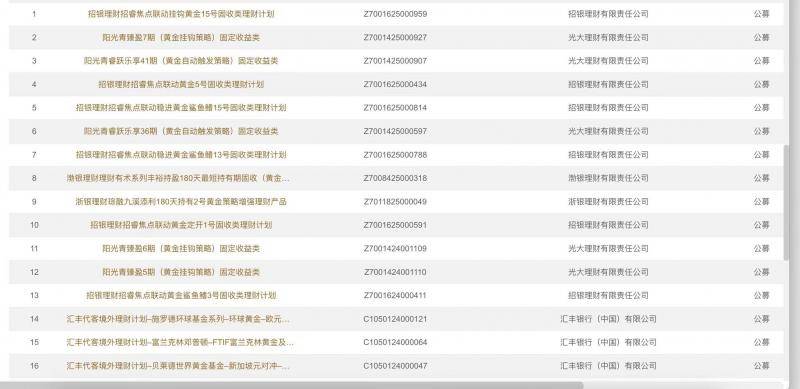
Core Viewpoint - The price of spot gold reached a record high of $3,674.27 per ounce on September 12, surpassing the previous peak of $850 per ounce set in January 1980, adjusted for inflation to approximately $3,590 [1] Group 1: Gold-Linked Financial Products - There has been a surge in the issuance of gold-linked financial products in China, with 47 existing products as of September 13, including 16 from bank wealth management subsidiaries [3][8] - Three new gold-linked financial products were issued in September, including the "Zhaorui Focus Linked Gold No. 5 Fixed Income Wealth Management Plan" by Zhaoyin Wealth Management and the "Sunshine Qingzhenying No. 7 (Gold Linked Strategy) Fixed Income Wealth Management Product" by Everbright Wealth Management [3][4] - The average annualized yield of gold fixed income products is reported to be between 2.00% and 4.00%, outperforming other fixed income products [14] Group 2: Market Trends and Predictions - The international gold price has increased by approximately 39% this year, with major financial institutions like UBS and Goldman Sachs raising their gold price targets significantly for the coming years [15][16] - UBS has adjusted its gold price target for the end of 2025 to $3,800 per ounce and for mid-2026 to $3,900 per ounce, citing expected monetary policy easing by the Federal Reserve and geopolitical risks [15] - The global gold ETF holdings are expected to exceed 3,900 tons by the end of 2025, approaching the record of 3,915 tons set in October 2020 [15] Group 3: Investment Considerations - Experts recommend that consumers interested in gold financial products should understand the characteristics, yield methods, and risk levels of these products, and invest based on their risk tolerance [16] - It is advised to maintain a rational investment approach, focusing on long-term asset preservation and value appreciation, especially in a volatile gold price environment [16]
最短持有期产品领跑“固收+权益”榜,近半年收益率最高超 4%
2 1 Shi Ji Jing Ji Bao Dao· 2025-08-07 11:20
Overall Performance - The average net value growth rate of RMB "fixed income + equity" public wealth management products over the past six months is 1.2%, with an average maximum drawdown of 0.07% [5] - 44.67% of the products recorded positive returns over the past six months [5] - In the list of products with positive returns, Jiao Yin Wealth Management has 4 products, Min Sheng Wealth Management has 3 products, Pu Yin Wealth Management has 2 products, and Xing Yin Wealth Management has 1 product [5] - Xing Yin Wealth Management's "Feng Li Xing Dong Duo Ce Li Zi Yuan You Shi 3 Months Shortest Holding Enhanced Fixed Income Class A" ranks first with a net value growth rate of 4.18% [5] - Jiao Yin Wealth Management's "Wen Xiang Ling Dong Hui Li Ri Kai 8 Hao (90 Days Holding Period) B" and Pu Yin Wealth Management's "Pu Xiang Zeng Yi Zhi San Months Shortest Holding Period 4 Hao A" rank second and third respectively [5] Highlight Product Analysis - Xing Yin Wealth Management's product employs a barbell strategy with a bond effective duration of 2-4 years, focusing on mid-to-short credit bonds for base configuration and long-end trading for phase gains [7] - The product's equity investments focus on companies with resource monopoly advantages in cyclical and technology sectors, with a moderate increase in cyclical and balanced growth companies to enhance portfolio elasticity and success rate [7] - As of the end of the first half, the product's net asset value is approximately 455 million, with equity investments accounting for 3.29%, and the top ten holdings mainly consist of bond funds and bonds [7]
