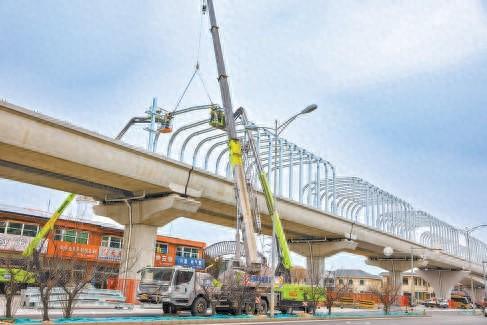
雄安R1线

Search documents
北京将引入武清至通州进京公交
Xin Lang Cai Jing· 2026-02-02 23:10
Core Viewpoint - Beijing plans to implement a new round of transportation facilitation measures for the Beijing-Tianjin-Hebei region, aiming to enhance connectivity and optimize traffic flow in the area [1] Group 1: Transportation Initiatives - The opening of the 22nd subway line (Hongmiao-Pinggu) is scheduled as part of the transportation facilitation measures [1] - The second batch of inspection stations, including Yingsi and Yongle, will undergo optimization and enhancement [1] - Customized commuter bus routes will be extended to surrounding areas of Beijing, including routes from Gu'an to Daxing Airport and from Dachang to the subway line 6 Luyang Station [1] Group 2: Infrastructure Development - The construction of the Xiong'an R1 line will be promoted, with conditions for trial operations with the Daxing Airport line expected to be met this year [1] - The M101 subway line construction will be advanced to improve transportation in the urban sub-center [1] - Preliminary research will be conducted for the renovation of the Tongyan Expressway node in the Canal Business District [1] Group 3: Road Traffic Optimization - The construction of the Tongyan Expressway and the East Sixth Ring Road rapid connection line will commence [1] - The Liuhe Bridge will be widened, and the old Jingyu line under East Sixth Ring Road will be renovated [1] - Traffic organization will be optimized for several roads, including Yongcui East Road and Yongcui West Road, transitioning from one-way to two-way traffic [1]
北京核心区公交车站将错时共享
Xin Lang Cai Jing· 2026-02-02 16:59
Group 1: Transportation Improvements - The 2026 Beijing Transportation Comprehensive Governance Action Plan aims to alleviate issues related to tourist bus parking and passenger drop-off in core scenic areas by implementing shared bus stop usage during off-peak hours [1] - The Xiong'an R1 line, connecting Xiong'an New Area to Beijing Daxing International Airport, is expected to be operational by mid-2026, facilitating a one-hour commute to key business districts in Beijing [2] - The plan includes the addition of 35,000 parking spaces in central urban areas, with 20,000 from new potential spaces and 5,000 from utilizing civil air defense projects [3] Group 2: Parking Management - The initiative will explore night-time limited parking around residential areas to increase parking resources, allowing parking from 7 PM to 7 AM the next day [3] - The action plan promotes "alternating traffic" management measures, with at least 20 points for optimization and improvement [4] - There will be enhanced management and maintenance of previously improved under-bridge spaces, including upgrades to 11 specific bridges [4]
雄安R1线今年将具备与大兴机场线贯通运营调试条件
Xin Jing Bao· 2026-02-02 11:13
Core Insights - The 2026 Beijing Transportation Comprehensive Governance Action Plan emphasizes the integration of transportation in the Beijing-Tianjin-Hebei region, with specific projects aimed at enhancing connectivity and efficiency [1][2] Group 1: Transportation Projects - The plan includes the opening of the 22nd subway line (Hongmiao-Pinggu) in Beijing [1] - The construction and renovation of the Xiong'an R1 line, which connects Xiong'an New Area to Beijing Daxing International Airport, is a key project expected to facilitate a one-hour commute to major business districts in Beijing [1][2] - The Daxing Airport Line is undergoing an extension to Lize Business District, which will enhance connectivity to major transport hubs and business areas [2] Group 2: Connectivity Enhancements - The Daxing Airport Line will reduce travel time from Lize Financial Business District to Beijing Daxing International Airport to 25 minutes, improving access to key areas [2] - The plan includes new measures for convenient travel between Beijing and Tianjin, along with the introduction of customized bus routes extending to surrounding areas [2] - The integration of various subway lines and transport hubs will allow for seamless transfers to reach the airport and other significant locations in Beijing [2]
今年计划开通轨道交通22号线
Xin Lang Cai Jing· 2026-01-21 22:38
Core Points - Beijing's transportation services are set to improve significantly by 2026, with a focus on creating a comprehensive transportation system that is convenient, smooth, green, smart, and safe [2] - The city aims to increase the proportion of green travel in the central urban area to 76.8% this year [2] - The construction of the 22nd subway line is planned to be completed this year, along with the renovation of the Guomao transfer passage on Line 10 to enhance commuting efficiency [2] Group 1: Infrastructure Development - The Beijing-Tianjin-Hebei transportation integration will continue to deepen, with the opening of the 22nd subway line and the promotion of the Xiong'an R1 line and Daxing Airport line connectivity [2] - Key infrastructure projects include the construction of the Liangma River North Road, New National Exhibition Liaison Line, and the overall upgrade of the South Central Axis Road [3] - The city plans to enhance road traffic quality by expanding the Fourth Ring Road renovation model and improving the overall road network efficiency [3] Group 2: Public Transport Enhancements - The city will continue to deepen "multi-network integration," focusing on the core of rail transit to improve comprehensive transportation service efficiency [3] - Plans include the construction of the M101 line and the overall upgrade of the suburban railway city sub-center line from Beijing West to Liangxiang [3] - The city aims to add over 30 new bus routes outside the Fourth Ring Road and more than 20 "short, frequent, and fast" connecting routes [3] Group 3: Non-Motorized Transport and Parking Solutions - The city plans to build seven slow-moving demonstration streets and create urban greenways around the Second Ring Road [5] - An additional 100,000 non-motorized vehicle parking spaces will be added, along with the trial construction of multi-story parking facilities [5] - The city aims to address parking difficulties in central urban areas by adding 35,000 new and shared parking spaces [5] Group 4: Traffic Safety and Smart Transportation - The city will enhance traffic safety and emergency response capabilities, including improving the resilience of mountain roads against disasters [6] - A total of 8,000 traffic lights will be interconnected and controlled, with the establishment of 500 dynamic green wave roads to improve intelligent traffic management [6] - The city is focused on creating a closed-loop management system for traffic, enhancing the smart service capabilities of the transportation network [6] Group 5: Achievements and Future Goals - In 2025, the green travel proportion in the central urban area reached 76.5%, reflecting the effectiveness of the integrated transportation system [7] - The city has expanded its rail network, with the operational mileage reaching 909 kilometers and the opening of new stations to improve connectivity [7] - The transportation department is exploring comprehensive governance paths for super-large cities, with significant improvements in road accessibility and infrastructure [7]