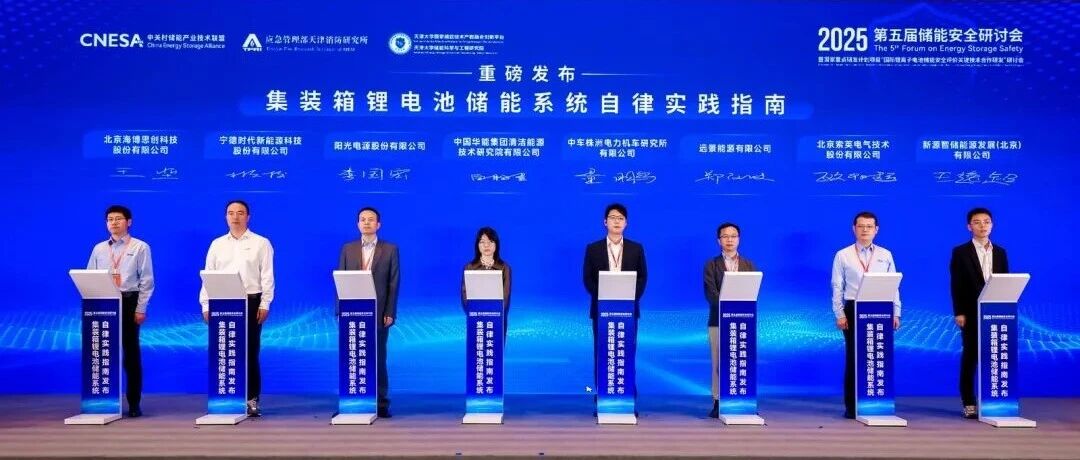
集装箱锂电池储能系统

Search documents
CNESA年终盘点 | 中关村储能产业技术联盟2025年十大事件
中关村储能产业技术联盟· 2026-01-18 08:27
Core Viewpoint - The article highlights the significant achievements and contributions of the Zhongguancun Energy Storage Industry Technology Alliance (CNESA) in promoting high-quality development in the energy storage sector, emphasizing its role in policy support, technological innovation, standard formulation, industry services, and international cooperation [1]. Group 1: Establishment and Organizational Structure - The CNESA established the Communist Party of China Zhongguancun Energy Storage Industry Technology Alliance Flowing Party Branch Committee in July 2025, with 6 members covering key departments such as industry research and government affairs [3]. - The alliance promotes the concept of "strong party building, strong development" and has created the "Energy Pioneer" party-building activity brand to enhance members' ideals and beliefs [3]. Group 2: Involvement in National Planning - In 2025, CNESA actively participated in the top-level design of the energy storage sector, leading several core tasks, including the sub-topic research for the National Energy Administration's "14th Five-Year Plan" [7]. - The alliance provided critical policy recommendations and conducted special research on key areas such as energy storage capacity compensation mechanisms and zero-carbon park construction [7]. Group 3: Research and Development Initiatives - CNESA led a study on the "Market-Based Capacity Compensation Mechanism for Energy Storage," collaborating with various institutions to analyze energy storage technology characteristics and cost [9]. - The alliance also spearheaded a national key research project on "Value Benefits and Carbon Emission Assessment Technologies for Large-Scale Energy Storage," addressing industry pain points and developing cost assessment models [13]. Group 4: Industry Reports and Guidelines - In 2025, CNESA published seven significant research reports, including the "Energy Storage Industry Research White Paper 2025," which reached over 230,000 online readers and was widely cited by mainstream media [15]. - The alliance, in collaboration with leading companies, released the "Self-Regulatory Practice Guidelines for Container Lithium Battery Energy Storage Systems (2025 Edition)" to establish a fair market environment [18]. Group 5: International Events and Competitions - The 13th Energy Storage International Summit and Exhibition (ESIE 2025) attracted over 200,000 participants and featured more than 4000 companies, making it the largest global platform for energy storage industry exchange [22]. - The 9th International Energy Storage Innovation Competition (ESIC 2025) received 303 entries, showcasing industry innovation and serving as a core platform for technology exchange and capital connection [26]. Group 6: Global Cooperation and Networking - In 2025, CNESA accelerated its international outreach by organizing multiple international business matchmaking events and participating in global energy storage policy forums [33]. - The alliance's efforts in international collaboration aim to enhance the global presence of Chinese energy storage companies and strengthen their international influence [33].

碳酸锂日评:低位震荡-20251017
Hong Yuan Qi Huo· 2025-10-17 07:38
Report Industry Investment Rating - No information provided Core View of the Report - On October 16, the main contract of lithium carbonate futures fluctuated upwards. The current supply and demand are both strong, the upstream inventory pressure is not large, the expectation of lithium ore supply contraction is weakened, the downstream inventory preparation has reached its peak, and the demand peak may be approaching. It is expected that the lithium carbonate price will fluctuate at a low level. The situation after Jiangxi's mining end submits the production report needs to be observed. It is recommended to short at the upper edge of the short - term range [1] Summary According to Related Content Futures Market - On October 16, 2025, the closing prices of the near - month, continuous - one, continuous - two, and continuous - three contracts of lithium carbonate futures were 73,820 yuan/ton, 74,940 yuan/ton, 75,080 yuan/ton, and 75,080 yuan/ton respectively, with increases of 1,160 yuan/ton, 2,220 yuan/ton, 2,140 yuan/ton, and 2,140 yuan/ton compared to the previous day. The trading volume of the active contract was 268,890 lots (+43,652), and the open interest was 177,951 lots (-10,572). The basis changed from premium to discount [1] Spot Market - The average price of battery - grade lithium carbonate (99.5%, domestic) remained at 73,000 yuan/ton, and the average price of industrial - grade lithium carbonate (99.2%, domestic) remained at 70,750 yuan/ton. The price difference between battery - grade and industrial - grade lithium carbonate was 2,250 yuan/ton, unchanged [1] Raw Material Market - The price of lithium spodumene concentrate (6%, CIF China) increased to 829 US dollars/ton (+1), and the prices of various types of lithium mica and phospho - lithium - aluminum stone also showed an upward trend [1] Downstream Product Market - The average prices of some downstream products such as ternary precursors, ternary materials, and cobalt acid lithium increased, while the average prices of some products such as lithium iron phosphate remained unchanged [1] Inventory - The registered warehouse receipts were 30,456 tons (-2,620). The social inventory decreased, with smelters and downstream reducing inventory, while other sectors increased inventory. The total SMM lithium carbonate inventory was 132,658 tons (-2,143) [1] Industry News - At the 5th Energy Storage Safety Seminar, the "Self - Practice Guide for Container Lithium - Battery Energy Storage Systems" was released, which is the first time the industry has transformed the consensus into systematic practical norms [1] Supply and Demand - In terms of supply, the lithium carbonate production increased last week, and the production is expected to increase in October. In terms of demand, the production of lithium iron phosphate and ternary materials increased last week, the production of power batteries increased last week, the production of lithium carbonate and lithium hydroxide is expected to increase in October, the production and sales growth rate of new energy vehicles slowed down in September, the 3C shipment volume was average, and the production plan of energy - storage batteries increased in October [1]
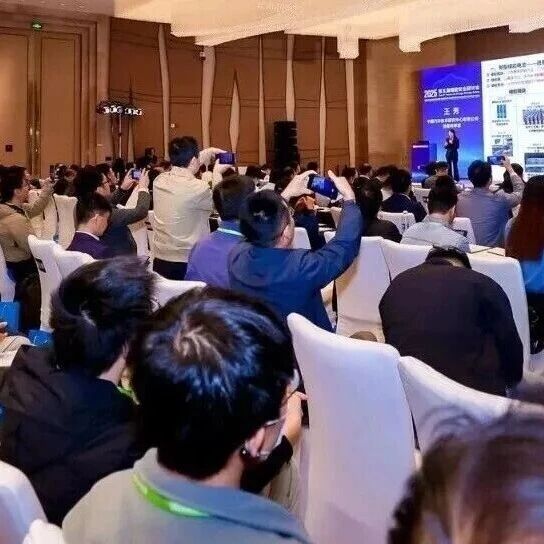
第五届储能安全研讨会暨国家重点研发计划项目研讨会成功举办
中关村储能产业技术联盟· 2025-10-17 03:58
Core Viewpoint - The forum emphasizes the critical importance of safety in the energy storage industry, highlighting the need for a comprehensive safety evaluation system and collaborative efforts across various sectors to mitigate risks associated with lithium-ion battery storage [9][11][37]. Group 1: Event Overview - The fifth Energy Storage Safety Forum and the National Key R&D Program project meeting were held in Tianjin, attracting over 600 participants and more than 40,000 online viewers [2]. - The event was co-hosted by several organizations, including the Zhongguancun Energy Storage Industry Technology Alliance and the Tianjin Fire Research Institute [3][5]. Group 2: Key Presentations - Professor Zhang Laibin discussed the advantages and challenges of using deep underground space for physical energy storage, emphasizing the importance of addressing safety issues for better development [15]. - Professor Sun Jinhua presented a systematic solution for fire safety in electrochemical energy storage, advocating for a three-tiered safety approach [16]. - Professor Xie Jia highlighted the significant energy contained in a 20-foot 314Ah energy storage container, equating it to 24 tons of TNT, and stressed the need for effective thermal runaway prevention strategies [19]. - Professor Chen Haosen introduced AI technologies for enhancing battery safety, focusing on real-time monitoring and predictive maintenance [20]. Group 3: Safety Evaluation and Guidelines - The Tianjin Fire Research Institute has developed a comprehensive safety evaluation system for lithium-ion battery storage, covering all levels from individual cells to entire power stations [23]. - The release of the "Self-Regulation Practice Guide" marks a significant milestone for the industry, providing normative guidance for containerized lithium battery storage systems [27][30]. Group 4: Forum Discussions - The forum included three parallel sub-forums focusing on safety technology innovations, fault diagnosis, and AI applications in energy storage safety [31][33][34]. - Experts shared insights on enhancing system reliability through advanced management techniques and the integration of AI for predictive safety measures [33][34]. Group 5: Conclusion and Future Outlook - The forum underscored the consensus that safety is the foundation for the scalable development of the energy storage industry, emphasizing the need to establish robust safety standards to maximize the sector's value in energy transition [37].
储能发展如何系好“安全带”?行业首部系统安全底线自律实践规范发布
Xin Lang Cai Jing· 2025-10-16 13:58
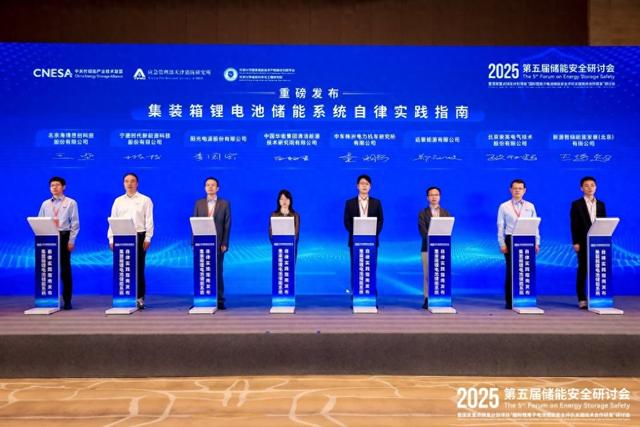
Core Viewpoint - The rapid development of lithium-ion battery technology in energy storage raises critical safety concerns that the industry must address [1][3]. Group 1: Release of Guidelines - The "Self-Regulatory Practice Guidelines" for container lithium battery energy storage systems was released at the fifth Energy Storage Safety Seminar in Tianjin on October 16 [1][3]. - This document, initiated by the Zhongguancun Energy Storage Industry Technology Alliance and 25 leading companies, is the first normative guidance for the industry [1][3]. Group 2: Objectives of the Guidelines - The guidelines aim to promote technological iteration and safety performance upgrades in energy storage products, shifting the industry focus from price competition to safety and value creation [3]. - Core principles outlined in the guidelines include "safety first, controllable risks, green and low-carbon, compatibility, and traceable quality" [3]. Group 3: Safety Concerns - As of May this year, there have been 167 reported incidents of fires and explosions in energy storage systems globally, highlighting significant safety risks [4]. - Increased frequency of energy storage system usage poses greater safety challenges for energy storage stations [4]. Group 4: Market Dynamics - The average price of energy storage systems has dropped by approximately 80% over the past three years, with some recent bids falling below 0.4 yuan/Wh, which deviates significantly from costs [5]. - The industry is experiencing chaotic expansion, with over 300,000 registered energy storage companies, leading to a potential market shakeout where many companies may be eliminated [5]. Group 5: Emphasis on Safety - Safety is emphasized as the foundation for the development of energy storage; any safety incidents could undermine investment logic and public trust in the industry [5].

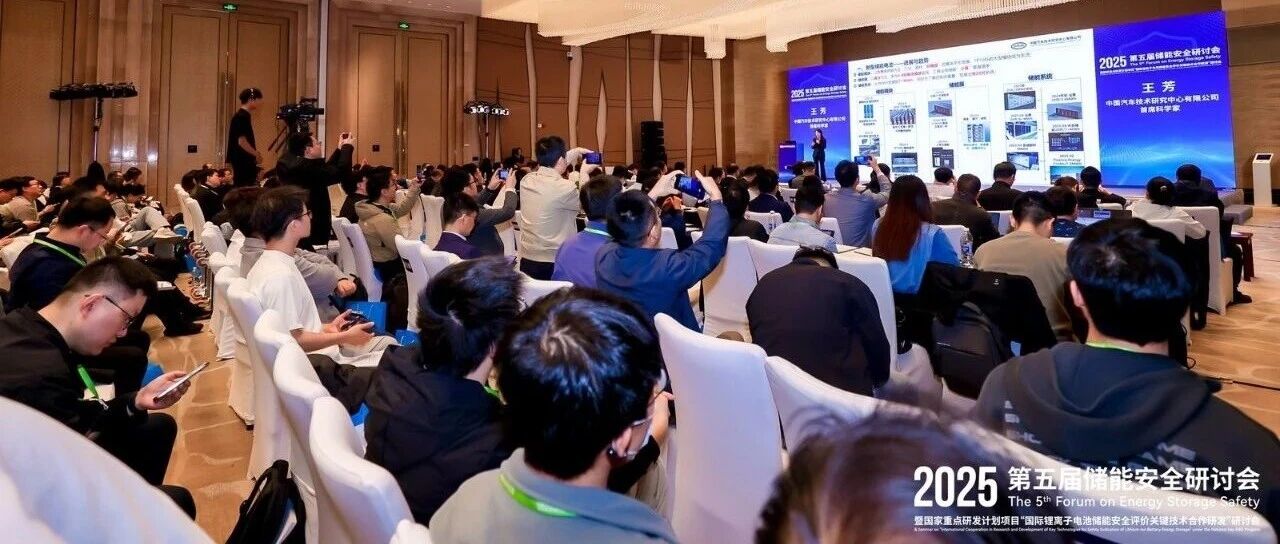
第五届储能安全研讨会暨国家重点研发计划项目研讨会隆重开幕
中关村储能产业技术联盟· 2025-10-16 12:17
Core Viewpoint - The forum emphasizes the critical importance of safety in the energy storage industry, highlighting the need for a comprehensive safety evaluation system and collaborative efforts across various sectors to mitigate risks associated with lithium-ion battery storage [7][10][20]. Event Overview - The fifth Energy Storage Safety Forum was held in Tianjin, gathering over 600 participants and attracting more than 40,000 online viewers, marking a significant event for the industry [2][3]. - The forum was co-hosted by several key organizations, including the Zhongguancun Energy Storage Industry Technology Alliance and the Tianjin Fire Research Institute [2][3]. Keynote Addresses - Li Bin, Vice President of Tianjin University, stressed that electrochemical energy storage is essential for the stability of new power systems, but safety incidents have raised systemic risks [7]. - Chen Haisheng, Chairman of the Zhongguancun Energy Storage Industry Technology Alliance, noted that safety is the lifeline for the sustainable development of the energy storage industry, with increasing global safety incidents prompting the need for a robust safety framework [10]. Expert Insights - Academics presented various safety technologies and challenges, including Zhang Laibin's discussion on the advantages and risks of using deep underground spaces for energy storage [12]. - Sun Jinhua proposed a three-tiered safety solution for electrochemical storage, focusing on intrinsic safety, process safety, and fire safety [14]. - Xie Jia highlighted the significant energy contained in storage systems, emphasizing the need for effective thermal runaway prevention strategies [16]. Safety Evaluation Framework - Li Jin from the Tianjin Fire Research Institute introduced a comprehensive safety evaluation system for lithium-ion battery storage, covering all levels from individual cells to entire power stations [20]. - Wang Fang emphasized the necessity of a systematic safety evaluation framework that encompasses all application scenarios and lifecycle stages of energy storage batteries [22]. Industry Guidelines - The forum saw the release of the "Self-Discipline Practice Guidelines" for container lithium battery storage systems, marking a milestone in industry self-regulation [24]. Parallel Forums - Three parallel sub-forums addressed specific topics: safety technology innovations, fault diagnosis and operational safety, and AI empowerment in energy storage safety, fostering in-depth discussions among experts [25][26][27]. Conclusion - The forum underscored the consensus that safety is foundational for the scalable development of the energy storage industry, with a collective commitment to establishing robust safety standards and practices [28].
《集装箱锂电池储能系统自律实践指南》发布
Zheng Quan Ri Bao Zhi Sheng· 2025-10-16 10:13
Core Points - The "Self-Regulatory Practice Guidelines for Container Lithium Battery Energy Storage Systems" was released during the fifth Energy Storage Safety Seminar [1] - The guidelines were initiated by the Zhongguancun Energy Storage Industry Technology Alliance and involve 25 leading companies in the industry [1] - The guidelines emphasize "safety first, controllable risks, green and low-carbon, compatibility and interoperability, and traceable quality" as core principles for future energy storage system design [1] Summary by Categories Guidelines Overview - The guidelines serve as a normative guidance document for container lithium battery energy storage systems [1] - They set baseline requirements for system parameters, key subsystems, and components [1] Industry Concerns Addressed - The guidelines provide recommendations on large-scale fire tests, fire-fighting effectiveness assessments, system reliability evaluations, information security, battery thermal management, and maintainability [1] Next Steps - The Zhongguancun Energy Storage Industry Technology Alliance will publicly display the guidelines on its website for two weeks, ending on October 31 [1] - After the public display period, the alliance will organize discussions with relevant companies and experts to finalize and officially release the guidelines [1]
重申安全底线,储能行业《自律实践指南》发布
Xin Jing Bao· 2025-10-16 09:37
Core Points - The "Self-Regulatory Practice Guidelines for Container Lithium Battery Energy Storage Systems" has been officially released, marking the first normative guidance document for the industry [1] - The guidelines aim to address product quality risks arising from intensified market competition and to prevent safety hazards such as thermal runaway and explosions due to low-price disorderly competition [1] - The guidelines are applicable to energy storage systems in power supply, grid-side, and commercial and industrial user sectors, specifically for prefabricated, containerized, or cabinet-style lithium battery energy storage systems [1] Summary by Sections - **Guideline Objectives** - The primary intention of the guidelines is to enhance safety and quality in the energy storage sector [1] - The guidelines emphasize "safety first, controllable risks, green and low-carbon, compatibility and interoperability, and traceable quality" as core principles for future energy storage system design [1] - **Key Recommendations** - The guidelines provide baseline requirements for system parameters, key subsystems, and components [1] - Recommendations include large-scale fire testing, fire effectiveness assessment, system reliability evaluation, information security, battery thermal management, and ease of maintenance [1] - **Regulatory Context** - In May, the National Energy Administration and other departments issued a notice to strengthen safety management in electrochemical energy storage, focusing on enhancing the inherent safety of battery systems and improving standards and regulations [2]
首份针对集装箱锂电池储能系统的规范性指导文件发布
Xin Lang Cai Jing· 2025-10-16 08:37
Core Insights - The document is the first normative guidance for container lithium battery energy storage systems initiated by the Zhongguancun Energy Storage Industry Technology Alliance and 25 leading enterprises in the industry [1] Group 1 - The guidance document represents the industry's first systematic practice standard that transforms consensus into actionable guidelines [1]
储能行业《自律实践指南》重磅发布!行业首部储能系统安全底线自律实践规范
中关村储能产业技术联盟· 2025-10-16 06:46
Core Viewpoint - The release of the "Self-Regulatory Practice Guidelines for Container Lithium Battery Energy Storage" marks a significant milestone for the future development of the energy storage industry, aiming to enhance safety and promote sustainable growth [2][5]. Summary by Sections Industry Guidelines - The "Self-Regulatory Practice Guidelines" is the first normative guidance document specifically for container lithium battery energy storage systems, developed by the Zhongguancun Energy Storage Industry Technology Alliance in collaboration with 25 leading enterprises [2][5]. - The guidelines emphasize core principles such as "safety first, risk controllable, green and low carbon, compatibility and interoperability, and quality traceability" for future energy storage system designs [5]. Safety and Performance - The guidelines set baseline requirements for system parameters, key subsystems, and components, addressing industry concerns regarding large-scale fire tests, fire effectiveness assessments, system reliability evaluations, information security, battery thermal management, and maintainability [5]. - Recommendations are provided for the production quality management of energy storage system integration and battery manufacturing [5]. Industry Collaboration - The guidelines will be promoted to energy storage users to become a widely recognized best practice within the industry, contributing to the healthy and sustainable development of the energy storage sector [5]. - The Zhongguancun Energy Storage Industry Technology Alliance will publicly display the guidelines for two weeks, inviting more industry chain enterprises to participate in the development process [5]. Event Support - The fifth Energy Storage Safety Seminar was organized by the Zhongguancun Energy Storage Industry Technology Alliance, with support from various institutions, including the Tianjin Fire Research Institute and Tianjin University [6].