
零跑D19增程版

Search documents
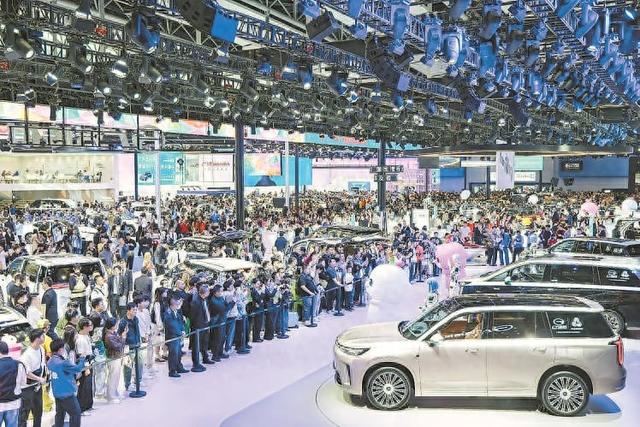
从广州车展看2026年车市动向:合资车用上“中国脑”
Bei Jing Ri Bao Ke Hu Duan· 2025-11-25 22:45
Core Insights - The 2025 Guangzhou International Auto Show showcases 93 new car models and 629 new energy vehicles, highlighting the industry's shift towards electrification and intelligence [1][3] - In October, new energy vehicles accounted for over 50% of total car sales for the first time, indicating a significant market trend [3] - The event emphasizes advancements in L3-level autonomous driving and next-generation battery technologies, which are seen as key areas for technological breakthroughs [4][5] New Energy Vehicles - Out of 1,085 vehicles displayed, 629 are new energy models, making up 58% of the total [3] - Notable new energy models include Xiaopeng's X9 Super Extended Range version priced at 309,800 yuan and Leap Motor's D19 Extended Range version with a 500 km pure electric range [3] - The market is witnessing a diversification in demand, with extended range vehicles addressing range anxiety while pure electric vehicles offer lower operating costs [3] Technological Advancements - Huawei's booth was one of the most popular, showcasing its smart driving solutions, including L3-level autonomous driving tests in seven major cities [4] - GAC Group's flagship model, the A800, has begun L3-level highway testing at speeds of 120 km/h, marking a significant milestone in autonomous vehicle testing [4] Battery Technology - SAIC MG introduced the MG4 model featuring semi-solid-state batteries, set for delivery in December [5] - GAC Group announced the production of a pilot line for solid-state batteries, aiming for small-scale trials by 2026 and mass production by 2027-2030 [5] Market Dynamics - Several luxury brands, including Beijing Hyundai and Lamborghini, were absent from the show, indicating a potential decline in competitiveness in the Chinese market [5] - Joint ventures between foreign brands and Chinese tech companies are emerging, with Volkswagen and Xiaopeng collaborating on a new electric SUV featuring L2-level assisted driving [5][6] Collaborations and Innovations - Audi launched the A5L with Huawei's smart driving technology, while BMW and Mercedes are partnering with Chinese tech firms to enhance their models with localized smart features [6] - These collaborations aim to shorten development cycles and quickly adapt to market changes, reflecting a strategic shift among joint venture brands [6]

纯电、增程和插混,哪种动力形式才是未来?
2 1 Shi Ji Jing Ji Bao Dao· 2025-11-21 00:37
Core Insights - The Chinese automotive industry is undergoing a transformation with a significant shift towards electric vehicles, particularly pure electric models, which have reached a retail penetration rate of 57.2% in October [1] - The sales share of range-extended electric vehicles has declined for five consecutive months, now accounting for only 26%, while pure electric vehicles have surged to a 74% share [1][3] - Industry leaders agree that pure electric vehicles are the future, but hybrid and range-extended vehicles will continue to coexist as complementary solutions [2][4] Market Trends - In October, retail sales of range-extended vehicles saw a year-on-year decline of 7.7%, with wholesale sales reaching 121,000 units, down 1.9% year-on-year [1] - The market is characterized by a strong preference for pure electric vehicles, with companies like Leap Motor reporting that 80% of their sales come from pure electric models [2][12] - The discussion among industry leaders highlights the need for different power solutions based on user scenarios, with a consensus that electric vehicles will dominate the market [2][5] Consumer Preferences - Consumers generally favor larger battery capacities for better driving experiences, but the complexity of vehicle usage scenarios necessitates a variety of power solutions [5][9] - The choice between pure electric, hybrid, and range-extended vehicles often depends on individual user needs, such as daily commuting versus long-distance travel [8][10] - The industry recognizes that while pure electric vehicles are becoming more popular, hybrid and range-extended options still play a crucial role in addressing consumer concerns about range anxiety [17][18] Technological Considerations - The trend towards larger batteries raises concerns about vehicle weight and complexity, which can impact performance and user experience [5][6] - Industry experts emphasize the importance of tailoring battery sizes and vehicle designs to meet specific user demands and driving conditions [6][10] - The development of smaller engines and range extenders is seen as a way to reduce costs and improve vehicle efficiency while still meeting diverse consumer needs [16][18] Future Outlook - The consensus among industry leaders is that the future will be dominated by electric vehicles, but hybrid and range-extended technologies will remain relevant until infrastructure and technology fully address current limitations [17][19] - Companies are exploring international markets where charging infrastructure may be less developed, suggesting that hybrid and range-extended vehicles could serve as viable solutions in those regions [18][19] - The ongoing evolution of battery technology and charging infrastructure is expected to further enhance the appeal of pure electric vehicles in the coming years [15][16]