
非现场执法系统

Search documents
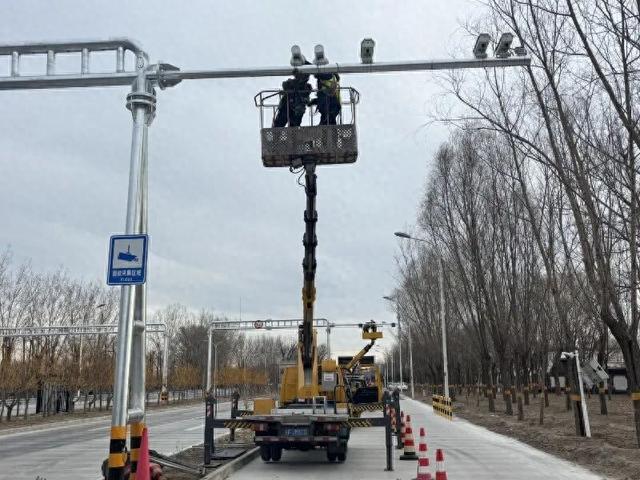
北京全市跨度最大的非现场治超执法点位,将于本月投入使用
Xin Lang Cai Jing· 2026-01-10 04:05
Core Viewpoint - The article emphasizes the significant dangers posed by overloading and over-limit transportation, highlighting the implementation of a new non-site remote supervision model characterized by "full coverage, full chain, and intelligence" by the Beijing Municipal Transportation Committee's Changping Highway Branch [1] Group 1: Technology Implementation - The Changping Highway Branch is deploying a non-site law enforcement system that integrates illegal capture and video monitoring equipment with dynamic weighing detection and information dissemination, creating a 24/7 "electronic eye" surveillance network [3] - Five non-site supervision points have been established on major roads including Jingqing Line, Ansi Road, Changjin Road, Changchi Road, and Qinbei Road, with a new point on Sayang Road expected to begin trial operation by the end of January [3] Group 2: Smart Traffic Management - The Changping Highway Branch is incorporating smart monitoring and "AI sentinels" on both sides of Sayang Road to provide continuous remote supervision and to automatically identify common safety hazards such as workers not wearing helmets or safety vests [5] - The branch plans to continue leveraging technological innovation as a key point in urban traffic governance, aiming to create a hub for innovation in highway construction, management, and maintenance to support high-quality transportation development in the capital [5]

推广非现场执法,这些“欠账”补起来!
Zhong Guo Huan Jing Bao· 2025-05-23 05:38
Core Viewpoint - The article emphasizes the increasing adoption of non-site law enforcement in ecological environment regulation, highlighting its advantages over traditional enforcement methods and the need for improvements in infrastructure and personnel training to maximize its effectiveness [1][2]. Group 1: Advantages of Non-Site Law Enforcement - Non-site law enforcement significantly enhances regulatory coverage, allowing limited enforcement resources to achieve greater effectiveness [1]. - It utilizes technology to secure evidence, reducing human intervention and minimizing arbitrary enforcement issues [1]. - The approach enables real-time monitoring of corporate emissions and data analysis to predict environmental risks, facilitating a shift towards more precise and intelligent ecological governance [1]. Group 2: Challenges and Recommendations - Current challenges include insufficient monitoring equipment coverage, weak data system support, and inadequate capabilities of enforcement personnel [1]. - Recommendations include expanding monitoring network coverage and enhancing the intelligence level of online monitoring systems, ensuring high-quality standards in equipment procurement and installation [2]. - There is a call for the establishment of a reliable anti-cheating network to prevent companies from evading regulation through data manipulation [2].