
非货币性黄金

Search documents
特朗普意外收获大礼!美国贸易逆差骤降至五年新低 黄金出口暴涨成最大推手
Sou Hu Cai Jing· 2025-12-12 03:38
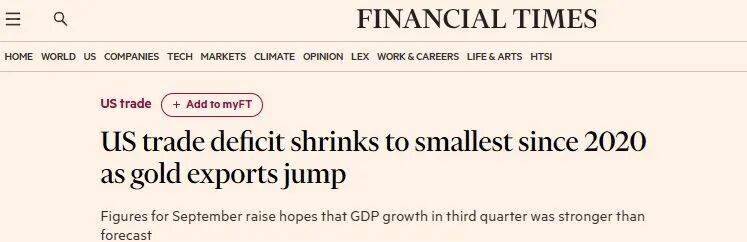
Core Viewpoint - The U.S. trade deficit narrowed in September more than expected, reaching its lowest level in over five years, which has raised market expectations for net exports to boost economic growth in the third quarter [1][3]. Group 1: Trade Data - The trade deficit decreased by 11% from the previous month to $52.8 billion, marking the smallest deficit since June 2020 and lower than the $63.3 billion predicted by economists [3]. - Exports increased by 3% from August to $289.3 billion, primarily driven by non-monetary gold, while imports rose by 0.6% [3]. Group 2: Economic Growth Projections - The Atlanta Federal Reserve estimates that the actual GDP growth rate for the three months ending September 30 will reach 3.6%, an upward revision of 0.1 percentage points from its previous forecast [4]. - Economists surveyed by Reuters had anticipated a GDP growth rate of 3% for the same period [4]. Group 3: Expert Opinions - Capital Economics' North America Chief Economist Paul Ashworth noted that a significant portion of the $8.7 billion increase in exports in September was due to a $6.1 billion rise in non-monetary gold shipments, which does not contribute to GDP [5]. - Pantheon Macroeconomics' senior U.S. economist Oliver Allen expects the surge in gold bar exports to likely decline in the fourth quarter, suggesting that the decrease in the trade deficit does not indicate a substantial trend [5]. Group 4: Political Context - The White House stated that the recent trade data further demonstrates the effectiveness of President Trump's "America First" trade agenda aimed at reducing the trade deficit [6].

美国补发8月贸易数据 逆差大幅收窄至596亿美元 黄金进口暴跌
智通财经网· 2025-11-19 14:28
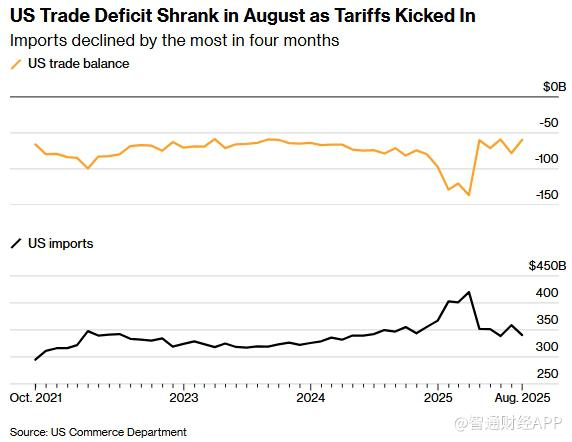
Core Insights - The latest data from the U.S. Department of Commerce indicates a significant narrowing of the trade deficit in August, attributed to a sharp decline in imports following the implementation of global tariffs announced by President Trump [1][3] - The trade deficit for goods and services decreased by nearly 24% from July, reaching $59.6 billion, which was better than the market expectation of $60.4 billion [1][3] Trade Data Summary - Total imports in August fell by 5.1%, marking the largest decline in four months, while exports saw a slight increase [3] - The previous month, July, experienced an expansion of the trade deficit due to businesses accelerating inventory purchases ahead of the implementation of tariffs [3] - The volatility in trade data is expected to impact economic indicators such as GDP, with the Atlanta Fed's GDPNow model indicating a 0.57 percentage point contribution from net exports to Q3 GDP [3] Import Dynamics - The primary reason for the decline in imports was a significant reduction in non-monetary gold imports, directly linked to increased tariffs on Swiss gold products [3] - The U.S. trade deficit with Switzerland has notably narrowed due to these tariff adjustments, and an agreement has been reached to lower gold import taxes [3] - Additionally, there was a decrease in imports of capital goods, including computer parts and communication equipment [3] Adjusted Trade Deficit - After inflation adjustment, the trade deficit for goods in August narrowed to $83.7 billion, the smallest since the end of 2023 [3] - The trade deficit with China expanded to its highest level since April, while the deficit with Mexico slightly decreased and the deficit with Canada significantly narrowed [3]
美国一季度经常账户赤字飙升至4502亿美元
news flash· 2025-06-24 13:02
Core Insights - The U.S. current account deficit surged to $450.2 billion in Q1, significantly higher than the revised $312 billion from the previous quarter, marking a record high [1] - The increase in the current account deficit is primarily attributed to a substantial rise in the trade deficit, driven by fluctuating trade policies and tariffs [1] Trade Data Summary - Exports rose by $21.1 billion to reach $539 billion, while imports skyrocketed by $158.2 billion to $1 trillion [1] - The surge in imports was mainly fueled by "non-monetary gold" and consumer goods, particularly pharmaceuticals and dental products [1] - The increase in gold imports blurred the lines between ordinary goods and investment products [1] - The growth in exports was largely driven by civil aircraft and computer-related products [1]