
风电资产

Search documents
四大证券报精华摘要:2月6日
Zhong Guo Jin Rong Xin Xi Wang· 2026-02-06 00:38
Group 1: Mechanical Industry - In 2025, the mechanical industry is expected to show a high-level slowdown with steady progress, achieving a growth rate of around 5.5% for the year [1] - The first quarter of 2025 had a good start, while the second quarter experienced a slowdown due to tariff fluctuations, but quickly stabilized [1] Group 2: Stock Market Trends - A-shares and Hong Kong stocks showed divergence, with Hong Kong's main index rising in the afternoon, particularly in the consumer sector [1] - Several public funds believe that Hong Kong stocks remain undervalued globally, with structural investment opportunities expected [1] Group 3: Autonomous Driving Industry - Waymo, a subsidiary of Alphabet, completed a financing round of over 100 billion yuan, marking a critical turning point for scaling autonomous driving [2] - Domestic leaders in autonomous driving, such as Xiaoma Zhixing and Wenyuan Zhixing, reported that their Robotaxi fleets have surpassed 1,000 vehicles, indicating a clearer path to profitability [2] Group 4: Cash Dividends in the Stock Market - Companies in the Shanghai market are actively distributing cash dividends, with nearly 20 companies set to distribute approximately 25.8 billion yuan before the 2026 Spring Festival [3] - The total cash dividends from Shanghai companies from December 2025 to before the 2026 Spring Festival are expected to exceed 347.6 billion yuan, a significant increase from the previous year's 300 billion yuan [3] Group 5: Fresh Food Instant Retail - Meituan announced the acquisition of Dingdong Maicai's China business for approximately 717 million USD, accelerating its layout in the instant retail sector [4] - This acquisition indicates a potential concentration of competition towards leading platforms in the industry [4] Group 6: Automotive Industry - In 2025, Chinese automakers are accelerating electrification, intelligence, and internationalization, with profit margins declining to the lowest in a decade [5] - The decline in profit margins is attributed to significant investments in R&D rather than industry recession, as companies focus on long-term assets [5] Group 7: Lithium Battery Industry - The lithium battery industry is gradually improving in supply and demand, leading to stabilized product prices and corporate profitability [6] - Over 70 A-share listed companies in the lithium battery sector have disclosed performance forecasts, with over 70% showing year-on-year profit growth [6] Group 8: Commercial Aerospace - Tianbing Technology's satellite launch facility has passed pre-acceptance review, marking a significant step in China's commercial aerospace sector [7] - The facility represents a transition from technology validation to engineering application, indicating a potential explosive growth period for the industry [7] Group 9: Capital Raising in Battery Manufacturing - Guoxuan High-Tech plans to raise no more than 5 billion yuan through a private placement to fund battery projects and supplement working capital [8] - This move is seen as a critical step for Guoxuan High-Tech to expand production capacity amid the high growth cycle of the global new energy vehicle and energy storage markets [8]



重大转型突破!中国华能一上市公司完成重组
中国能源报· 2026-02-05 10:49
Core Viewpoint - The successful completion of the merger and acquisition project by Inner Mongolia Huadian, a listed company under China Huaneng Group, marks a significant transformation and improvement in the quality and core competitiveness of the company's listed entities [1]. Group 1: Merger and Acquisition Details - Inner Mongolia Huadian issued 536 million shares at a price of 4.94 yuan per share, raising a total of 2.65 billion yuan for the acquisition [1]. - The project involved acquiring controlling rights to high-quality wind power assets with a total installed capacity of 1.6 million kilowatts from the controlling shareholder, Northern Company, for a price of 5.336 billion yuan [1]. Group 2: Market Performance and Investor Sentiment - The issuance price of 4.94 yuan per share represents a premium of nearly 7% compared to the 20-day average price prior to the issuance and a premium of nearly 4% compared to the closing price on the trading day before the issuance [1]. - This project is noted as the only instance in recent years within the power industry to achieve a market-based premium issuance, setting a best practice case for targeted placements among listed companies in the power sector [1]. - The successful fundraising reflects strong recognition of the Huaneng brand value by market investors, showcasing the company's excellent governance [1].


募集权益资金26.5亿元 内蒙华电完成并购重组项目
Zhong Guo Jing Ji Wang· 2026-02-05 04:07
Core Viewpoint - Inner Mongolia Huadian, a listed company under China Huaneng Group, successfully completed a merger and acquisition project by issuing 536 million shares at a price of 4.94 yuan per share, raising a total of 2.65 billion yuan in equity funds [1] Group 1: Financial Details - The project involved acquiring controlling rights of high-quality wind power assets with a total installed capacity of 1.6 million kilowatts from the controlling shareholder, Northern Company, for a price of 5.336 billion yuan [1] - The issuance price of 4.94 yuan per share represents a premium of nearly 7% compared to the average price over the previous 20 trading days and a premium of nearly 4% compared to the closing price on the trading day before the issuance [1] Group 2: Industry Impact - This case sets an excellent practice example for targeted issuance in the power industry among listed companies [1]
超151亿元资金“抢筹”,仅四家入围!600863,定增落地
Shang Hai Zheng Quan Bao· 2026-02-04 15:40
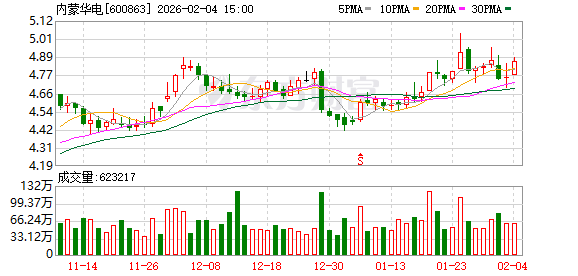
Core Viewpoint - Inner Mongolia Huadian, a listed company under China Huaneng, successfully completed a private placement raising 2.65 billion yuan at a price of 4.94 yuan per share, attracting over 15.1 billion yuan in subscriptions, indicating strong institutional interest in the company's asset quality and transformation prospects [2][5]. Group 1: Fundraising Details - The private placement had a subscription multiple of over 5.72 times, with 44 institutional investors participating, including notable entities like UBS AG and China National Investment Fund [5][6]. - The four successful subscription entities were: - China Everbright Financial Asset Investment Co., Ltd. (30 million yuan) - Hubei Cultural Tourism Capital Holdings Co., Ltd. (10 million yuan) - CCB Financial Asset Investment Co., Ltd. (100 million yuan) - Shandong High-speed (Shenzhen) Investment Co., Ltd. (1.25 billion yuan) [6]. Group 2: Asset Acquisition and Strategic Importance - The fundraising is part of a strategy to acquire high-quality wind power assets with a total installed capacity of 1.6 million kilowatts from Northern Power, enhancing the company's renewable energy portfolio [5][8]. - Following the acquisition, the company's total installed capacity is expected to reach approximately 5.5 million kilowatts, with the proportion of renewable energy increasing by 8 percentage points to over 23% [8][10]. Group 3: Financial and Operational Implications - The newly acquired wind power assets are anticipated to provide stable cash flow and enhance the company's resilience against coal price fluctuations, thereby improving operational stability [10]. - The company has committed to a cash dividend policy of no less than 70% from 2025 to 2027, reflecting a focus on shareholder returns [10].
石油巨头难舍化石能源项目
Zhong Guo Hua Gong Bao· 2025-08-18 03:36
Core Viewpoint - The oil industry is undergoing a strategic shift from aggressive production growth to a focus on capital efficiency and shareholder returns, while still pursuing resource extraction behind the scenes [2][5]. Group 1: Strategic Shifts in Oil Companies - Major oil companies like BP and Shell are publicly committing to gradually reduce oil production over the coming decades, while U.S. firms like ExxonMobil and Chevron are emphasizing shareholder returns rather than aggressive expansion [2][3]. - Despite the narrative of "managed decline," companies are actively seeking to maximize the value of existing resources, with ExxonMobil consolidating assets in the Permian Basin and Chevron acquiring Hess to secure low-cost, long-lifecycle oil resources [2][3]. Group 2: Investment in Fossil Fuels vs. Renewables - Oil giants are advancing deepwater projects in Guyana, Brazil, and the Gulf of Mexico, which remain competitive despite stabilizing costs, and are expanding LNG investments, anticipating strong demand through at least 2040 [3]. - While companies are investing in renewable energy projects, these initiatives are often seen as diversification rather than core business, with higher return thresholds compared to oil and gas projects delaying capital reallocation [3][4]. Group 3: Human Resources and Industry Capabilities - The oil industry possesses a vast pool of skilled professionals capable of delivering large-scale projects, which could be leveraged for low-carbon technology development, but current focus remains on extending oil field life and optimizing refinery profits [4][5]. - The industry's cautious approach to transitioning to renewables is understandable from a short-term commercial perspective, but it risks losing competitive advantage if companies wait for clearer market signals before acting [4][5]. Group 4: Future Opportunities and Challenges - Oil companies have unique advantages for leading a pragmatic energy transition, including global reach, project reserves, and experience in managing complex supply chains [5]. - The balance between managing decline and preparing for the future is currently skewed towards maintaining the status quo, which could hinder growth opportunities that lie within the energy transition [5].