食品安全责任保险

Search documents
守护“舌尖上的安全” 保险如何“叫好又叫座”
Jin Rong Shi Bao· 2025-12-10 02:03
Core Viewpoint - The article discusses the development of food safety liability insurance in China, highlighting the transition from optional to necessary risk management tools as the government encourages participation and integrates it into the national food safety emergency response system [1][4]. Group 1: Government Initiatives - The State Administration for Market Regulation has initiated the revision of the National Food Safety Incident Emergency Plan, incorporating the establishment of a food safety liability insurance system into the emergency response chain [1][4]. - The revision aims to promote a multi-governance model for food safety, shifting from single regulation to a combination of regulation and market assurance [1][4]. Group 2: Industry Response - The food safety liability insurance (referred to as "food safety insurance") is expected to evolve from an optional tool to a necessary risk management tool, compelling insurance companies to develop customized products for small and micro enterprises and new business models [1][4]. - The insurance typically covers economic compensation for third-party injuries or losses due to food contamination or quality defects, which the insured enterprise is legally responsible for [3]. Group 3: Market Challenges - Despite the government's encouragement, the current uptake of food safety insurance remains low, with significant gaps in market coverage, particularly among small and micro enterprises [8]. - Key challenges include insufficient risk awareness among enterprises, lack of historical loss data for accurate pricing, short service chains focusing on post-incident compensation, and inadequate inter-departmental collaboration [8][9]. Group 4: Innovative Practices - Various regions have developed distinctive food safety insurance promotion models, including customized products for popular consumption scenarios and comprehensive solutions covering all business types [6][7]. - For instance, Ningbo has implemented a multi-faceted guarantee model for food safety insurance, achieving full coverage with a total premium of 222 million yuan and a total insured amount of 117.91 billion yuan [6]. Group 5: Future Directions - To activate the market potential of food safety insurance, insurance companies are encouraged to enhance their professional service capabilities and utilize technology such as IoT and blockchain for risk tracking and database construction [9][10]. - There is a need for insurance products to be tailored to the specific risks associated with new business models like food delivery and live streaming, ensuring comprehensive coverage throughout the food supply chain [10].
同频共振数十载 中国平安与深圳特区的时代交响
Shen Zhen Shang Bao· 2025-08-25 22:53
Core Insights - The establishment of the Shenzhen Special Economic Zone in August 1980 marked the beginning of a transformative journey for both Shenzhen and China Ping An, which evolved from a small property insurance company to a global financial giant with assets exceeding 13 trillion yuan and nearly 245 million customers [2][4] - China Ping An's growth trajectory is closely intertwined with Shenzhen's development, showcasing a narrative of reform, innovation, and breakthroughs [3][4] Group 1: Historical Development - China Ping An was founded in 1988 in Shekou, becoming China's first joint-stock insurance company and pioneering several industry innovations [4][5] - Shenzhen's GDP grew from 2.7 million yuan in 1980 to 180.4 billion yuan in 1999, reflecting the rapid economic development of the region [4] - In the new millennium, China Ping An transitioned from an insurance company to a comprehensive financial group, aligning with Shenzhen's goal of becoming a regional financial center [4][5] Group 2: Strategic Innovations - China Ping An's comprehensive financial strategy received strong support from Shenzhen's government, contributing to its successful IPO in 2007, which set a record for the largest insurance company IPO globally [5] - The company has invested over 100 billion yuan in technology research and development, applying for more than 55,000 technology patents, positioning itself among the leading financial institutions globally [5][6] Group 3: Financial Services and Initiatives - China Ping An is actively involved in various financial sectors, including technology finance, green finance, inclusive finance, pension finance, and digital finance, responding to national mandates for sustainable development [6][9][13][15] - The company has developed a comprehensive technology finance service system for tech enterprises, supporting Shenzhen's ambition to become a global innovation hub [8][9] Group 4: Future Outlook - As Shenzhen celebrates its 45th anniversary, China Ping An continues to play a significant role in the region's economic development, embodying the spirit of innovation and reform [16][17] - The company aims to leverage its financial capabilities to support national strategies and contribute to the modernization of China [17]



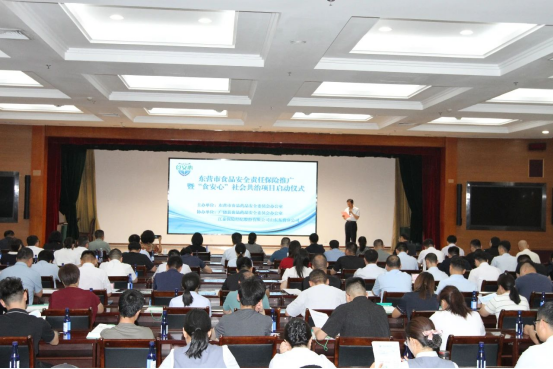
东营多方联手构建“食安心”社会共治项目:守护“舌尖上的安全”
Qi Lu Wan Bao· 2025-06-30 04:47
Core Viewpoint - The "Food Safety Responsibility Insurance Promotion and 'Food Assurance' Social Co-Governance Project" aims to enhance food safety risk management through collaboration among various departments and resources, ensuring the safety of food for the public [1][3][13] Group 1: Project Overview - The project involves multiple stakeholders, including food safety offices, market regulation bureaus, financial regulatory bodies, insurance associations, and culinary associations, to discuss and promote food safety [1][4] - The initiative is described as a significant exploration in social governance for food safety, integrating insurance, finance, communication, and industry associations to create a new co-governance model [3][10] Group 2: Insurance Features - The "Food Assurance" project offers four insurance plans with low premiums and high coverage, addressing food safety responsibilities, property damage, third-party compensation, and loss of business profits during closure [4][8] - The project aims to simplify the insurance process, enhance claims efficiency, and provide comprehensive risk management services, including risk assessment and training for insured enterprises [8][12] Group 3: Stakeholder Roles - The project is supported by various financial and communication institutions that will provide innovative services and policy support to ensure the project's success [12] - Industry associations are encouraged to act as a bridge, promoting participation among food enterprises, especially small and medium-sized businesses, in the insurance program [10][12] Group 4: Implementation Strategy - The East Ying City Food and Drug Safety Office, Market Regulation Bureau, and Financial Regulatory Bureau have issued a plan to ensure the project's effective implementation, focusing on coordination, risk management, and service improvement [12][13] - The project will follow a principle of "government guidance, market operation, multi-party participation, and step-by-step advancement" to enhance food safety incident prevention and response [13]