骁龙8 Gen2

Search documents
手机AI愈发重要,可为何厂商不再宣传NPU算力
3 6 Ke· 2025-12-01 02:42
Group 1 - The smartphone industry is increasingly emphasizing "AI" as a key selling point, with major brands claiming to have developed their own AI models and performance optimization solutions for various applications [1][3] - Chip manufacturers are also showcasing improvements in NPU architecture and energy efficiency, often in conjunction with AI model demonstrations during new SoC launches [3][8] - Historically, manufacturers provided specific performance metrics for NPUs, allowing consumers to easily compare different brands and generations of SoCs [5][6] Group 2 - Qualcomm's Snapdragon series initially disclosed NPU performance metrics, with the Snapdragon 855 featuring 7 TOPs, and subsequent models showing significant increases up to 52 TOPs for the Snapdragon 8 Gen1 [10] - However, Qualcomm stopped disclosing NPU performance numbers after the Snapdragon 8 Gen1, indicating a potential slowdown in performance improvement, with the latest Snapdragon 8 Gen3 reportedly achieving 100 TOPs [10][12] - Other chip manufacturers may face even greater challenges in NPU performance, leading to a general trend of not disclosing NPU performance metrics across the industry [11] Group 3 - The slowdown in NPU performance improvement is attributed to rising semiconductor design costs and the need to allocate power to new CPU and GPU architectures, making it difficult to maintain previous performance doubling trends [15][17] - The nature of AI tasks has evolved from primarily computational vision to more complex content generation, requiring NPUs to adapt their design and focus on energy efficiency for prolonged use [20][21] - Current NPU designs are expected to continue improving, but the approach will differ from past strategies that relied solely on scaling and frequency increases [21][23] Group 4 - Companies are exploring ways to enhance NPU performance through software optimizations and collaborations with AI model developers, as seen in Samsung's partnership with Nota AI to improve the Exynos 2500's NPU performance [25]


小米自研芯片杀疯了!雷军憋了10年的大招,直接对标苹果华为?
Sou Hu Cai Jing· 2025-05-23 01:23
Core Insights - Xiaomi has announced the launch of its self-developed mobile chip "Xuanjie O1" during its 15th anniversary event, marking a significant milestone in its technology capabilities [1][14] - The chip positions Xiaomi as the fourth global and second domestic brand to master mobile SoC core technology, directly competing with Apple's A-series, Huawei's Kirin, and Samsung's Exynos [1][14] Development Journey - Xiaomi's chip development began in September 2014 with the establishment of Pinecone Electronics, initially perceived as a marketing attempt [4] - Despite early setbacks with the Surge S1 chip, Xiaomi invested 8 billion yuan in 2023 alone, totaling 30 billion yuan over ten years, leading to significant breakthroughs in chip technology [4] Technical Specifications - The Xuanjie O1 chip, designed by Qin Muyun, features a 4nm process from TSMC, with a performance score reaching 2 million, surpassing Snapdragon 8 Gen3 [6] - It includes a powerful architecture with one 3.2GHz super core, three 2.8GHz middle cores, and four efficiency cores, along with an advanced GPU supporting ray tracing technology [6][8] AI Capabilities - The chip integrates Xiaomi's self-developed NPU "Kunlun," capable of processing 15 trillion operations per second, significantly enhancing AI performance in photography [8] - The AI algorithms reportedly reduce noise in night photography to half the level of the iPhone 15 Pro [8] Market Positioning - The first device featuring the Xuanjie O1, the Xiaomi 15S Pro, is priced at 5,299 yuan, significantly lower than Huawei's Mate60 Pro, indicating Xiaomi's strategy to penetrate the mid-to-high-end market [8][14] - Xiaomi aims to make top-tier technology accessible to the general public, contrasting with the luxury positioning of competitors [8][14] Product Features - The Xiaomi 15S Pro boasts impressive specifications, including a 2K full-depth micro-curved screen, Leica triple-camera system, and a 6000mAh silicon-carbon battery [8] - The device also features UWB technology for seamless integration with Xiaomi's ecosystem, allowing for automatic unlocking of vehicles [14] Challenges Ahead - Industry experts have noted potential challenges, including limited initial chip production capacity and software compatibility issues, which Xiaomi is actively addressing [12][14] - The company is working on optimizing compatibility for popular games to ensure a smooth user experience [12]

雷军晚间突然官宣:小米自研手机处理器玄戒O1亮相!
Sou Hu Cai Jing· 2025-05-15 16:58
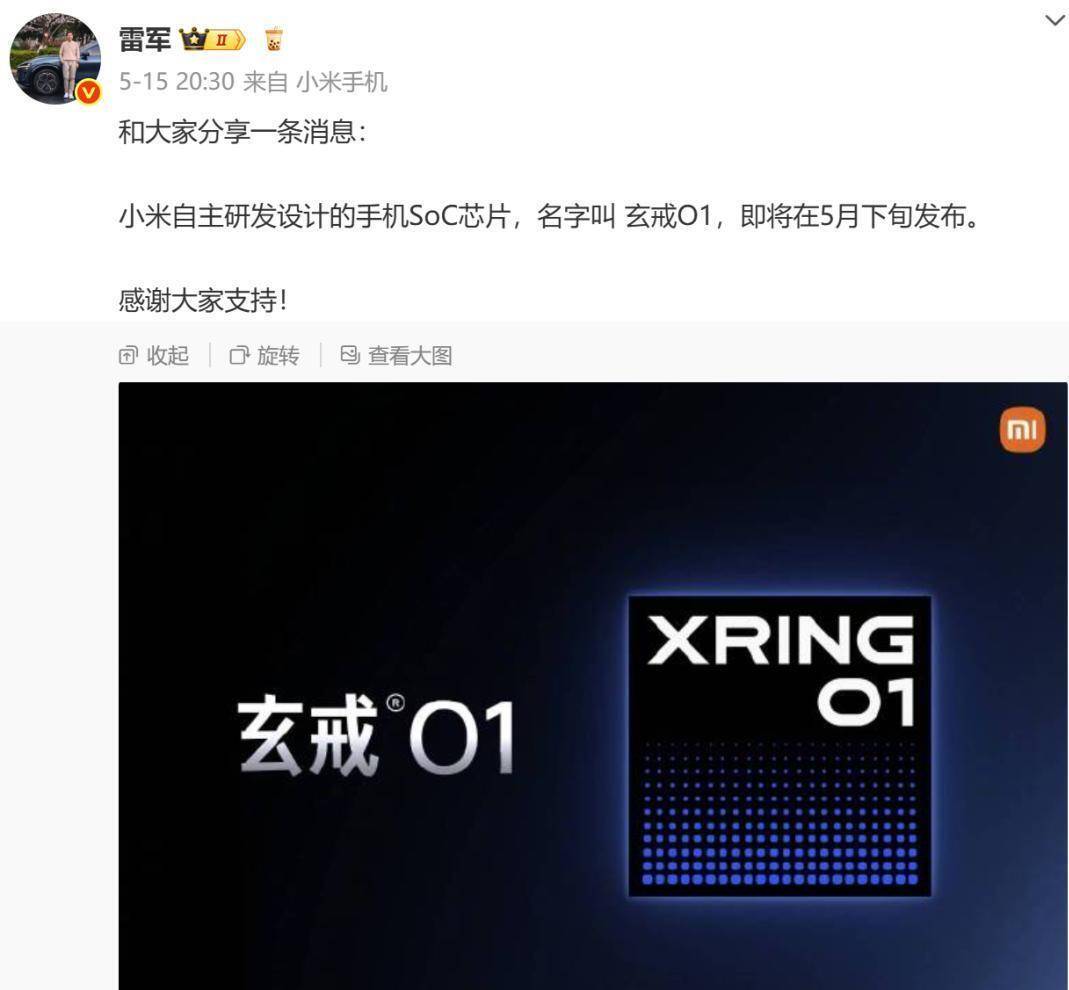
Group 1 - Xiaomi has regained its position as the number one smartphone brand in China in the first quarter of this year, launching the Redmi Turbo 4 Pro with the Snapdragon 8s Gen4 processor and a large 7660mAh battery at a price of 1699 yuan [1] - The company is also set to release the Civi 5 Pro, which will feature the same Snapdragon 8s Gen4 processor, indicating a focus on high-performance devices [1] - Despite these successes, Xiaomi recognizes that to truly compete with Huawei, it must not only surpass Huawei in sales but also achieve self-research capabilities that meet or exceed Huawei's standards [1] Group 2 - The Xiaomi 15S Pro is highlighted as a significant new model, featuring Xiaomi's second self-developed main processor after an eight-year gap since the launch of the Mi 5C with the Surge S1 processor [3] - Xiaomi has been secretly developing processors since 2014, and the company has opted to wait until it can produce a product that competes with Qualcomm's flagship chips before launching [3] - The self-developed SoC named "Xuanjie O1" is set to be announced in late May, with early reports suggesting it will be built using TSMC's 4nm process and will have performance levels comparable to Snapdragon 8 Gen2, although the GPU performance may be slightly lower [5][7] Group 3 - The Xuanjie O1 processor is expected to have lower power consumption due to the advanced 4nm technology compared to Huawei's 7nm Kirin 9XXX, indicating a technological advantage [7] - There are questions regarding the pricing strategy for the Xiaomi 15S Pro, especially in comparison to the Xiaomi 15 Pro, which uses the Snapdragon 8 Gen1 processor [7]