高铁旅游计次票

Search documents
【人民日报】京哈高铁 连接双城,带动发展
Ren Min Ri Bao· 2026-01-23 00:45
Core Insights - The Beijing-Harbin High-Speed Railway (京哈高铁) has been operational for five years, serving 210 million passengers, significantly enhancing connectivity between major cities in Northeast China and Beijing [1] - The railway is a crucial part of China's high-speed rail network, facilitating economic integration and development in the Northeast region [1][7] Group 1: Operational Achievements - Over the past five years, the railway has transported over 210 million passengers, with more than 63 million traveling from Beijing to Northeast China and approximately 39.36 million from Harbin to Beijing [1] - The railway spans 1,198 kilometers and connects Beijing, Hebei, Liaoning, Jilin, and Heilongjiang, forming an essential segment of the "Eight Vertical and Eight Horizontal" high-speed rail network [1] Group 2: Economic Impact - The high-speed railway has stimulated local economies, particularly in cities like Chengde, which has seen a surge in tourism due to its proximity to Beijing [6] - In Northeast China, the railway has become a key player in the "ice and snow economy," with significant tourist traffic during peak seasons, such as 140,500 visitors on New Year's Day 2026 [6] Group 3: Future Developments - Starting July 1, 2025, the railway will operate at a maximum speed of 350 km/h, reducing travel times between Beijing and Harbin to approximately 4 hours and 33 minutes [5] - The railway's expansion is expected to further enhance connectivity, allowing for same-day round trips between major cities along the route [5] Group 4: Technological Innovations - The high-speed trains are equipped with advanced cold-resistant technology, ensuring safe operation in extreme winter conditions [12] - Innovations such as the "ice melting and snow removal" system have improved operational efficiency, addressing challenges posed by winter weather [13][14]
京哈高铁 连接双城,带动发展
Ren Min Ri Bao· 2026-01-22 23:55
Core Viewpoint - The Beijing-Harbin High-Speed Railway (京哈高铁) has been operational for five years, serving 210 million passengers and significantly enhancing connectivity in Northeast China, contributing to regional economic development and tourism [1][5]. Group 1: Operational Achievements - The Beijing-Harbin High-Speed Railway has transported a total of 210 million passengers over five years, with over 63 million passengers traveling from Beijing to Northeast China and approximately 39.36 million from Harbin to Beijing [1]. - The railway spans 1,198 kilometers and is a crucial part of China's high-speed rail network, connecting major cities in Beijing, Hebei, Liaoning, Jilin, and Heilongjiang [1][4]. - The railway's full operation began on January 22, 2021, with the opening of the Beijing to Chengde section [1]. Group 2: Economic and Social Impact - The high-speed railway has stimulated the development of cities along its route, such as Chengde, which has seen a surge in tourism due to its proximity to Beijing [7]. - In Northeast China, the railway has become a key transportation method for the "ice and snow economy," with significant tourist traffic to Harbin during peak seasons [7]. - Cities like Qiqihar have experienced a dramatic increase in passenger flow, with daily traffic rising from 10,000 in 2020 to 17,000 by 2025, contributing to local economic growth [7]. Group 3: Future Developments - Starting July 1, 2025, the Beijing-Harbin High-Speed Railway will operate at a maximum speed of 350 km/h, further reducing travel times between major cities [4]. - The fastest travel times will be reduced to 2 hours and 29 minutes to Shenyang and 4 hours and 33 minutes to Harbin, enabling same-day round trips between key cities [4]. Group 4: Technological Innovations - The high-speed railway employs advanced technologies to ensure safe operation in extreme winter conditions, including special materials for train construction and innovative snow removal systems [12][13][15]. - The railway's infrastructure has been enhanced to withstand cold weather, with features like heated switches and real-time monitoring systems to maintain operational safety [15].

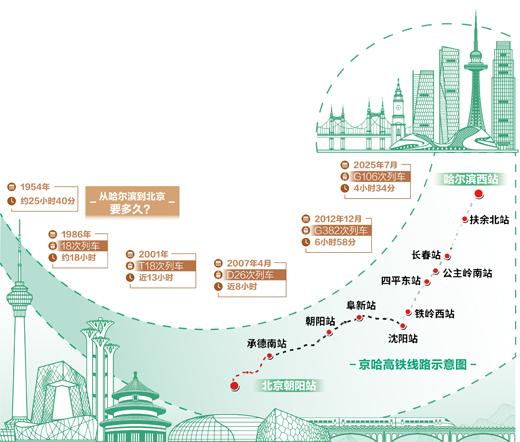
从北京到哈尔滨,最快只要4小时33分钟 京哈高铁 连接双城,带动发展
Ren Min Ri Bao· 2026-01-22 22:01
Core Viewpoint - The Beijing-Harbin High-Speed Railway (京哈高铁) has been operational for five years, serving 210 million passengers and significantly enhancing connectivity in Northeast China and the Beijing-Tianjin-Hebei region [1][6]. Group 1: Operational Achievements - The Beijing-Harbin High-Speed Railway has transported a total of 210 million passengers over five years, with over 63 million passengers traveling from Beijing to Northeast China and 39.36 million from Harbin to Beijing [1]. - The railway spans 1,198 kilometers and is a crucial part of China's "eight vertical and eight horizontal" high-speed rail network, connecting Beijing, Hebei, Liaoning, Jilin, and Heilongjiang [1][5]. Group 2: Future Developments - Starting July 1, 2025, the Beijing-Shenyang section of the high-speed railway will operate at a speed of 350 km/h, reducing travel times to 2 hours and 29 minutes to Shenyang and 4 hours and 33 minutes to Harbin [5]. - The high-speed railway is expected to create a "2-3 hour" transportation circle, facilitating same-day round trips between major cities along the route [5]. Group 3: Economic Impact - The high-speed railway is driving development in cities along its route, with cities like Chengde experiencing a surge in tourism due to the "half-hour tourism circle" [6][7]. - The railway has become a key player in the "ice and snow economy" of Northeast China, with significant passenger traffic during peak tourist seasons, such as 140,500 visitors on New Year's Day 2026 [6][7]. Group 4: Technological Innovations - The high-speed railway is equipped with advanced technologies to withstand harsh winter conditions, including special materials for train bodies and systems for snow and ice removal [11][12][13]. - Innovations such as real-time monitoring systems and snow-melting devices at stations enhance operational safety and efficiency during winter [13].
新年伊始 这些小变化传递积极信号
Ren Min Ri Bao· 2026-01-08 01:34
Group 1: Consumer Policies - A new round of "national subsidies" has been launched, covering a range of products including smart glasses, home appliances, and vehicle updates, with subsidies up to 15% for digital and home appliances [2] - The Hainan duty-free policy has been adjusted, expanding the number of duty-free items from 45 to 47 and allowing residents with departure records to purchase certain items multiple times within a year, leading to a significant increase in shopping activity [2] Group 2: Transportation and Services - The introduction of a new railway tourism ticket in Northeast China allows travelers to visit multiple destinations with a single ticket, enhancing convenience for tourists [3] - New regulations promoting green consumption have been implemented, aiming to facilitate the transition to a low-carbon economy across various sectors [3] Group 3: Housing Market - The VAT rate for individuals selling homes purchased for less than two years has been reduced from 5% to 3%, significantly lowering transaction costs and stimulating the real estate market [7] Group 4: Credit Repair - A one-time credit repair policy has been implemented, allowing individuals to remove certain overdue records from their credit reports if debts are repaid by March 31, 2026, reflecting a shift towards a more supportive credit management approach [8] Group 5: Taxation and Business Environment - The new VAT law has come into effect, providing clearer legal guidelines for businesses and enhancing the certainty of tax policies, which is expected to invigorate business operations [10]
动静热词丨冬季旅游
Xin Lang Cai Jing· 2025-12-19 13:18
Core Viewpoint - Guizhou is leveraging over 600 cultural and tourism activities this winter to create a vibrant and unique experience, combining geographical gifts, ethnic customs, and contemporary trends [1][2]. Group 1: Natural Attractions - Guizhou's unique geographical endowments provide diverse winter experiences, such as skiing in Liupanshui under the sun, enjoying the warm winter sun in Qianxinan's Wanfenglin, and relaxing in mineral-rich hot springs across the province [1]. - The province's natural resources collectively create a distinctive winter appeal that attracts tourists [1]. Group 2: Integrated Experiences - Guizhou employs a "+" thinking approach to activate resources, enhancing experiences through cross-industry integration, such as "hot springs + traditional Chinese medicine + forests" and "ice and snow + cultural tours + local cuisine" [1]. - These multi-faceted experiences transform tourists from mere spectators into active participants, enriching their journeys [1]. Group 3: Policy Initiatives - The province implements a multi-level policy framework, including high-speed rail tourism tickets, all-in-one travel passes, free ski experience vouchers, and ticket discounts to attract diverse customer segments [2]. - These initiatives aim to convert visitor traffic into lasting engagement, shifting the focus from merely selling attractions to providing shared life experiences [2].
3万亿元,“中部第一城”目标定了
Mei Ri Jing Ji Xin Wen· 2025-12-05 16:10
Group 1: Economic Goals and Development Plans - Wuhan aims to achieve a GDP exceeding 3 trillion yuan by 2030, with significant progress expected in the construction of a modernized city [1][2] - The city's GDP reached 2 trillion yuan in 2023, making it the first city in Central China to surpass this milestone, with projections of 2.11 trillion yuan in 2024 [1][2] - The development strategy emphasizes high-quality growth, with a focus on technological and industrial innovation as key drivers [2] Group 2: Specific Action Plans - Wuhan has launched three action plans to establish itself as an international consumption center, research center, and exhibition center by 2027, targeting a retail sales total of over 1.07 trillion yuan [3] - The city aims to rank among the top 10 global research cities by 2027, enhancing its international competitiveness [3] - The plan includes hosting 1,200 various exhibitions and events by 2027, reinforcing its position as a national trade and logistics hub [3] Group 3: Broader Economic Context - Wuhan's growth is part of Hubei's broader strategy during the 14th Five-Year Plan, positioning the city as a leading force in the central region's economic rise [2] - The city is compared to other major cities like Shanghai and Beijing, which have successfully crossed the 3 trillion yuan GDP threshold within a few years [2] - The focus on integrating commerce, logistics, and financial services is seen as essential for resource allocation and market activation [2]