鸿鹄

Search documents
小摩:微创机器人-B海外布局加速 维持“增持”评级
Zhi Tong Cai Jing· 2026-02-16 03:29
Core Viewpoint - Morgan Stanley has issued a report rating MicroPort Scientific Corporation-B (02252) as "Overweight" with a target price of HKD 41, highlighting the company's strong order growth and market expansion [1] Group 1: Company Performance - MicroPort's core product "Tumi" has surpassed 200 cumulative orders, indicating an addition of approximately 20 orders since late January 2026, continuing the strong momentum observed from October 2025 to January 2026 [1] - The company's market coverage has expanded to over 50 countries and regions, up from over 40 at the end of December 2025, with 12 markets ordering more than five units, primarily led by emerging markets such as India and Brazil [1] Group 2: Product and Market Position - MicroPort primarily provides surgical robots for minimally invasive surgeries, with "Tumi" and "Honghu" being its core products in the laparoscopic and orthopedic fields, respectively [1] - "Tumi" is the first clinically validated Chinese laparoscopic surgical robot that demonstrates efficacy comparable to the Da Vinci surgical system, which is currently the leading product from Intuitive Surgical in China and globally [1] - This achievement establishes MicroPort as a leading domestic enterprise in China, positioning it to benefit from the trend of import substitution [1]

小摩:微创机器人-B(02252)海外布局加速 维持“增持”评级
智通财经网· 2026-02-16 03:28
Core Viewpoint - Morgan Stanley has issued a report rating MicroPort Robotics-B (02252) as "Overweight" with a target price of HKD 41, highlighting the company's strong order growth and market expansion [1] Group 1: Product Performance - The core product "TUMI" has surpassed 200 cumulative orders, indicating an addition of approximately 20 orders since late January 2026, continuing the strong momentum observed from October 2025 to January 2026 [1] - The product range has expanded to over 50 countries and regions, up from over 40 by the end of December 2025, with 12 markets ordering more than five units, primarily led by emerging markets such as India and Brazil [1] Group 2: Market Position - MicroPort Robotics primarily provides surgical robots for minimally invasive surgeries, with "TUMI" and "HONGHU" being its core products in the laparoscopic and orthopedic fields, respectively [1] - "TUMI" is the first clinically validated Chinese laparoscopic surgical robot that matches the efficacy of the Da Vinci surgical system, which is currently the leading product from Intuitive Surgical in China and globally [1] - This achievement solidifies MicroPort Robotics' position as a leading domestic enterprise in China, allowing it to benefit from the trend of import substitution [1]
国产手术机器人,走到哪一步了?
机器人圈· 2026-01-28 09:46
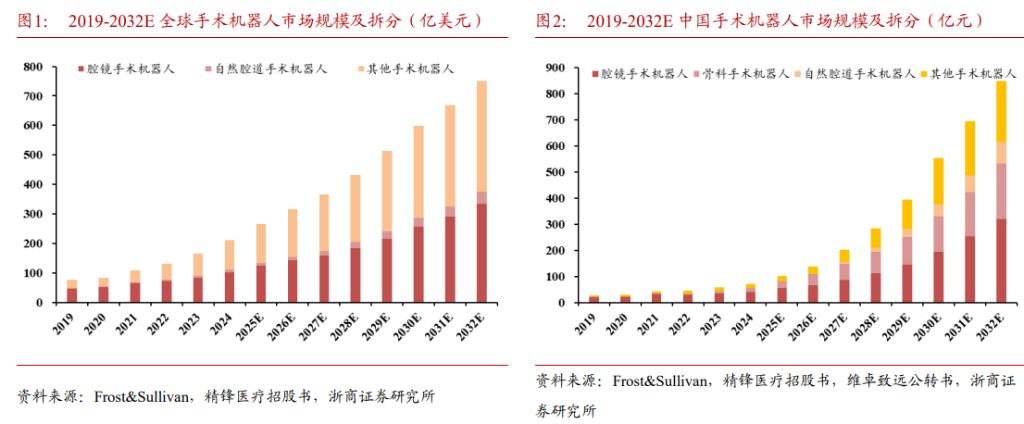
Core Insights - The article highlights that the Chinese surgical robot market is transitioning from an early development phase to a rapid growth phase, driven by the implementation of the medical insurance bureau's pricing policy and accelerated overseas market expansion [1][3]. Market Size and Growth - The Chinese surgical robot market is projected to grow from approximately 7.2 billion RMB in 2024 to 76.7 billion RMB by 2032, representing a compound annual growth rate (CAGR) of about 34% [2][5]. - In comparison, the global market is expected to increase from 21.2 billion USD to 75 billion USD during the same period, with a CAGR of around 17%, indicating that China's growth rate significantly outpaces the global average [2]. Market Segmentation - Laparoscopic surgical robots are expected to dominate the market, accounting for 58% of the total market size in 2024, with a projected CAGR of 29% from 2024 to 2032, reaching 32.1 billion RMB by 2032 [5]. - The orthopedic surgical robot market follows closely, with a market share of 26% in installed capacity and 22% in sales revenue. The CAGR for this segment is anticipated to be 41%, reaching 21.3 billion RMB by 2032 [5]. Policy Impact - The year 2026 is identified as a critical turning point due to the establishment of a national pricing framework, which will address the economic concerns of hospitals regarding the adoption of surgical robots [7][9]. - The medical insurance bureau's guidelines released on January 20, 2026, categorize surgical robots into four types and provide a clear reimbursement structure, which is expected to facilitate product adoption in hospitals [9]. International Expansion - The article notes that the Chinese surgical robot market currently accounts for only about 5% of the global market, indicating significant potential for overseas expansion [10]. - Leading domestic companies are rapidly entering international markets, with notable achievements such as MicroPort's 160 global commercial orders and the increasing share of overseas revenue for companies like Precision Medical [10]. Business Model - The surgical robot business model is likened to the "razor and blades" model, where the primary revenue source comes from consumables and services rather than just equipment sales [11][12]. - Companies are encouraged to focus on increasing installed base as a key indicator for future cash flow, with the potential for high-value orthopedic consumables sales being a critical factor for profitability [12].


国产手术机器人,走到哪一步了?
Hua Er Jie Jian Wen· 2026-01-23 09:04
Core Viewpoint - The domestic surgical robot industry is at a critical turning point from "concept validation" to "scale profitability" with the implementation of medical insurance policies and accelerated overseas market expansion [1] Market Size and Growth - The Chinese surgical robot market is projected to grow from 7.2 billion RMB in 2024 to 76.7 billion RMB by 2032, representing a compound annual growth rate (CAGR) of approximately 34% [2][3] - In comparison, the global market is expected to increase from 21.2 billion USD to 75 billion USD during the same period, with a CAGR of about 17%, indicating that China's growth rate significantly outpaces the global average [3] Segment Analysis - Laparoscopic surgical robots will dominate the market, accounting for 58% of the total market size in 2024, with a projected CAGR of about 29% from 2024 to 2032, reaching 32.1 billion RMB by 2032 [6] - The orthopedic surgical robot market follows closely, with a projected CAGR of 41% from 2024 to 2032, reaching 21.3 billion RMB by 2032 [6] Policy Impact - The year 2026 is identified as a pivotal moment for policy implementation, addressing the issue of "who pays" for surgical robots, which has been a barrier to adoption [8][9] - The release of the medical insurance guidelines on January 20, 2026, will clarify the reimbursement framework, significantly easing the entry barriers for surgical robots into hospitals [9] International Expansion - The Chinese surgical robot market currently accounts for about 5% of the global market, indicating substantial overseas market potential [10] - Leading domestic companies are rapidly expanding into international markets, with significant orders and certifications achieved, such as MicroPort's 160 global commercial orders and the CE certifications for various products [10][11] Business Model - The surgical robot industry follows a "razor and blades" business model, where the primary revenue comes from consumables and services rather than just equipment sales [12] - Companies are encouraged to focus on increasing installation base as a key leading indicator for future cash flow, similar to the strategy employed by Intuitive Surgical [12]
西南证券:微创机器人-B(02252)全球商业化订单加速突破 五大赛道协同发力
智通财经网· 2025-12-29 09:00
Core Insights - The company has achieved significant milestones in its robotic surgery product line, with a total of over 230 surgical robot orders, including more than 160 global commercial orders for its endoscopic surgical robot [1][2] - The company’s self-developed bronchoscopic surgical robot "Dudao" has received NMPA approval, further expanding its product offerings [1][3] Group 1: Order Growth and Market Presence - The company’s self-developed endoscopic robot "Tumi" has surpassed 160 global commercial orders, with approximately 120 new orders expected in 2025, indicating strong growth momentum [2] - In the domestic market, over 90% of the hospitals using Tumi are top-tier hospitals, with 23% being among the top 100 hospitals, reflecting a high level of market recognition [2] - The company is expanding its overseas presence, leveraging its established marketing network to penetrate over 40 countries across Asia, Europe, Africa, Oceania, and South America, with installations in 15 countries marking a significant milestone for domestic endoscopic surgical robots [2] Group 2: Product Line and Regulatory Approvals - The company has completed its portfolio of surgical robots, now offering five types: endoscopic (Tumi), orthopedic (Honghu), vascular (R-ONE), percutaneous (Mona Lisa), and bronchoscopic (Dudao), all of which have received NMPA approval [3] - Tumi, along with other products, has successfully obtained overseas registration certificates, accelerating the company’s international expansion [3] Group 3: Revenue Forecast - Revenue projections for the company are estimated to reach 500 million, 1.2 billion, and 1.8 billion yuan for the years 2025, 2026, and 2027 respectively, indicating a phase of rapid growth and impending volume increase [4]

港股通资金押注,微创机器人-B(02252)股价回调近40%后即将“深蹲起跳”?
智通财经网· 2025-12-02 01:48
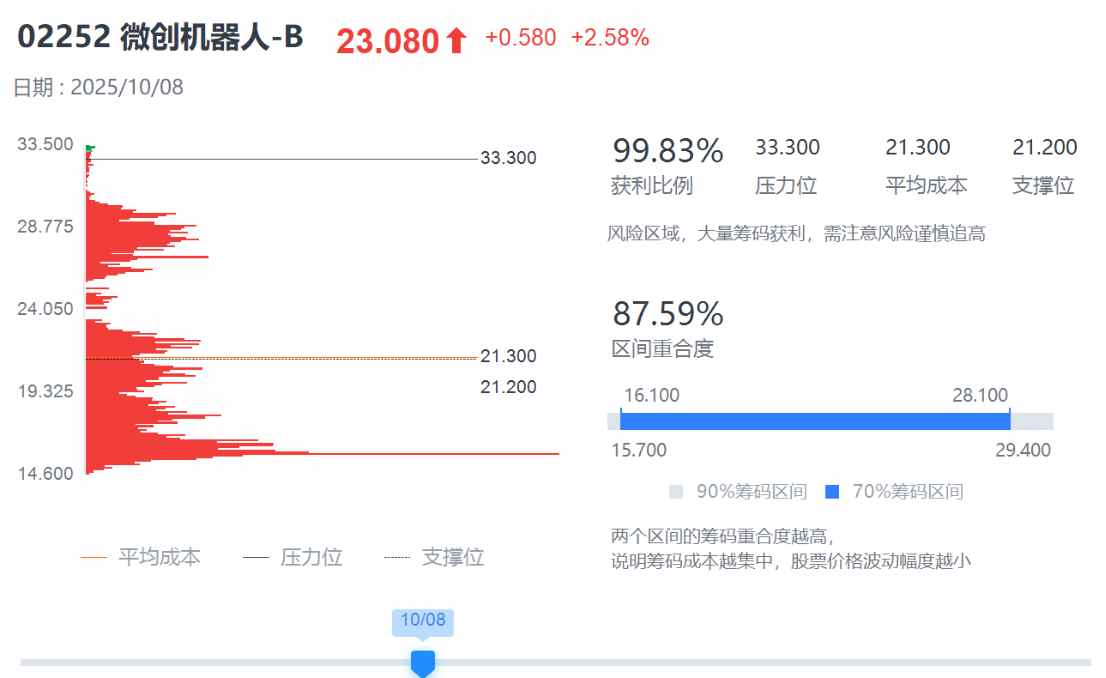
Core Viewpoint - In 2024, MicroPort Robotics faced significant challenges due to its own R&D and commercialization struggles, compounded by governance issues at its parent company. However, changes in the parent company's shareholding structure and the potential of its equipment and consumables business model have led to a resurgence in the company's stock performance [1]. Stock Performance - MicroPort Robotics experienced two significant price surges in 2024, with the stock reaching a high of 33.70 HKD, marking a maximum increase of 252.14% [2]. - Following the peak on October 8, the stock price fell to 21.20 HKD by November 21, representing a decline of 37.09% from its high [2]. - Investor sentiment shifted from divergence to consensus, with Hong Kong Stock Connect funds reversing their previous buying and selling strategies to accumulate shares during the downturn [2][8]. Technical Analysis - The stock's price movement in September showed a strong upward trend, with a nearly 40% increase driven by a "three consecutive days of gains" pattern, leading to a significant increase in trading volume [3]. - The Bollinger Bands (BOLL) indicated a breakout from previous trading ranges, with the stock showing a "six consecutive days of gains" pattern, establishing a steep upward channel [3]. - Despite the recent volatility, the distribution of shares remains concentrated at lower price levels, suggesting potential support for future price movements [3]. Volume and Market Sentiment - The stock's price increase was accompanied by declining trading volumes, indicating a lack of buying momentum, which is typically seen as a bearish signal [5]. - As the stock price fell below key technical levels, trading volumes decreased significantly, reflecting a shift in investor sentiment from active selling to cautious observation [7]. Institutional Activity - Recent trading data indicates that Hong Kong Stock Connect funds have begun to accumulate shares, contrasting with their previous selling behavior during the stock's earlier price increases [8][10]. - Over the past 60 days, these funds have been net sellers, but recent trends show a shift towards buying as the stock stabilizes [10]. Financial Performance - MicroPort Robotics reported a total revenue of 176 million HKD for the first half of 2025, a year-on-year increase of 77%, driven by significant growth in overseas markets [13]. - The company has improved its cost management, resulting in a 59% reduction in net losses during the same period [13]. - Following positive financial results, Morgan Stanley has raised its target price for MicroPort Robotics, reflecting confidence in the company's growth potential [14].
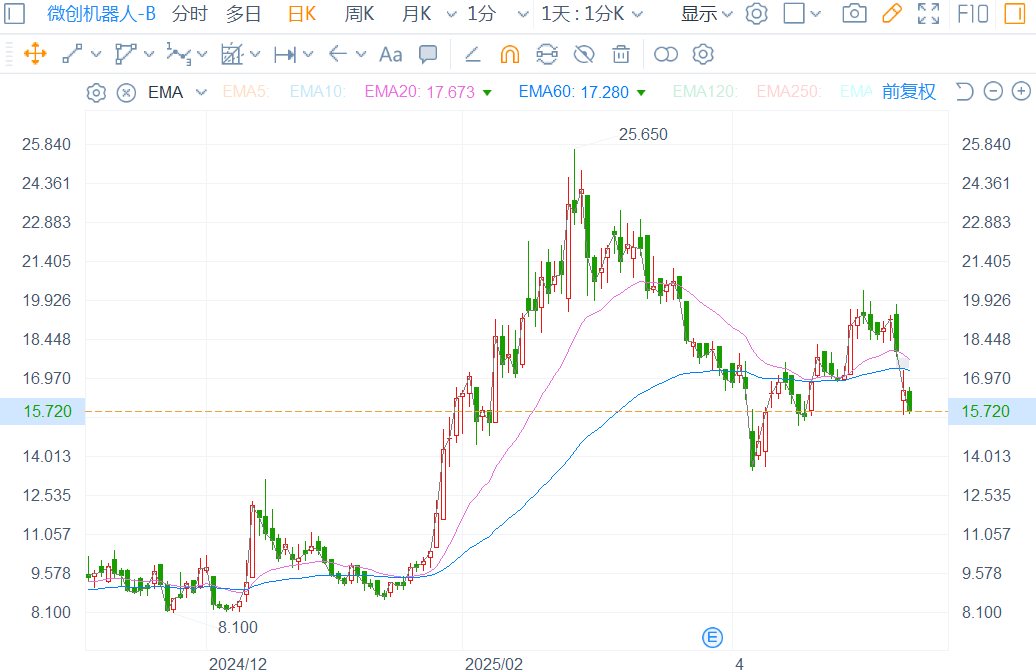
宣布折让13.8%配股+控股股东减持,微创机器人-B(02252)为何“流血式融资”?
智通财经网· 2025-05-15 11:16
Core Viewpoint - The recent announcement of a discounted placement by MicroPort Robotics has raised concerns about the company's financial health and investor confidence, highlighting ongoing cash flow challenges despite strong revenue growth [1][3]. Company Summary - MicroPort Robotics announced the placement of 25.1365 million new H-shares at HKD 15.5 per share, a discount of approximately 13.79% from the previous closing price, raising about HKD 382 million [1]. - The company's major shareholder, Shanghai Mocha Artificial Intelligence Technology, also sold 30.16 million shares at the same price, reducing its stake from 48.08% to 43.98%, resulting in a total dilution of approximately 2.44% [1]. - Following the announcement, the stock price dropped by 8.12% and 4.84% on May 14 and 15, respectively, with the current stock price at HKD 15.72 and a total market capitalization of HKD 15.817 billion [2]. Financial Performance - In 2024, MicroPort Robotics reported total revenue of CNY 257 million, a year-on-year increase of 145.95%, driven by strong sales in domestic and international markets [4]. - Despite revenue growth, the company has faced significant losses, with net losses of CNY 1.14 billion, CNY 1.012 billion, and CNY 642 million from 2022 to 2024, totaling CNY 2.794 billion in cumulative losses [4]. - The company's R&D expenses were CNY 569 million and CNY 309 million for 2023 and 2024, respectively, indicating high investment levels that have impacted profit margins [5]. Asset and Liability Structure - As of December 31, 2024, MicroPort Robotics had total assets of CNY 1.279 billion and total liabilities of CNY 1.021 billion, with a debt-to-asset ratio of 80%, up from 65% in 2023 [6]. - The company reported a net cash outflow from operating activities of CNY 298 million, with cash and cash equivalents totaling CNY 612 million, indicating limited liquidity [6]. Industry Context - The domestic surgical robot market is experiencing rapid growth, with a projected market size of approximately CNY 9.59 billion in 2024 and a compound annual growth rate of 34.5% over the past five years [9]. - The market is characterized by increasing competition and technological gaps, with the Da Vinci surgical robot currently dominating the market, holding a 46.9% share, which has decreased by 16.3 percentage points year-on-year [10]. - The industry faces challenges such as high R&D costs, reliance on imported core components, and slow commercialization efficiency, which complicate the path to profitability for companies like MicroPort Robotics [11].