
10年期美债期货

Search documents
特朗普强买格陵兰搅动世界,黄金为何没“疯涨”?
Xin Lang Cai Jing· 2026-01-20 02:05
Core Viewpoint - The article discusses the potential market reactions and implications of President Trump's threats to impose tariffs on European allies, highlighting the complexities of investor sentiment and the evolving global order [3][9]. Market Reactions - Following Trump's tariff threats, U.S. stock index futures fell by over 1%, while gold prices rose by nearly 2%, indicating a shift in investor sentiment [10][12]. - The S&P 500 index futures and European stock markets experienced similar declines, reflecting a cautious market response [10]. Investor Sentiment - Investors may have become desensitized to Trump's tariff announcements, as previous threats did not lead to significant long-term economic impacts [11]. - The concept of "TACO trading" suggests that investors are betting on Trump backing down from his threats, given the uncertainty surrounding his policy decisions [11][12]. Potential Benefits - Some investors perceive potential benefits from increased military spending in Europe as a response to the tariff threats, which could positively impact defense stocks [12]. - European utility stocks have also seen gains due to a flight to safety, indicating a shift in investment strategies [12]. Historical Context - The article draws parallels to historical events, suggesting that investors often overlook immediate threats until they escalate into significant crises, as seen in the lead-up to World War I [12][13]. - Historical data indicates that markets can rebound quickly after initial shocks, as evidenced by the performance of the UK stock market during World War II [12][13]. Future Implications - The evolving global order may lead to increased attempts by other countries to decouple economically and militarily from the U.S., which could create more volatility in the markets [13]. - Investors are advised to remain flexible as the situation could either lead to a catastrophic breakdown or a resolution where Europe concedes to U.S. demands [13].


美债,又陷风暴?
Zheng Quan Shi Bao· 2025-07-14 15:03
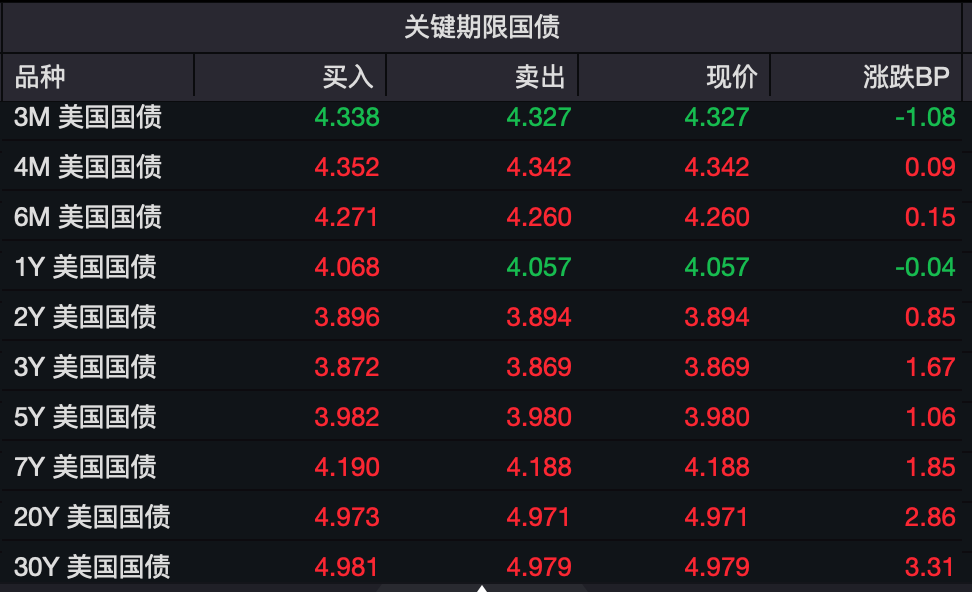
Core Viewpoint - The recent increase in long-term U.S. Treasury yields is attributed to the signing of the "Big and Beautiful" bill, which is expected to raise the U.S. fiscal deficit, alongside ongoing uncertainties from global tariff conflicts initiated by the Trump administration [1][9]. Treasury Yield Summary - The 30-year Treasury yield is approaching 5%, while the 20-year yield is also nearing this threshold, and the 10-year yield is close to 4.5% [2][3]. - Shorter-term Treasury yields are relatively stable, with the 1-year yield exceeding 4% and the 2-year, 3-year, and 5-year yields fluctuating around 3.9% [3]. - Recent fluctuations in Treasury yields have led to corresponding changes in long-term Treasury futures prices, with the 10-year futures price dropping from nearly $112 to $110.77 [4]. Market Reactions to Legislation - The "Big and Beautiful" bill, which raises the federal debt ceiling to $5 trillion and includes tax cuts to stimulate economic growth, has raised concerns about increased Treasury supply, potentially leading to higher yields [9]. - The anticipated net issuance of Treasury securities is projected to be around $1 trillion in the third quarter, with refinancing pressures easing compared to the previous quarter [9]. Tariff Concerns - The announcement of a 30% tariff on imports from Mexico and the EU starting August 1, 2025, has added to market anxieties, contributing to the volatility in Treasury yields [10]. - Despite these concerns, the long-term value of U.S. Treasuries is supported by the market's recognition of U.S. creditworthiness and the expected downward trend in interest rates [10].
欧盟关税延期提振风险敏感型外汇 美元延续跌势
智通财经网· 2025-05-26 06:29
Group 1 - The decision by President Donald Trump to delay higher tariffs on the EU has significantly boosted currencies closely tied to global trade, causing the dollar to drop to its lowest level in nearly two years against a basket of currencies [1] - The Bloomberg Dollar Spot Index fell by 0.4%, nearing its lowest level since July 2023, following Trump's announcement to extend the deadline for the 50% tariffs on the EU to July 9 [1] - The Australian dollar and New Zealand dollar saw substantial gains, with the Australian dollar rising to 0.6537 USD and the New Zealand dollar reaching 0.6032 USD, both at their highest levels since November of the previous year [1] Group 2 - The dollar index has cumulatively declined over 7% since 2025, erasing all gains from the previous year, which recorded the largest annual increase since 2015 [1] - Concerns over tariffs and the extension of tax cuts during Trump's first term have led to growing worries about the U.S. government's fiscal situation, resulting in a weakening demand for the dollar [1] - The delay in EU tariffs has provided support to G10 and emerging market currencies, with the euro rising by 0.5% against the dollar, reaching its highest level since April [1] Group 3 - The 10-year U.S. Treasury futures have declined, indicating that yields are expected to rise by more than three basis points, although global Treasury spot trading is paused due to a U.S. holiday [3]