
澳元

Search documents
美银:历史数据显示石油价格冲击往往利好这些货币
美股IPO· 2026-03-08 00:48
Group 1 - The core viewpoint of the article highlights that historical oil supply shocks tend to favor certain currencies, particularly the US dollar and Canadian dollar, while currencies like the New Zealand dollar and Australian dollar face pressure [1][3] Group 2 - The analysis indicates that the foreign exchange market has reacted moderately to recent US-Israel military actions in Iran, with price movements largely aligning with expectations, including a general strengthening of the US dollar [3] - Historical analysis of geopolitical events disrupting global oil supply reveals a consistent pattern where currencies of oil-producing countries perform well, while those of energy-importing countries tend to weaken [3] - The Canadian dollar (CAD) and US dollar (USD) typically show strong performance during oil shocks, whereas the New Zealand dollar (NZD), Australian dollar (AUD), Swedish krona, and occasionally the Japanese yen (JPY) perform poorly [3] - The occasional weakness of the yen during oil shocks may reflect Japan's heavy reliance on energy imports, which can offset its traditional safe-haven status during market stress [3] Group 3 - Despite increased currency volatility due to Middle Eastern tensions, many hedging strategies remain attractively priced compared to past oil supply disruptions [3] - The article emphasizes that the volatility of CADJPY and NZDUSD may present valuable trading opportunities, with potential benefits from CADJPY positions in a rising oil price environment and shorting NZDUSD if conflicts persist [3] - The analysis notes that while volatility in the foreign exchange market has increased, many hedging trades are still below levels typically observed during previous oil shock events, suggesting that the market may be underestimating tail risks associated with geopolitical escalations [3]


领先指标2026年2月
莱坊· 2026-03-03 02:35
Investment Rating - The report does not explicitly state an investment rating for the industry Core Insights - The ongoing inflation has led to an increase in the Reserve Bank of Australia's (RBA) interest rates, with the annual headline inflation rising to 3.8% and trimmed mean inflation at 3.3% [4][5] - The Australian dollar (AUD) has appreciated significantly, surpassing US$0.70, driven by a decline in the US dollar and expectations of interest rate hikes in Australia [6][11] - The report highlights that high inflation is expected to prompt the RBA to raise interest rates further in 2026, with the cash rate target projected at 3.85% [35][44] Economic Indicators - The report indicates that the real GDP growth is forecasted at 2.1% for 2025, with an unemployment rate of 4.1% [12] - The core consumer price index inflation is expected to be 3.2% by December 2025, with a cash rate target of 3.85% and a 10-year bond yield of 4.8% [12] - The business confidence and future orders are under pressure due to anticipated rising interest rates, as indicated by the January PMI [14][16] Consumer Indicators - Household consumption continues to improve, driven by discretionary spending, with an annual growth rate of 6.3% [25][27] - Consumer sentiment is affected by changing interest rate expectations, with confidence indices showing a decline [27][28] - The report notes broad-based growth in consumer spending across various categories, with leisure and entertainment seeing significant increases [29][31] Inflation and Interest Rates - The report emphasizes that high inflation rates are likely to lead to further interest rate hikes by the RBA, with the trimmed mean inflation rate projected to be 3.2% by December 2025 [35][41] - Historical data shows that the headline CPI has been above the RBA's target range, indicating persistent inflationary pressures [39][40] Financial Markets - Global financial markets remain stable, with the Australian stock market showing slight increases in January [48][49] - The report notes that market volatility is below long-term averages, indicating a stable investment environment [50]
邦达亚洲:日本央行官员发表乐观言论 美元日元承压收跌
Xin Lang Cai Jing· 2026-02-27 13:21
Group 1: Japan's Monetary Policy - Japanese Prime Minister Fumio Kishida expressed a desire to maintain an accommodative monetary policy, while the Bank of Japan's most hawkish committee member, Hajime Takata, called for an increase in the benchmark interest rate [1][6] - Takata suggested that the central bank should further adjust its policy, indicating a divergence between the central bank's internal support for aggressive policy normalization and the government's stance [1][6] Group 2: Gold Market Outlook - Bank of America Global Research predicts that gold prices could surpass $6,000 per ounce within the next 12 months due to uncertainties from changes in the Federal Reserve's leadership and economic risks from U.S. tariff policies [2][7] - The report acknowledges that gold prices may face short-term resistance as investors adjust to higher price levels, with a potential for a temporary decline before spring [2][7] - Analysts express caution regarding silver, indicating that its price movements are more complex, with a possibility of further short-term declines, but also the potential for silver to return to $100 per ounce [2][7] Group 3: Currency Market Movements - The gold price experienced slight gains, trading around 5,195, supported by ongoing geopolitical tensions and concerns over U.S. tariff uncertainties, although strong U.S. economic data limited its upward potential [3][8] - The Australian dollar saw a slight decline, trading around 0.7130, influenced by profit-taking and a stronger U.S. dollar due to favorable economic data and reduced expectations for Fed rate cuts [4][9] - The USD/JPY pair traded lower at approximately 155.90, affected by profit-taking and renewed expectations for Bank of Japan interest rate hikes, although a stronger dollar limited the decline [5][10]
澳元高位震荡加息博弈
Jin Tou Wang· 2026-02-27 02:36
Core Viewpoint - The Australian dollar (AUD) is experiencing a strong performance against the US dollar (USD), driven by the Reserve Bank of Australia's (RBA) hawkish policy and expectations surrounding the US Federal Reserve's interest rate decisions [1][2]. Group 1: Australian Economic Factors - The RBA raised interest rates by 25 basis points to 3.85% on February 3, 2026, marking it as the first developed economy to tighten monetary policy in 2026 after a period of easing [1]. - Inflation pressures are a key driver for the RBA's actions, with the Consumer Price Index (CPI) rising to 3.8% year-on-year in December 2025, exceeding the target range of 2%-3% [1]. - Market expectations suggest that if inflation does not ease, the RBA may raise rates an additional 1-2 times, each by 25 basis points, enhancing the interest rate differential [1]. Group 2: US Economic Factors - The Federal Reserve's mixed stance is influencing the USD's strength, with January's minutes being hawkish while recent economic data has been inconsistent [2]. - The February CPI data showed a surprising decline, which has increased expectations for rate cuts, but persistent core inflation limits the Fed's ability to lower rates [2]. - The USD index was reported at 97.75, reflecting a decline of over 9% since late November 2025, indirectly supporting the AUD [2]. Group 3: Commodity Market Influence - The AUD's performance is closely tied to commodity prices, as Australia is a major exporter of iron ore and copper [2]. - Recent stability in commodity prices, along with slight increases in oil and copper prices, is providing support for the AUD [2]. - However, uncertainties in global economic recovery and demand from major trading partners may suppress commodity exports, potentially dragging down the AUD [2]. Group 4: Technical Analysis - The AUD/USD pair is currently in a short-term consolidation phase, with key support at 0.7060 and resistance at 0.7120 [2]. - The Relative Strength Index (RSI) indicates a neutral position, and trading volume is moderate, suggesting ongoing market contention between bulls and bears [2]. Group 5: Future Considerations - Key variables to monitor include Australian inflation and employment data (which will influence interest rate decisions), Federal Reserve policies and US economic data (impacting the USD), and commodity prices (affecting the AUD's commodity currency status) [2]. - Global risk sentiment and the interest rate differential between Australia and the US will also play a significant role in the AUD's future movements [2].
澳元强势震荡通胀高企加息预期
Jin Tou Wang· 2026-02-26 02:43
Core Viewpoint - The Australian dollar (AUD) is experiencing strong fluctuations against the US dollar, supported by high inflation and a hawkish stance from the Reserve Bank of Australia (RBA) [1] Group 1: Economic Indicators - As of January, Australia's Consumer Price Index (CPI) year-on-year is at 3.8%, remaining steady from December and exceeding expectations [1] - The core CPI has risen to 3.4%, consistently above the RBA's target range of 2%-3% [1] - The RBA raised interest rates by 25 basis points to 3.85% on February 3, becoming the first developed economy to increase rates in 2026, reinforcing hawkish expectations [1] Group 2: Market Dynamics - The Australian dollar has appreciated by 6.2% since the beginning of 2026, outperforming other major currencies [1] - The strength of the AUD is attributed to rising prices of industrial and precious metals, as well as record iron ore shipments [1] - The US dollar is under pressure, with market expectations of two potential rate cuts by the Federal Reserve in 2026, creating additional space for AUD appreciation [1] Group 3: External Factors - The recovery of domestic demand in China and the evolving trade relationship between China and the US are significant external factors influencing the AUD [1] Group 4: Challenges and Technical Analysis - The consumer confidence index in January is at 92.9 points, indicating pessimism, which may suppress domestic demand due to sensitivity to interest rate hikes [1] - The RBA must balance growth and employment, with an unemployment rate of 4.1%, limiting the scope for further rate increases [1] - Technically, the AUD faces resistance at the 0.7157 level and support at 0.7013, requiring a breakthrough of the resistance to open up further upward potential [1] Group 5: Short-term Outlook - The short-term outlook for the AUD is characterized by strong fluctuations, supported by inflation, rate hike expectations, and rising commodity prices [2] - However, consumer weakness, limited rate hike capacity, and resistance levels may constrain upward movement [2] - Investors are advised to monitor central bank signals, inflation trends, and US dollar movements for cautious operations [2]
澳元震荡上行 加息预期与经济动能交织
Jin Tou Wang· 2026-02-26 02:27
Group 1 - The core viewpoint is that the Australian dollar (AUD) is experiencing a short-term upward trend against the US dollar (USD), supported by the Reserve Bank of Australia's (RBA) interest rate hike expectations and commodity currency attributes, despite economic growth momentum slowing and external risks limiting its upward potential [1][3]. - The RBA raised interest rates by 25 basis points to 3.85% on February 3, demonstrating its commitment to controlling inflation, which, although has decreased from its peak, remains above the target range of 2%-3%. Market expectations suggest that if inflation remains sticky, further rate hikes may occur, enhancing the attractiveness of the AUD [1][2]. - The AUD benefits from strong commodity prices, which provide marginal support for the exchange rate, even though the appreciation of the AUD somewhat dilutes the price increases of commodities priced in AUD [1][2]. Group 2 - Economic growth momentum is slowing, with the Westpac Bank indicating that the leading index growth rate for Australian economic activity fell to 0.02% in January 2026, raising concerns that further rate hikes could suppress consumption and investment, hindering economic recovery [2]. - There is significant divergence in views regarding the RBA's policy path, with some analysts suggesting that economic growth is nearing potential levels, limiting further rate hike capacity, and even considering the possibility of rate cuts within the year, which could weaken the upward momentum of the AUD [2]. - Technical analysis indicates that the AUD/USD is in a phase of upward movement, having broken through previous resistance levels, with key support at 0.7115 and resistance at 0.7150. The expected short-term trading range is between 0.7115 and 0.7150, pending confirmation from economic data or RBA signals [2][3].
三大商品货币率先起飞,市场押注全球即将重回加息周期
Feng Huang Wang· 2026-02-25 22:23
Core Viewpoint - The Australian dollar, Norwegian krone, and New Zealand dollar have significantly outperformed other major currencies this year as traders bet on a shift from interest rate cuts to hikes in global monetary policy [1][3]. Group 1: Currency Performance - The Australian dollar has appreciated over 6% against the US dollar year-to-date, reaching its highest level in nearly three years [1]. - The New Zealand dollar has risen approximately 3.7% against the US dollar this year, with expectations of an upcoming interest rate hike [3]. - The Norwegian krone has gained over 5% due to unexpectedly high inflation, leading traders to speculate on a potential small rate hike in the first half of the year [3]. Group 2: Monetary Policy Shifts - The Reserve Bank of Australia raised its benchmark interest rate by 25 basis points to 3.85%, marking its first rate hike in over two years [1][3]. - Analysts believe this could signal the beginning of a sustained tightening cycle, with expectations of one to two more rate hikes this year, each by 25 basis points [3]. - The shift in monetary policy reflects a broader trend among major economies to end years of rate cuts and focus on controlling inflation [3]. Group 3: Economic Context - The economic structures of Australia, New Zealand, and Norway are heavily weighted towards commodities, often categorizing them as "commodity currencies" [3]. - Recent increases in oil, copper, and other export commodity prices have provided additional support for these currencies [3]. - Concerns over the U.S. government's fluctuating policies and rising debt levels have led investors to seek diversification away from dollar-denominated assets, benefiting these commodity currencies [4].
【环球财经】1月澳大利亚通胀率保持在3.8% 澳元有望继续走强
Xin Hua Cai Jing· 2026-02-25 12:48
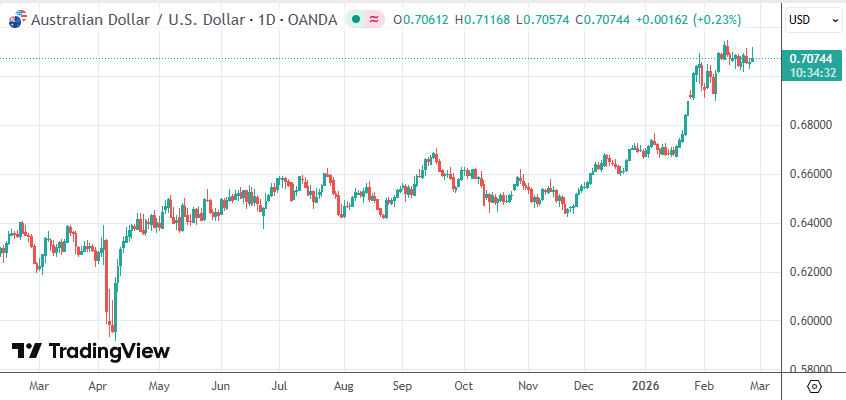
Group 1 - The core consumer price index (CPI) in Australia for January 2026 increased by 3.8% year-on-year, matching the previous month and exceeding market expectations of 3.7% [1] - The trimmed mean inflation rate rose from 3.3% to 3.4%, surpassing the market forecast of 3.3% and remaining above the Reserve Bank of Australia's target range of 2%-3% [1] - Following the inflation data release, the Australian dollar (AUD) appreciated approximately 0.2% against the US dollar, reaching 70.71, indicating a potential hawkish stance from the Reserve Bank of Australia [1] Group 2 - Analysts suggest that ongoing price pressures in the Australian economy may lead to an underestimation of the risk of an interest rate hike by the Reserve Bank of Australia in March [2] - The market now anticipates at least one more rate hike this year, with expectations for a March increase rising to about 15% and for May to 70%, driven by the higher-than-expected January inflation data [2] - A shift to a hawkish stance by the Reserve Bank of Australia is expected to benefit the Australian dollar, with further strengthening anticipated [2]
利率风向突变?外汇交易员开始押注:新鹰派时代将至!
Jin Shi Shu Ju· 2026-02-25 07:21
Core Viewpoint - The foreign exchange market is experiencing a significant shift as traders bet on a transition from declining global interest rates to rising rates, with the Australian dollar, Norwegian krone, and New Zealand dollar outperforming other major currencies this year [2][3]. Group 1: Currency Performance - The Australian dollar has risen nearly 6% against the US dollar this year, reaching a three-year high, driven by the Reserve Bank of Australia's anticipated new rate hike cycle to combat inflation [2][3]. - The New Zealand dollar has increased by nearly 4%, with traders expecting the country to initiate its first rate hike in the coming months [2]. - The Norwegian krone has appreciated over 5%, spurred by unexpected inflation increases that have led traders to price in potential rate hikes in the first half of the year [2][3]. Group 2: Economic Context - Analysts suggest that these currencies are indicative of a broader hawkish shift among major economies, moving away from years of rate cuts to focus on controlling inflation [3]. - The Australian economy is at the forefront of this rate hike wave, with the trimmed mean inflation rate reported at 3.4%, exceeding analysts' expectations and increasing the likelihood of further rate hikes [3][4]. - The performance of these currencies is also supported by rising prices of commodities such as oil and copper, which are significant for their economies [3]. Group 3: Investor Sentiment - Investors are diversifying away from US dollar assets due to concerns over the unpredictable policies of the Trump administration and rising government debt [4]. - The expectation of rate hikes in other regions has contributed to the weakening of the US dollar, as higher rates elsewhere erode the support for the dollar [4]. - Despite pressure from President Trump for lower borrowing costs, most traders believe the Fed's rate cut cycle is not yet over, with expectations of two to three 25 basis point cuts this year [4]. Group 4: Fiscal Health - The Australian dollar, Norwegian krone, and New Zealand dollar are favored by investors due to the relative fiscal health of their countries, contrasting with concerns over large government deficits and rising debt in currencies like the yen, dollar, and pound [4][5]. - The top-performing G10 currencies are characterized as fiscally sound and commodity-exposed, making them attractive destinations for capital as it rotates out of the US [5][6].
澳大利亚通胀率高于预期 提振市场对加息的预期
Xin Lang Cai Jing· 2026-02-25 01:15
Core Insights - Australia's core inflation rate for January exceeded expectations, indicating a potential need for further tightening of monetary policy, which has led to an appreciation of the Australian dollar [1][2] Inflation Data - The Australian Bureau of Statistics reported that the trimmed mean consumer price index rose by 3.4% year-on-year in January, surpassing economists' forecast of 3.3% [1][2] - The Reserve Bank of Australia's target is to maintain inflation within the midpoint of the 2% to 3% target range [1][2] - Compared to the previous month, this core inflation indicator increased by 0.3%, up from a 0.2% increase in December [1][2] Market Reactions - Following the data release, the Australian dollar rose by 0.2%, and the yield on the 3-year government bonds, which are sensitive to policy changes, also increased as traders bet on another rate hike by the central bank [1][2] - The stock market's gains narrowed following the announcement [1][2]