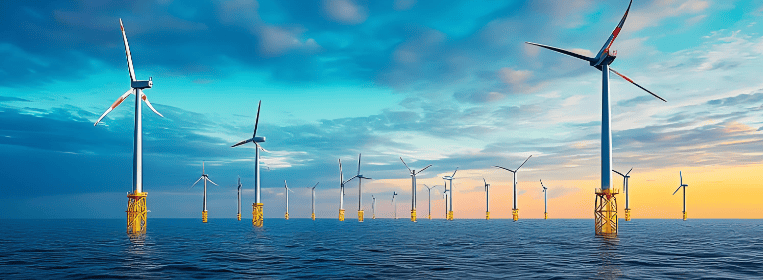
17兆瓦直驱型漂浮式海上风电机组

Search documents
新能源博弈,美国“命门”正被中国扼住
Sou Hu Cai Jing· 2025-11-09 08:08
Core Insights - The article emphasizes China's growing advantages in the new energy revolution, particularly in wind, solar, energy storage, nuclear fusion, and green hydrogen sectors, suggesting that the U.S. needs to be cautious of its position [1][15]. Wind Energy - China has transformed from a follower to a rule-maker in the wind energy sector, boasting the largest installed capacity globally and significant advancements in technology, such as the development of a 7 MW offshore wind turbine main shaft bearing [3]. - The introduction of the world's largest 17 MW direct-drive floating offshore wind turbine, with all key components made in China, highlights China's dominance [3]. - China's advancements in deep-sea wind energy technologies, such as the domestically developed "high-drag towing anchor technology," have received international certification, establishing new benchmarks [3]. Solar Energy - China holds a commanding position in the solar energy market, with Chinese innovators accounting for 59% of global solar cell and module-related patent applications [4]. - Companies like Dongfang Risen have achieved an average mass production efficiency of 26.2% for heterojunction solar cells, indicating a significant technological lead [4][5]. - The article suggests that China is defining the global standards for the next generation of solar technology, while U.S. tariffs may hinder its own industry [5]. Energy Storage - As of September 2025, China's new energy storage installed capacity exceeds 40% of the global total, showcasing both scale and technological leadership [8]. - Innovations in battery technology, including advancements in lithium-ion, sodium-ion, and all-vanadium flow batteries, demonstrate China's diverse technological breakthroughs [8]. - The Guangdong Meizhou Baohua energy storage project has pioneered a "quantity-based pricing" model in the electricity spot market, setting a global benchmark for energy storage commercialization [8]. Nuclear Fusion - China has achieved significant breakthroughs in nuclear fusion technology, including the successful development of second-generation high-temperature superconducting tape for fusion reactors, indicating a shift towards self-sufficiency in core materials [9][11]. - The majority of critical components for U.S. fusion projects, such as the TF magnet, rely on Chinese suppliers, highlighting potential supply chain vulnerabilities for the U.S. [12]. Green Hydrogen - China's integrated capabilities in the green hydrogen sector are exemplified by the National Energy Investment Group's project, which has set multiple global records in green ammonia and hydrogen production [13]. - Collaborations between companies and research institutions have led to significant advancements in PEM electrolysis technology, reducing reliance on imported materials [13]. - China's dominance in ultra-high voltage transmission networks further solidifies its position, as the international standards set by China may dictate future U.S. infrastructure developments [13]. Conclusion - The article concludes that U.S. policymakers must recognize the tightening grip of China's industrial chain advantages in the new energy revolution, presenting a stark choice between cooperation and strategic disadvantage [15].

向深蓝要能源:中国漂浮式风电的技术突围与产业雄心
Sou Hu Cai Jing· 2025-07-16 11:57
Core Insights - China's offshore wind power development is undergoing a historic transition, moving from nearshore to deep-sea projects, with cumulative installed capacity expected to exceed 41.27 million kW by May 2025, maintaining the global lead for four consecutive years [2] - The shift to deep-sea projects is driven by the need for advanced technology, particularly floating wind turbine technology, which is essential for water depths exceeding 50 meters [2][4] - Significant advancements in technology, such as the development of a 17 MW floating wind turbine and a 20 MW unit with enhanced stability, are positioning China as a global leader in floating wind power technology [4][5] Technological Breakthroughs - The floating wind turbine technology involves systemic innovations across materials science, fluid dynamics, and intelligent control [2] - The 17 MW turbine developed by Huaneng and Dongfang Electric features a rotor diameter of 262 meters and has been designed to withstand extreme weather conditions, including 17-level typhoons [4] - The introduction of dynamic cables with enhanced durability and reduced maintenance costs is crucial for deep-sea energy transmission [5] Economic Viability - The integration of wind power, hydrogen production, and energy storage is being exemplified by Huaneng's project in Shandong, which aims to reduce green hydrogen costs significantly [8] - The cost of floating wind power has decreased from 35,000 RMB/kW in 2021 to 22,000 RMB/kW in 2025, representing a 37% reduction [9] - A vertical integration model in the supply chain has led to a 25% reduction in logistics costs and a 40% decrease in delivery times [9] Commercialization Pathways - The offshore wind operation and maintenance sector is experiencing a shift towards intelligent monitoring systems, improving inspection efficiency and response times [10] - The market for offshore wind projects is expanding, with a reported 50% increase in order volume in early 2025 [11] - Innovative business models, such as the "green electricity premium + carbon trading" approach, are enhancing cash flow for projects [11] Global Positioning - China is transitioning from a follower to a leader in the floating wind power sector, expected to account for 40% of global new installations by 2025 [15] - The "wind-fish integration" model in Fujian is reducing ecological compensation costs, while large-scale projects are driving significant investments in the industry [15] - The advancements in floating wind technology are reshaping the global wind power landscape, with China holding a 70% market share in Southeast Asia [15]