
3纳米

Search documents
台积电:硅基话语权的巅峰
格隆汇APP· 2026-01-16 09:29
Core Viewpoint - TSMC's recent financial report signifies not just growth but a transformative era driven by AI, marking the onset of the fourth industrial revolution [5][21]. Financial Performance - TSMC reported a net profit of NT$505.7 billion, exceeding expectations of NT$467 billion, with a year-on-year increase of 35% [7]. - The gross margin reached 62.3%, surpassing the anticipated ceiling of 60.6% [8]. - For Q1 2026, TSMC's revenue guidance is set between $34.6 billion and $35.8 billion, significantly above the expected $33.22 billion [15]. - The gross margin guidance for Q1 2026 is projected at 63%-65%, outpacing market expectations of 59.6% [16]. - Capital expenditures for 2026 are expected to reach $52 billion to $56 billion, far exceeding the previous year's $40.9 billion and market expectations of $46 billion [17]. AI and Technology Leadership - TSMC's advanced 3nm, 5nm, and 7nm processes contributed 77% of total revenue, with 3nm and 5nm alone accounting for 63% [12]. - The company anticipates a nearly 30% growth in revenue in 2026, surpassing the 25% market expectation, with a five-year compound annual growth rate (CAGR) of 25% starting in 2024 [24]. - TSMC has raised its CAGR forecast for AI accelerators from 45% to a range of 55%-59% for 2024-2029, indicating a robust growth trajectory [26]. Advanced Packaging Technologies - CoWoS (Chip-on-Wafer-on-Substrate) is TSMC's proprietary advanced packaging technology, with expected monthly production capacity reaching 115,000 pieces by the end of 2026 [30]. - The demand for CoWoS is so high that it has created an overflow capacity of approximately 15,000 pieces per month, benefiting other packaging companies [32]. - CoWoP (Chip-on-Wafer-on-PCB) is a revolutionary technology that bypasses the capacity constraints of ABF substrates, simplifying structure and reducing costs [37][38]. Global Expansion Strategy - TSMC is executing an unprecedented global factory expansion plan, with key sites in Taiwan, the USA, Japan, and Germany, to meet demand and strategically position itself in the geopolitical landscape [58][59][60][61]. - The company is establishing a 2nm core base in Hsinchu and Kaohsiung, which will serve as the heart of its operations [59]. Conclusion - TSMC is not merely a semiconductor company; it is a pivotal player in the evolution of technology and the AI revolution, shaping the future of the global digital economy [63].



台积电:硅基话语权的巅峰
Ge Long Hui· 2026-01-16 07:21
Core Insights - TSMC's Q4 2025 financial report and Q1 2026 guidance significantly exceeded Wall Street's most optimistic forecasts, indicating a powerful growth driven by AI technology [1][3][10] - The company is positioned as a central player in the AI-driven fourth industrial revolution, with its advanced manufacturing processes and strategic investments shaping the future of the semiconductor industry [1][15] Financial Performance - Q4 2025 revenue reached NT$1.046 trillion, a year-on-year increase of 20.5% [3] - Net profit was NT$505.7 billion, surpassing the expected NT$467 billion, with a year-on-year growth of 35% [3] - Gross margin stood at 62.3%, exceeding the anticipated 60.6% [3] Q1 2026 Guidance - Revenue guidance for Q1 2026 is projected between $34.6 billion and $35.8 billion, significantly above the expected $33.22 billion [10] - Gross margin guidance is set at 63%-65%, well above the market expectation of 59.6% [11] - Capital expenditure for 2026 is expected to reach $52 billion to $56 billion, far exceeding the previous year's $40.9 billion and market expectations of $46 billion [12][13] AI and Technology Leadership - TSMC's growth narrative is fundamentally tied to its dominance in the AI sector, with projected revenue growth of nearly 30% in 2026, surpassing the 25% forecast [18] - The company has raised its compound annual growth rate (CAGR) forecast for AI accelerator business from 45% to a range of 55%-59% for 2024-2029 [20] - TSMC's AI business revenue is expected to reach at least $90 billion by 2029, potentially challenging the total revenue of many current tech giants [21][22] Advanced Packaging Technologies - TSMC's CoWoS (Chip-on-Wafer-on-Substrate) technology is in high demand, with expected monthly production capacity reaching 115,000 units by the end of 2026 [24] - The introduction of CoWoP (Chip-on-Wafer-on-PCB) technology aims to bypass bottlenecks in the supply chain, significantly enhancing value and reducing costs [30][32] - CPO (Chip-on-Photonic) technology is set to address the communication challenges posed by AI's data demands, integrating optical communication capabilities into chip designs [41][44] Global Expansion Strategy - TSMC is aggressively expanding its manufacturing footprint globally, with key facilities in Taiwan, the United States, and Japan to meet rising demand and geopolitical considerations [49][51] - The company is establishing a significant presence in Europe with a new facility in Dresden, Germany, marking its strategic expansion into the European market [51] Conclusion - TSMC is not merely a semiconductor company but a pivotal force in defining the future of technology and the global digital economy, with its strategic decisions shaping the landscape for years to come [52]

台积电产能争夺战升级:英伟达CEO黄仁勋率先开启“包地”战略
Sou Hu Cai Jing· 2026-01-15 23:28
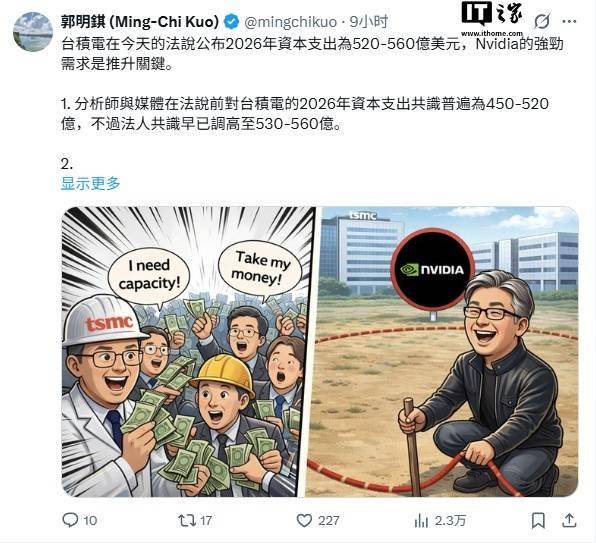
Group 1 - TSMC's capital expenditure budget for 2026 is projected to be between $52 billion and $56 billion, which translates to approximately 363.25 billion to 391.20 billion RMB [1] - Market analysis suggests that TSMC typically adopts a conservative approach when announcing capital expenditure guidance, indicating a higher likelihood that the actual expenditure will exceed pre-meeting expectations [1] - NVIDIA's strong demand is identified as a key driver for TSMC's increased capital expenditure, with NVIDIA adopting a more aggressive strategy to secure advanced process capacity [3] Group 2 - NVIDIA's CEO Jensen Huang proposed a "land package" strategy, offering to invest in securing land adjacent to TSMC's Fab 18, which significantly influenced TSMC's capital expenditure outlook [3] - Prior to Huang's proposal, institutional investors had consensus expectations for TSMC's 2026 capital expenditure at around $45 billion to $50 billion, approximately 314.36 billion to 349.28 billion RMB [3] - TSMC is facing tight capacity in advanced processes (such as 3nm and 2nm nodes) and advanced packaging technologies, maintaining a strict review mechanism for capacity allocation [4] Group 3 - To secure sufficient capacity close to their most optimistic demand, customers are encouraged to adopt strategies similar to NVIDIA's, which involves investing more funds to lock in land and bear capacity construction costs [5] - The global semiconductor manufacturing resources are becoming increasingly tight, making it more challenging for other customers to achieve similar capacity supply as NVIDIA [5]

消息称台积电考虑明年将高端工艺制程涨价 5%~10%
Sou Hu Cai Jing· 2025-09-01 05:08
Core Insights - TSMC is considering a price increase of 5% to 10% for all high-end process technologies in 2026 to offset U.S. tariffs, currency fluctuations, and supply chain cost pressures [1] - The higher pricing has been communicated to TSMC's foundry partners, affecting major customers like Nvidia and Apple who will face increased chip costs [1] - TSMC is also advancing its technology by planning to build a new 1.4nm advanced process plant, with an expected investment of 1.2 to 1.5 trillion New Taiwan Dollars (approximately 279.64 to 349.55 billion RMB) [3] Pricing Strategy - TSMC's potential price hike is a strategic response to external economic pressures, indicating a proactive approach to maintaining profitability [1] - The company has already informed its partners about the upcoming price adjustments, which will impact key clients in the semiconductor industry [1] Technological Advancements - TSMC is committed to advancing its manufacturing capabilities, with plans to start construction on a 1.4nm process plant in October 2023 [3] - The first two factories are expected to begin mass production by 2028, with future plans to progress to 1nm technology [3]
台积电消费应用接单转淡 第4季营收恐无法再创高
Jing Ji Ri Bao· 2025-08-03 23:20
Group 1 - The core viewpoint indicates that the impact of U.S. tariffs is leading to a conservative consumer outlook for the second half of the year, with expectations that demand for terminal products like PCs and smartphones during the year-end holiday season may not meet expectations [1] - TSMC's orders related to consumer applications are weakening, and there are concerns that TSMC's revenue in Q4 may decline from the historical high in Q3, marking the first time in nearly a decade that Q4 performance may not exceed Q3 [1] - Approximately 40% of TSMC's terminal applications are in the consumer sector, which is being affected by tariffs and economic changes, leading to a slowdown in growth for the peak season in Q4, although it is still expected to outperform the same period last year [1] Group 2 - TSMC's revenue in the first half of the year increased by about 40% year-on-year, with Q4 revenue estimated to be between $31.8 billion and $33 billion, averaging $32.4 billion, indicating a quarter-on-quarter decline despite being better than the same period last year [2] - The estimated decline in Q4 revenue is projected to be in the high single to mid-double digit percentage range compared to Q3 [2]