3.5D XDSiP

Search documents
3.5D封装,走到台前
半导体行业观察· 2026-03-07 03:07
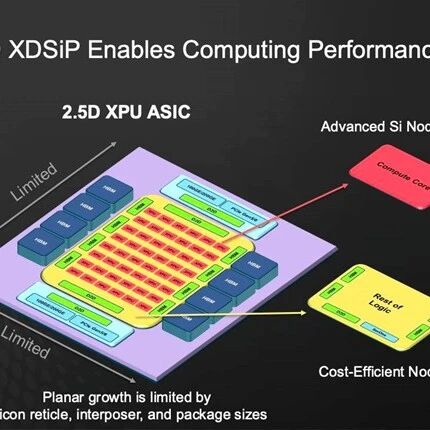
Core Viewpoint - The semiconductor industry is transitioning to a "post-Moore's Law" era, with explosive demand for computing power driving innovations in multi-dimensional architectures, exemplified by Broadcom's delivery of the first 2nm custom computing SoC based on its 3.5D XDSiP platform [2][4]. Group 1: 3.5D Packaging Technology - Broadcom's 3.5D XDSiP platform represents a significant evolution in semiconductor packaging technology, allowing for independent scaling of compute, memory, and network I/O in a compact form, addressing the increasing demands of AI training and inference [4][6]. - The 3.5D packaging integrates the advantages of 2.5D interconnects with 3D stacking capabilities, utilizing face-to-face (F2F) bonding technology to enhance signal density by 7 times and reduce power consumption by 90% [25][29]. - The technology is designed to facilitate the modularization of chiplets, enabling optimal combinations of different process nodes for enhanced performance and efficiency in AI and high-performance computing (HPC) applications [58][59]. Group 2: Industry Trends and Competitors - The demand for advanced packaging technologies is expected to grow, with 2.5D and 3D packaging projected to become the second-largest advanced packaging format by 2028, following wafer-level packaging [6][8]. - AMD has also adopted 3.5D packaging with its MI300 series AI accelerators, showcasing a competitive strategy that leverages chiplet designs for enhanced integration and performance [35][37]. - Major players like TSMC, Samsung, and Intel are actively exploring 3.5D packaging technologies, with TSMC aiming to expand its CoWoS capacity significantly by 2025 to meet the rising demand for advanced packaging solutions [46][47]. Group 3: Challenges and Future Outlook - Despite the advantages of 3.5D packaging, challenges remain in terms of cost reduction, yield improvement, and ensuring reliability under various operational conditions, particularly concerning thermal management [49][50]. - The industry is exploring new technologies and standards to address these challenges, with a focus on hybrid bonding and advanced design tools to facilitate the integration of complex systems [54][56]. - The successful implementation of 3.5D packaging is anticipated to reshape the semiconductor landscape, driving innovations in chip design and manufacturing processes, ultimately supporting the growing needs of AI and HPC sectors [58][59].



5-star analyst resets Broadcom price target before earnings
Yahoo Finance· 2026-03-03 18:47
Core Viewpoint - Broadcom's stock has significantly outperformed the S&P 500, gaining almost 60% over the past year, while the S&P 500 index is up about 15.52% during the same period [1] Group 1: Financial Performance and Outlook - Broadcom is expected to report Q1 fiscal year 2026 revenue of approximately $19.1 billion and non-GAAP EPS of $2.00, with Q2 projections of $20.4 billion and $2.16 EPS [6][7] - The Q1 results and outlook are anticipated to be slightly above consensus, driven by strength in Networking [6] - Broadcom's revenue is projected to have an adjusted EBITDA of 67% of the projected revenue [9] Group 2: Market Position and Competitive Landscape - Broadcom's partnership with Google has been pivotal, particularly in the development of TPUs, contributing to its strong market position [3] - The company has secured $21 billion in rack orders due to Anthropic's planned procurement of up to 1 million TPUs, with ramp-up expected in the second half of 2026 [6] - Competitors like Nvidia and Microsoft are also significant players in the market, with Nvidia's stock up 46% and Microsoft's up 0.39% [8] Group 3: Technological Advancements - Broadcom has begun shipping the industry's first 2nm custom compute system-on-a-chip built on its 3.5D eXtreme Dimension System-in-Package (XDSiP) platform, which enhances performance and efficiency [11] - The XDSiP platform allows for independent scaling of compute, memory, and network I/O, catering to the demands of AI applications [13] - The technology is expected to support a broader customer base and is set to ship in the second half of 2026 [14] Group 4: Analyst Insights - RBC Capital Markets has lowered Broadcom's price target to $340 from $370, citing recent peer multiple contraction [10] - The sustainability of demand for Anthropic's TPU rack beyond the initial $21 billion order remains uncertain, especially with Anthropic's agreement with Nvidia and Microsoft [10]
业界首颗3.5D芯片,博通正式交付
半导体行业观察· 2026-02-27 02:19
Core Viewpoint - Broadcom has announced the delivery of the industry's first 2nm custom computing SoC based on its 3.5D XDSiP platform, which combines 2.5D technology and face-to-face (F2F) 3D integration, marking a significant advancement in semiconductor integration technology [2][3]. Group 1: Technology and Innovation - The 3.5D XDSiP platform is a modular multi-dimensional stacked chip platform that supports independent scaling of compute, memory, and network I/O within a compact form factor, enabling efficient low-power computing for massive AI workloads [2]. - Broadcom's XDSiP technology integrates 2nm process innovations with face-to-face 3D integration, providing unprecedented computing density and energy efficiency, crucial for next-generation AI and high-performance computing [3]. - The design of Broadcom's XDSiP utilizes hybrid copper bonding (HCB) technology, optimizing inter-chip communication and significantly enhancing interconnect speed while reducing signal routing distances [10]. Group 2: Market and Strategic Partnerships - Fujitsu is the first company to publicly adopt Broadcom's 3.5D XDSiP technology, which is a key driver for its FUJITSU-MONAKA project aimed at delivering high-performance, low-power processors [3][11]. - Broadcom expects to sell at least 1 million chips based on its stacked design technology by 2027, representing a potential revenue source worth billions of dollars [15]. - The company has collaborated with major tech firms like Google and OpenAI to develop custom processing units, contributing to significant growth in its AI chip business, which is projected to double year-over-year [16]. Group 3: Competitive Landscape - Broadcom's 3.5D XDSiP technology aims to compete with existing solutions from AMD and Intel, as it seeks to establish a standardized platform for building multi-chip processors [13]. - The company is positioned as a significant competitor to NVIDIA and AMD in the AI chip market, with its technology allowing clients to build more powerful and energy-efficient chips to meet the growing computational demands of AI software [15][16]. - Broadcom's initial design is similar to AMD's MI300X but is open for licensing to any interested parties, indicating a strategic move to broaden its market reach [8][13].
OpenAI会做个怎样的芯片?
半导体行业观察· 2025-09-08 01:01
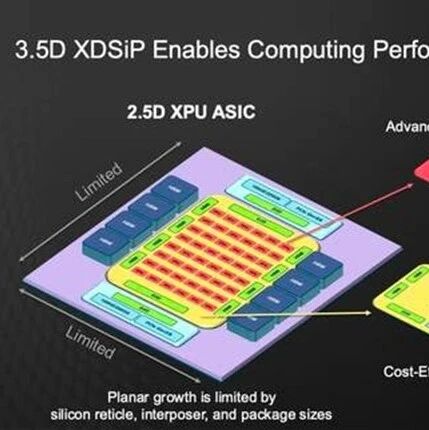
Core Viewpoint - OpenAI is reportedly developing custom AI accelerators with the help of Broadcom to reduce reliance on Nvidia and lower costs for its GPT series models [1][2]. Group 1: OpenAI and Broadcom Collaboration - Broadcom's CEO revealed that OpenAI is a $10 billion customer, indicating a significant partnership focused on AI technology [1]. - OpenAI is rumored to be developing a chip to replace Nvidia and AMD GPUs, expected to be unveiled next year for internal use only [1][2]. - Broadcom is currently serving three XPU customers and anticipates improved AI revenue prospects for fiscal year 2026 due to substantial orders [1]. Group 2: Technical Aspects of the Chip - The architecture of OpenAI's chip may resemble AMD's MI300 series, utilizing advanced stacking techniques for high-performance computing [5]. - Broadcom's 3.5D XDSiP technology is likely a candidate for OpenAI's chip, supporting extensive AI computing systems [5][7]. - The chip will require high-performance matrix multiplication units and sufficient high-bandwidth memory to optimize AI workloads [7]. Group 3: Broader Industry Context - OpenAI's investment in AI infrastructure aligns with broader trends, as other companies like Apple are also rumored to collaborate with Broadcom for custom AI accelerators [9][10]. - Apple has committed to investing $500 billion and expanding its domestic manufacturing capabilities, indicating a competitive landscape in AI chip development [10].