
3D打印服务

Search documents
南风股份(300004):核电领域HVAC重要供应商3D打印业务可期
Shenwan Hongyuan Securities· 2026-03-25 15:37
Investment Rating - The report assigns an "Accumulate" rating for the company, marking its first coverage [6][8]. Core Insights - The company is a key supplier in the nuclear power HVAC sector, with over 80% market share in China, and is expected to benefit from the accelerated pace of nuclear power construction during the 14th Five-Year Plan [6][8]. - The company is also venturing into the 3D printing business, which is anticipated to become a significant growth driver in the future [6][8]. - Financial forecasts indicate a recovery in profitability, with projected net profits of 0.42 billion, 1.14 billion, and 1.95 billion yuan for 2025, 2026, and 2027 respectively [7][8]. Financial Data and Profit Forecast - Total revenue is projected to grow from 6.20 billion yuan in 2024 to 12.53 billion yuan in 2027, with a compound annual growth rate (CAGR) of approximately 43.9% [2]. - The net profit attributable to shareholders is expected to increase significantly, from 0.42 billion yuan in 2025 to 1.95 billion yuan in 2027, reflecting a strong recovery trajectory [2][7]. - The earnings per share (EPS) is forecasted to rise from 0.09 yuan in 2025 to 0.41 yuan in 2027 [2][7]. Business Overview - The company specializes in ventilation and air handling systems, primarily serving the nuclear power, subway, and tunnel industries, with a strong competitive position in these markets [18][19]. - The 3D printing segment is being developed through its subsidiary, which aims to provide comprehensive 3D printing services and has already established initial partnerships in various industries [19][20]. Market Position and Competitive Advantage - The company holds a unique position as the first in the industry to obtain design and manufacturing licenses for nuclear-grade fans and valves, establishing a significant barrier to entry for competitors [6][8]. - The HVAC systems for nuclear power plants are critical for ensuring safety and operational efficiency, which enhances the company's value proposition in this sector [59][60]. Growth Drivers - The acceleration of nuclear power construction and infrastructure projects during the 14th Five-Year Plan is expected to drive demand for the company's products [10][11]. - The 3D printing technology, particularly its dual light source approach, is anticipated to find applications in high-tech industries, further diversifying the company's revenue streams [10][11].

华曙高科:4Q25强劲反转,3C 需求爆发驱动公司迎奇点
SINOLINK SECURITIES· 2026-03-01 05:45
Investment Rating - The report assigns a "Buy" rating for the company, indicating an expected price increase of over 15% in the next 6-12 months [13]. Core Insights - The company is projected to achieve significant revenue growth, with estimated revenues of 716 million, 1.34 billion, and 2.26 billion RMB for 2025, 2026, and 2027 respectively, reflecting year-on-year growth rates of 45.6%, 86.9%, and 68.5% [4][9]. - The net profit attributable to the parent company is expected to be 68 million, 165 million, and 309 million RMB for the same years, with growth rates of 1.4%, 142.6%, and 86.8% respectively [4][9]. - The company is focusing on expanding its 3D printing services, particularly in the consumer electronics sector, which is expected to drive rapid revenue growth [10]. - The industrial-grade 3D printing market is experiencing a surge in demand, and the company is well-positioned with a comprehensive product and service offering, creating a strong competitive barrier [10]. Financial Projections - Revenue and net profit forecasts for the company are as follows: - 2025: Revenue of 716 million RMB (+45.6% YoY), Net Profit of 68 million RMB (+1.4% YoY) - 2026: Revenue of 1.34 billion RMB (+86.9% YoY), Net Profit of 165 million RMB (+142.6% YoY) - 2027: Revenue of 2.26 billion RMB (+68.5% YoY), Net Profit of 309 million RMB (+86.8% YoY) [4][9]. - The price-to-sales (P/S) ratios for 2025, 2026, and 2027 are projected to be 60X, 32X, and 19X respectively [4].

未知机构:国金计算机科技华曙高科4Q2025强劲反转3C需求爆发驱动公司迎奇-20260228
未知机构· 2026-02-28 02:30
Summary of Conference Call Notes Company and Industry Overview - The conference call discusses **华曙高科 (Huashu High-Tech)**, a company in the **3D printing** industry, particularly focusing on applications in the **3C (computer, communication, consumer electronics)** sector [1][2]. Key Financial Highlights - In **2025**, the company reported a revenue of **¥7.16 billion**, representing a **45.6% year-over-year increase**, indicating a strong reversal and high growth trend [1]. - For **4Q2025**, the revenue reached **¥3.18 billion**, showing a **116.2% year-over-year increase** and a **100% quarter-over-quarter increase** [1]. - The net profit attributable to shareholders for **4Q2025** was **¥0.53 billion**, which is a **128.2% year-over-year increase** and a **430% quarter-over-quarter increase** [1]. - The net profit margin for **4Q2025** was **16.8%**, up by **0.9 percentage points year-over-year** and **10.5 percentage points quarter-over-quarter** [1]. Core Business Insights - The company is experiencing a **surge in demand** for 3D printing services, particularly in the **3C sector**, driven by improvements in titanium powder production processes [1]. - Major smartphone manufacturers like **Apple, Honor, and Huawei** are accelerating the application of 3D printing titanium alloy technology in the mass production of precision components such as **foldable screen hinges and titanium alloy frames** [1]. Strategic Initiatives - The company has established a **joint venture** to expand its 3D printing services in the **civilian sector**, focusing on the **3C industry**, which is expected to drive rapid revenue growth [2]. - The **industrial-grade 3D printing** market is experiencing a significant increase in demand, necessitating a shift from traditional manufacturing processes to 3D printing technology to meet requirements for **heat dissipation and lightweight materials** [2]. - The company has a comprehensive product layout, covering both **metal and polymer 3D printers**, and is enhancing its service offerings in 3D printing, thereby building a **top-tier competitive barrier** [2]. Risk Factors - Potential risks include **underperformance in downstream application expansion**, **technology iteration risks**, **geopolitical and exchange rate fluctuations**, and **lock-up stock release risks** [3].
华曙高科:2025年净利润6798.12万元,同比增长1.15%
Xin Lang Cai Jing· 2026-02-27 09:13
Core Viewpoint - The company reported significant revenue growth for the fiscal year 2025, driven by technological innovations and market expansion [1] Financial Performance - The total operating revenue for 2025 reached 716 million yuan, representing a year-on-year increase of 45.55% [1] - The net profit for the same period was 67.98 million yuan, showing a modest year-on-year growth of 1.15% [1] Technological Advancements - The company continuously upgraded and transformed its equipment through technological innovation, enhancing product printing efficiency [1] - Software systems, control modules, and production processes were optimized to cater to diverse application scenarios [1] Market Expansion - The company actively expanded its downstream application market and improved its industrial chain layout [1] - This expansion effectively enhanced production efficiency and accelerated the order delivery process [1] - The company also provided 3D printing services based on the needs of downstream customers, contributing to the significant revenue growth in 2025 [1]
登顶美国亚马逊畅销榜,3D打印材料商三绿科技挂牌、IPO齐推进
Sou Hu Cai Jing· 2026-02-25 14:31
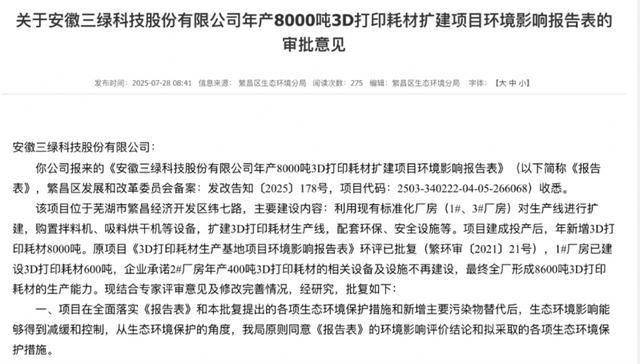
Group 1 - The company Anhui Sanlv Technology Co., Ltd. has entered the IPO guidance phase by signing a counseling agreement with Dongfang Securities and completing the filing with the Anhui Securities Regulatory Bureau [1][2] - The company operates in the rubber and plastic products industry, focusing on the development of 3D printing materials and related equipment [2][4] - As of the end of 2024, the company had 115 employees and held 102 patents, indicating a strong focus on innovation and intellectual property [4] Group 2 - The company plans to expand its production line to add 8,000 tons of 3D printing materials annually, which will enhance its production capacity [2] - The company has a registered capital of 65.3722 million yuan and is currently applying for listing on the National Equities Exchange and Quotations [2][4] - The major shareholders include Jiang Kun, who holds 48.69% of the shares, and other family members, indicating a family-controlled structure [4][5] Group 3 - The company reported significant revenue growth, with total revenues of 468 million yuan in 2023 and projected revenues of 763 million yuan in 2024 [10] - The net profit for 2023 was approximately 43.91 million yuan, increasing to about 61.29 million yuan in 2024, reflecting a positive financial trend [10] - The asset-liability ratio improved from 59.48% in 2023 to 46.56% in mid-2025, indicating better financial health [10][11] Group 4 - The company primarily sells its products through online platforms, with B2C sales accounting for 80.23% of total revenue in the first half of 2025 [13][14] - The FDM consumables segment has shown strong sales performance, contributing 84.12% of total revenue in the first half of 2025 [15][16] - The company has established a comprehensive sales system that includes major e-commerce platforms like Amazon and eBay, enhancing its market reach [13] Group 5 - The company has undergone A-round financing in 2022, with investments from state-owned enterprises and venture capital firms, indicating strong backing [6][8] - The company has faced inquiries from the National Equities Exchange regarding its sales model and operational performance, which may impact its IPO process [20][22] - The company has a significant amount of inventory, valued at approximately 85.73 million yuan at the end of 2025, which is crucial for meeting market demand [19]

科塞尔智能科技(苏州)有限公司成立,注册资本3000万人民币
Sou Hu Cai Jing· 2026-02-07 00:33
Core Viewpoint - Koser Intelligent Technology (Suzhou) Co., Ltd. has been established with a registered capital of 30 million RMB, fully owned by Norsberry New Materials Technology (Suzhou) Co., Ltd. [1] Group 1: Company Overview - The legal representative of Koser Intelligent Technology is Mao Weihua [1] - The company is registered with a capital of 30 million RMB [1] - The business scope includes design and production of civil aircraft components, AI application software development, 3D printing services, and new materials technology research [1] Group 2: Shareholding Structure - Norsberry New Materials Technology (Suzhou) Co., Ltd. holds 100% of Koser Intelligent Technology [1] Group 3: Business Activities - The company is involved in various activities including software development, technical services, and import/export of goods and technology [1] - Specific activities require approval from relevant authorities before commencement [1]
未知机构:国金计算机科技华曙高科全球3D打印龙头下游需求临近爆发节点-20260203
未知机构· 2026-02-03 02:10
Summary of Conference Call Records Company and Industry Overview - The company discussed is Huashu High-Tech, a leading player in the global 3D printing industry, particularly in metal and polymer 3D printing equipment [1][2] - The global 3D printing market is projected to reach $21.9 billion in 2024, with an expected compound annual growth rate (CAGR) of 18% over the next decade, potentially exceeding $114.5 billion by 2034 [2] Core Insights and Arguments - The company has established a complete ecosystem that includes equipment, materials, proprietary software, and after-sales services, creating significant competitive barriers [1] - The R&D expense ratio for the company is projected to reach 22.23% in Q1-Q3 2025, indicating a strong commitment to maintaining technological leadership [1] - A joint venture is set to be established by December 2025, focusing on 3D printing services in consumer sectors such as 3C, which is expected to shift the company’s revenue model from solely equipment and materials to a dual-driven model including services [1][3] - The aerospace sector is anticipated to account for nearly 50% of the company's revenue in 2024, with significant contributions from the FS1521M large-scale equipment, which can be configured with up to 32 fiber lasers [2] - The company is actively expanding its 3D printing services in the 3C and automotive industries, with major clients like Apple and Honor adopting 3D printing technology for precision components [2] Additional Important Points - The company is positioned to benefit directly from the explosive demand in the aerospace sector, as evidenced by a core client, Fei Er Kang, purchasing approximately 40 metal 3D printing machines [2] - The investment recommendation suggests a "buy" rating based on the company's technological advantages and the anticipated rapid growth in 3D printing services and equipment [3] - Risks highlighted include potential underperformance in downstream application expansion, fluctuations in raw material prices, technological evolution risks, geopolitical and exchange rate volatility, and risks associated with the unlocking of restricted shares [3]
2025年我国3D打印设备产量同比增长52.5% 3D打印为什么又火了?
Zheng Quan Ri Bao· 2026-02-02 00:01
Core Insights - 3D printing technology is experiencing rapid growth, transitioning from laboratory settings to production lines and everyday applications, driven by increasing demand and decreasing costs [1][2][4] Group 1: Market Demand and Applications - The significant increase in 3D printing equipment production by 52.5% by 2025 reflects strong downstream demand, particularly for personalized and customized products [1] - Consumers can now easily access 3D printing services through e-commerce platforms, allowing for high-precision products without the need to own a printer [1] - 3D printing is becoming an essential tool for companies in research and flexible production, enabling rapid prototyping and reducing development cycles [3] Group 2: Cost Reduction Factors - The decline in manufacturing costs for 3D printers is attributed to advancements in domestic manufacturing capabilities, with consumer-grade printers now priced similarly to mid-range smartphones [2] - The development of new alternative alloys and AI technologies has further reduced costs and simplified the modeling process, making 3D printing more accessible [3] Group 3: Policy and Capital Support - Government policies are playing a crucial role in promoting the market development of 3D printing, with initiatives aimed at innovation and application expansion [4] - Significant capital investment has been observed in the 3D printing sector, with various companies, including tech giants and venture capitalists, actively funding the industry [5] Group 4: Challenges and Solutions - Despite the growth, the 3D printing industry faces challenges in service and business models, with many users struggling with common issues like nozzle blockages and inadequate after-sales support [6] - Shared manufacturing and leasing models are being explored to help small and medium-sized enterprises reduce initial costs and operational expenses [7] - The industry is also leveraging e-commerce platforms and AI technologies to improve demand response and streamline the manufacturing process [7]
3D打印为何又火了
Jing Ji Ri Bao· 2026-02-01 22:06
Core Insights - The production of 3D printing equipment in China is expected to grow by 52.5% year-on-year by 2025, driven by strong downstream demand and advancements in technology [1][2][4] Application Trends - The demand for personalized and customized products is becoming mainstream, with consumers able to easily order 3D printed items through e-commerce platforms [1] - 3D printing technology is increasingly being integrated into various fields such as cultural creativity and educational technology, creating new consumer experiences and driving industry growth [3] Cost Reduction Factors - Significant reductions in manufacturing costs for 3D printers have been achieved due to advancements in domestic manufacturing capabilities, with consumer-grade 3D printers now priced similarly to mid-range smartphones [2] - The development of new alternative alloys and AI technologies has further reduced costs and simplified the operation of 3D printing, making it more accessible to the general public [3] Policy and Capital Support - Government policies are playing a crucial role in promoting the market development of 3D printing, with initiatives aimed at fostering innovation and expanding applications [4] - The 3D printing industry has seen multiple financing rounds since 2025, with investments from both tech companies and venture capital firms, indicating strong market interest [5][6] Challenges and Opportunities - Despite the growth, the 3D printing industry is still in its early stages, facing challenges in technical services and business models [7] - There is a mismatch between diverse market demands and supply efficiency, with the need for improved service models such as shared manufacturing and leasing to support small and medium enterprises [8][9]
3D打印为什么又火了
Zheng Quan Ri Bao· 2026-02-01 16:07
Core Insights - The 3D printing industry is experiencing significant growth, with a projected 52.5% increase in equipment production by 2025, driven by strong downstream demand and advancements in technology [1][2][4]. Group 1: Market Demand and Applications - The rise in 3D printing equipment production reflects a booming demand for personalized and customized products, particularly in sectors like cosplay and the anime industry [1]. - Consumers can now easily access 3D printing services through e-commerce platforms, allowing them to obtain high-precision products without needing to own a printer [1]. - 3D printing is becoming an essential tool for companies in research and development, enabling rapid prototyping and reducing costs associated with trial and error [3]. Group 2: Technological Advancements - The decline in costs for 3D printing technology is attributed to breakthroughs in domestic manufacturing components, with consumer-grade printers now priced similarly to mid-range smartphones [2]. - New alternative alloys and AI technologies are enhancing the efficiency and accessibility of 3D printing, making it suitable for a wider range of applications [3]. - Features like automatic leveling and cloud-based algorithms are simplifying the user experience, transforming 3D printers into household appliances rather than specialized tools [3]. Group 3: Policy and Investment Support - Government policies are playing a crucial role in promoting the market development of 3D printing, with initiatives aimed at fostering innovation and expanding applications [4]. - Recent policies have identified desktop 3D printers as key digital consumer products, and educational institutions are increasingly incorporating 3D printing into their curricula [4]. - Capital investment in the 3D printing sector has surged, with numerous financing rounds completed since 2025, involving both tech companies and venture capital [5]. Group 4: Challenges and Solutions - Despite the growth, the 3D printing industry faces challenges in service and business model development, with many users struggling with common issues like nozzle clogs and material compatibility [6]. - The uneven distribution of professional 3D printing service providers makes it difficult to meet diverse market demands, particularly in lower-tier markets [6]. - Shared manufacturing and leasing models are being explored to reduce costs for small and medium enterprises, although these models face operational challenges [7].