3D集成芯片

Search documents
链接两大国家级经济圈 “无锡实践”打造协同发展新样本
Zheng Quan Shi Bao· 2025-10-19 18:00
Core Insights - The article highlights the collaborative efforts between the Yangtze River Delta and the Guangdong-Hong Kong-Macau Greater Bay Area, emphasizing their roles as key growth engines for China's high-quality economic development [1] Group 1: Regional Collaboration - Wuxi is leveraging its strategic position in the Yangtze River Delta to propose the establishment of a collaborative innovation zone between the Yangtze River Delta and the Greater Bay Area, aiming to break down regional barriers and enhance cooperation [1][2] - The establishment of the Xiganghu Intelligent Robotics Research Institute, led by top research teams, aims to cultivate ten innovative robotics companies within three years, serving as a model for cross-regional innovation collaboration [2][3] Group 2: Innovation and Technology - The Xiganghu Institute has developed a complete innovation chain from basic research to industrial application, focusing on intelligent robotics and smart detection technologies [2][3] - Wuxi has established 17 innovation "outposts" in the Greater Bay Area, facilitating 136 cooperative projects and attracting over 120 companies, thereby enhancing cross-regional innovation dynamics [2][3] Group 3: Financial Integration - Wuxi is actively integrating into the Greater Bay Area's financial ecosystem, hosting events to connect local enterprises with investors and establishing various funds to support technology and industry [5][6] - The city has implemented policies to support high-quality development for listed companies, resulting in 58 companies listed on the Shenzhen Stock Exchange and 26 on the Hong Kong Stock Exchange, fostering a sustainable capital link for regional integration [6]
三维芯片堆叠, 革新下一代计算架构
半导体行业观察· 2025-06-21 03:05
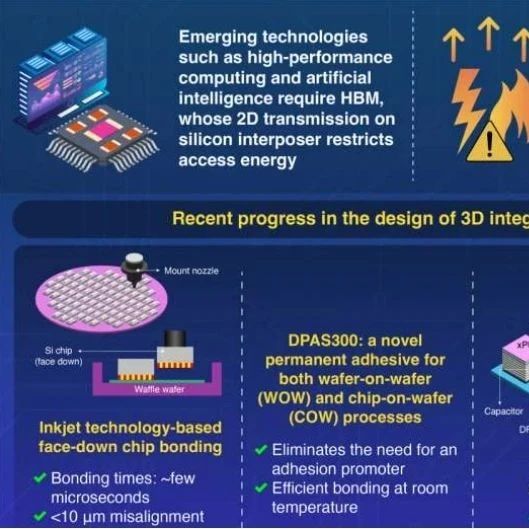
Core Viewpoint - The article discusses the development of a new power technology for 3D integrated chips using a three-dimensional stacked computing architecture, addressing the demand for high-performance computing applications that require high memory bandwidth, low power consumption, and low power noise [3][6]. Group 1: Technology Development - Researchers have developed key technologies such as precision high-speed bonding and adhesive techniques to meet the needs of high-performance computing applications [3]. - The traditional system-in-package (SiP) methods are limited in size, necessitating the development of new chip integration technologies [3]. - The innovative 2.5D/3D chip integration method named BBCube was conceived by a research team from Science Tokyo [3][5]. Group 2: Research Achievements - The research team successfully bonded different sized chips onto a 300 mm wafer with a spacing of only 10 μm, achieving a bonding time of less than 10 milliseconds [5]. - Over 30,000 different sized chips were manufactured on the wafer without any chip detachment failures [5]. - A new adhesive material, DPAS300, was developed, exhibiting good adhesion and thermal stability for the COW and wafer-to-wafer processes [5]. Group 3: Performance Enhancements - To enhance memory bandwidth and power integrity of BBCube, a 3D xPU-on-DRAM architecture was adopted, incorporating new power distribution highways [6]. - Innovations reduced the energy required for data transmission to one-fifth to one-twentieth of that of traditional systems, while power noise was suppressed to below 50 mV [6]. - The chip integration technology developed by the researchers has the potential to transform the next generation of computing architectures [6].