718 Cayman

Search documents
Porsche Cars Canada reports its sales results for 2025
Globenewswire· 2026-01-16 14:00
Sales Performance - Porsche Cars Canada, Ltd. reported total sales of 10,010 units for 2025, reflecting a decrease of 3.5% compared to 2024's sales of 10,374 units [1][3] - Porsche Approved Certified Pre-Owned vehicle sales increased to 4,295 units in 2025, marking a growth of 4.7% from 4,101 units in 2024 [1][3] Model-Specific Sales - The 718 Boxster saw sales of 468 units in 2025, up from 451 units in 2024 [3] - The 718 Cayman experienced a significant increase in sales, reaching 506 units in 2025 compared to 379 units in 2024 [3] - The 911 model sold 2,037 units in 2025, down from 2,208 units in the previous year [3] - The Cayenne model's sales decreased to 2,551 units from 2,949 units in 2024 [3] - The Macan model had sales of 3,877 units, an increase from 3,779 units in 2024 [3] - The Panamera model's sales rose to 321 units from 248 units in 2024 [3] - The Taycan model saw a decline in sales, with 250 units sold compared to 360 units in 2024 [3] Brand Development - The opening of the Porsche Experience Centre Toronto in 2025 has enhanced customer engagement and brand presence in Canada, being the first of its kind in the country and the tenth globally [2][4] - Porsche Cars Canada, Ltd. employs over 70 staff members to support various functions including sales, marketing, and public relations, ensuring a high-quality customer experience [4]


Porsche Deliveries Fall on China Woes and Model Gaps
WSJ· 2026-01-16 08:11
Group 1 - Deliveries dropped by 10% in 2025 due to a slowdown in luxury spending in China [1] - The company ceased production of its 718 Boxster and 718 Cayman models, contributing to the decline in deliveries [1]
保时捷闭店、关停充电桩,在中国开始降本求生
3 6 Ke· 2025-12-31 01:00
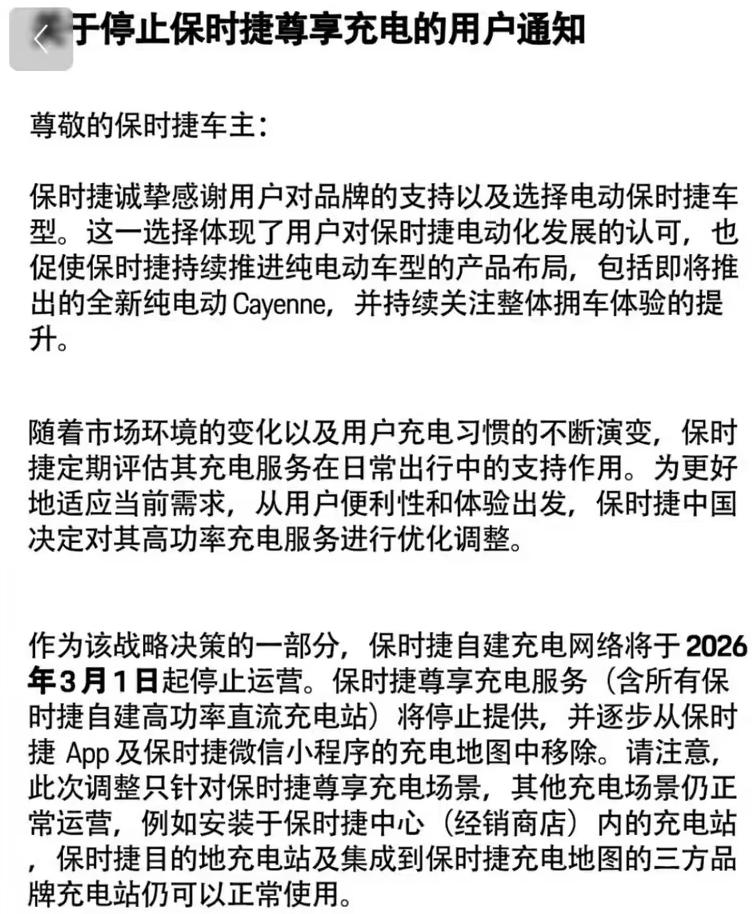
Core Viewpoint - Porsche is undergoing significant cost-cutting measures in China, including the withdrawal of its self-built charging network and the closure of several dealerships, amid a sharp decline in profits and sales in the region [1][6][10]. Group 1: Cost-Cutting Measures - Porsche has announced the gradual dismantling of its self-built charging network in China, effective from March 1, 2026, while still providing access to third-party charging resources [1][3]. - The company has reportedly closed several dealerships, including the Zhengzhou and Guiyang centers, with concerns raised about customer deposits and service packages [6][8]. - Plans are in place to reduce the number of sales outlets in China from 150 to 80 by 2024, indicating a significant contraction in its operational footprint [8]. Group 2: Financial Performance - Porsche's operating profit plummeted from €4.035 billion (approximately ¥33.395 billion) in the same period last year to just €40 million (around ¥331 million), marking a 99% year-on-year decline [10][11]. - The company reported a net profit drop of 95.9% to €114 million (about ¥943 million) for the first three quarters, with a net loss of €600 million (approximately ¥4.97 billion) in the third quarter alone [10][11]. - Total cash and cash equivalents decreased by €1.591 billion (around ¥13.14 billion) to €5.531 billion (approximately ¥45.7 billion) [11]. Group 3: Sales and Market Dynamics - Global deliveries for Porsche fell by 6% year-on-year, with the Chinese market experiencing a 26% decline, dropping from being the largest market to the third largest [12]. - Despite the downturn, Porsche is not abandoning the Chinese market; instead, it is adjusting its strategy to regain market share, including the establishment of a strategic R&D center in Shanghai [12][15]. - The R&D center aims to develop market-specific technologies, such as infotainment systems and driver assistance solutions, with a focus on accelerating development cycles [15]. Group 4: Strategic Adjustments - Porsche is shifting its approach to electric vehicle production, with plans to modify its electric platform to accommodate internal combustion engine models, indicating a potential return to fuel-powered vehicles [16].
保时捷变招,大力发展混动车型而非纯电动汽车
汽车商业评论· 2025-05-22 13:23
Core Viewpoint - Porsche is adjusting its electric vehicle (EV) strategy due to slowing demand in the luxury car segment, indicating that the ambitious goal of launching over 80% electric sports cars by 2030 may not be realistic given current market trends [3][5][7]. Group 1: Strategic Adjustments - The company plans to balance its production strategy between fuel vehicles, hybrid vehicles, and electric sports cars, acknowledging that the transition to electric vehicles may take longer than initially expected [3][7]. - Porsche's strategic shift is expected to result in an additional loss of €1.3 billion in the fiscal year 2025, alongside a plan to cut approximately 3,900 jobs by 2029 [7][9]. - The CEO highlighted the need for a flexible approach to production in response to market developments, emphasizing that the company is currently restructuring around a target of 250,000 units per year [5][9]. Group 2: Market Challenges - Porsche's first-quarter 2025 revenue was €8.86 billion, a 1.7% year-over-year decline, with a significant drop in sales profit by 40.6% to €760 million [9]. - The company faced a 42% decline in deliveries in the Chinese market, which is its largest market, while European markets also saw declines of 10% and 34% [9][11]. - The CEO acknowledged the challenges posed by tariffs in the U.S. and a significant downturn in the Chinese market, describing the current situation as a "fierce storm" [11][28]. Group 3: Product Development - Porsche is expanding its product line to include more models equipped with fuel and plug-in hybrid systems alongside electric models, with plans for a new SUV series expected to launch by the end of the decade [16][18]. - The electric versions of the 718 models have faced delays, now expected to launch in 2027 due to supply chain issues with high-performance batteries [20][22]. - The Cayenne series will see both fuel and electric versions available, with the electric version set to launch later this year [18][24]. Group 4: Leadership and Governance - The dual role of the CEO, managing both Porsche and its parent company Volkswagen, has come under scrutiny from investors, who are concerned about the impact on independent management [26][28]. - Investors are urging the CEO to focus on one company amid pressures from declining stock prices and challenges in key markets [28].