90GHz示波器

Search documents
中美半导体竞争进入新阶段,国产芯片“能力版图”逐步补齐 | 湾芯展 2025
Tai Mei Ti A P P· 2025-10-17 10:49
Core Insights - The 2025 Bay Area Semiconductor Industry Ecosystem Expo (Bay Chip Expo 2025) was held in Shenzhen, attracting over 600 companies from major integrated circuit countries and regions, including prominent global players and domestic firms [1][8] - New Kai Lai emerged as a standout participant, showcasing a range of semiconductor process and testing equipment, including optical inspection products and advanced measurement devices [1][5] - New Kai Lai's subsidiaries, Wanliyan and Qiyunfang, launched new technologies, including domestic EDA design software and a new generation of high-speed real-time oscilloscopes with bandwidth exceeding 90 GHz, addressing critical technology gaps in China's semiconductor capabilities [1][6][7] Company Highlights - New Kai Lai was established in June 2022 in Longgang District, Shenzhen, with a registered capital of 1.5 billion yuan, fully owned by Shenzhen Deep Core Technology Investment Co., Ltd., which is ultimately controlled by the Shenzhen State-owned Assets Supervision and Administration Commission [2] - The company’s booth at the expo attracted significant attention, indicating its role as a key player in the semiconductor industry [1][5] Product Innovations - Wanliyan's newly released 90 GHz oscilloscope enhances domestic oscilloscope performance by 500%, with a sampling rate of 200 billion samples per second, enabling precise capture of high-speed signals [5][6] - Qiyunfang introduced EDA design software that supports collaborative design and improves performance metrics, including a 30% increase in efficiency and a 40% reduction in development cycles [7] Industry Developments - The expo also highlighted the 2024 Annual Top Ten Advances in Chinese Chip Science, showcasing significant technological breakthroughs that challenge foreign monopolies in advanced semiconductor devices [8] - A new semiconductor and integrated circuit fund was launched in Shenzhen with an initial scale of 5 billion yuan, focusing on various core areas, including general and specialized computing power and advanced packaging technologies [9] - Shenzhen's semiconductor and integrated circuit industry is projected to reach 256.4 billion yuan in 2024, reflecting a year-on-year growth of 26.8% [9]

每经热评|600余家企业集中亮相湾芯展 中国芯片的“硬实力”藏不住了
Mei Ri Jing Ji Xin Wen· 2025-10-16 14:45
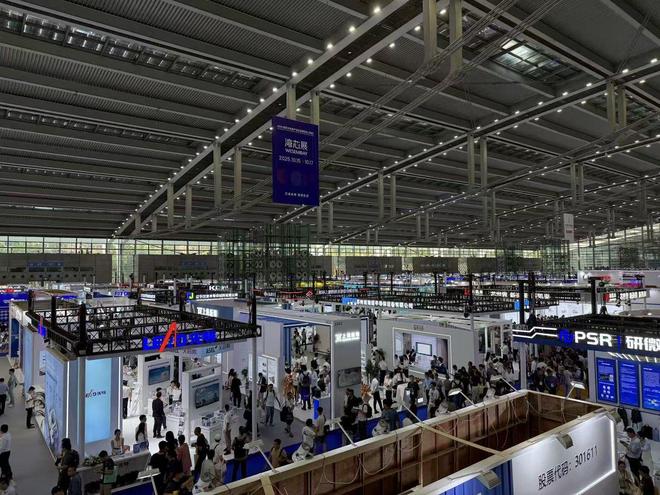
Core Insights - The 2025 Bay Area Semiconductor Industry Ecosystem Expo (Bay Chip Expo) in Shenzhen showcased over 600 companies and attracted thousands of visitors, highlighting the advancements and potential of China's semiconductor industry [1][2] - The expo serves as a platform for Chinese chip manufacturers to demonstrate their innovations and capabilities, particularly in overcoming previous technological restrictions imposed by foreign entities [1][4] - China's semiconductor market is characterized by a robust industrial ecosystem, which fosters collaboration and innovation across the entire supply chain [2][3] Industry Overview - In 2024, China's integrated circuit import scale is projected to reach approximately 2.8 trillion yuan, with the Bay Area being the largest semiconductor growth market in China [2] - The expo emphasizes the importance of a complete industrial system that provides diverse application scenarios for chips, facilitating new market opportunities [2] - The semiconductor industry is known for its high capital requirements and long cycles, necessitating support from risk and patient capital, which the expo exemplifies [2][3] Market Dynamics - As of Q3 2025, there have been 93 mergers and acquisitions in China's chip industry, a 33% increase year-on-year, with a total transaction value of 54.9 billion yuan, reflecting a nearly 50% growth [3] - The expo also highlights the increasing participation of foreign companies, with international exhibitors growing by over 50%, indicating China's openness to global collaboration [3][4] Future Outlook - The Chinese semiconductor industry is moving towards maturity, with a focus on comprehensive system advancements across design, equipment, materials, and software [4][5] - Continuous innovation and open cooperation are seen as key strategies for building resilience and securing a competitive edge in the future [5]
专访深圳技术大学集成电路与光电芯片学院院长宁存政:国内半导体优势在“量”,短板在“精”
Mei Ri Jing Ji Xin Wen· 2025-10-16 09:30
Core Insights - The current state of China's semiconductor industry shows significant advantages in labor costs, market scale, and mid-to-low-end equipment manufacturing, but there are notable shortcomings in high-end technology areas, particularly in lithography machines and other advanced equipment [1][7][9] Industry Overview - The semiconductor sector is the core of the information technology industry, essential for modern technological development and closely related to daily life and research [2][6] - Establishing a complete domestic industrial ecosystem, research ecosystem, and supply chain is crucial for long-term healthy development [2][6] Domestic Advantages - China's semiconductor industry benefits from labor, scale production, cost control, and market size, with significant capabilities in low-tech equipment manufacturing [7] - The industry chain's downstream has reached a high level of maturity, especially in Shenzhen and surrounding areas, leveraging a complete industrial ecosystem and diverse application scenarios [7] Challenges and Shortcomings - There are significant gaps in high-end technology products, particularly in critical manufacturing equipment like lithography machines, which require high reliability and consistency [8][9] - The industry faces challenges in upgrading and breaking through in high-precision technology areas, which are key to future development [8] Recent Innovations - Recent innovations in the semiconductor field include the launch of the new Kai Lai 90GHz oscilloscope, showcasing ongoing advancements across various segments [10] - The establishment of a semiconductor micro-nano processing center at Shenzhen Technology University aims to support small and medium enterprises in high-end chip research and development, reducing barriers and costs [10]