
ADS MAX 4.1智驾系统

Search documents
商业航天+太空算力+3D打印,最硬核的16家公司
Sou Hu Cai Jing· 2025-12-29 15:28
Group 1: Policy and Capital - The policy environment is clearing obstacles for commercial aerospace, with Shanghai emphasizing the construction of a world-class industrial cluster and supporting commercial aerospace companies in satellite internet constellation construction [2] - The new regulations from the Shanghai Stock Exchange specifically target commercial rocket companies, signaling a key move to accelerate innovation in commercial aerospace [2] - The National Space Administration has issued a plan for high-quality and safe development of commercial aerospace, outlining 22 key measures, including the establishment of a national commercial aerospace development fund [2][24] Group 2: Rocket Technology Costs - The core bottleneck in commercial aerospace is insufficient capacity and high costs, with domestic commercial rocket launch prices ranging from 60,000 to 150,000 RMB per kilogram, compared to SpaceX's Falcon 9 at approximately 21,000 RMB per kilogram [3] - Domestic reusable technology is still under development, with recent test flights indicating progress but not yet achieving successful landings [3] - The use of 3D printing technology is revolutionizing rocket engine production, significantly reducing costs and manufacturing time [4] Group 3: Satellite Constellation Networking - The competition in satellite internet is fundamentally about the allocation of orbital and frequency resources, with strict deadlines imposed by the International Telecommunication Union (ITU) [5] - China has multiple large-scale satellite constellation plans, including the G60 constellation aiming to deploy 1,296 satellites by 2027 and over 10,000 by 2030 [5][6] - The pace of satellite launches has accelerated significantly since the second half of 2025, indicating a shift from planning to actual deployment [6] Group 4: Space Computing - The demand for computing power is growing exponentially, with space offering unique advantages for data processing, such as low cooling requirements and abundant solar energy [7] - Companies like Google and NVIDIA are leading initiatives to establish space-based data centers, with plans to deploy satellites equipped with AI chips for data processing [7][30][31] - China is also advancing in this area, with plans for a space computing constellation and the first space computing center expected to be operational within five years [8] Group 5: Industry Chain Extension and Ecosystem - The technological spillover from commercial aerospace is empowering other industries, particularly in automotive intelligence and low-altitude economy [9] - Various initiatives are being launched to enhance data assetization and promote the integration of data elements into rural revitalization efforts [9] - The convergence of commercial aerospace with the digital economy is forming a closed-loop ecosystem, linking satellites, vehicles, and data centers [9] Group 6: Key Companies to Watch - Companies to focus on include those involved in space computing and data, such as Shunhao Co., Putian Technology, and Yuke Technology [10] - In rocket manufacturing and 3D printing, key players include Aerospace Power, Western Materials, and Aerospace Electromechanical [10] - For satellite communication and payload, notable companies include China Satellite, Shanghai Hanhua, and Aerospace Hongtu [10]

全球科技(计算机)行业周报:商业航天、6G成产业布局重点,政策技术驱动-20251229
Huaan Securities· 2025-12-29 03:07
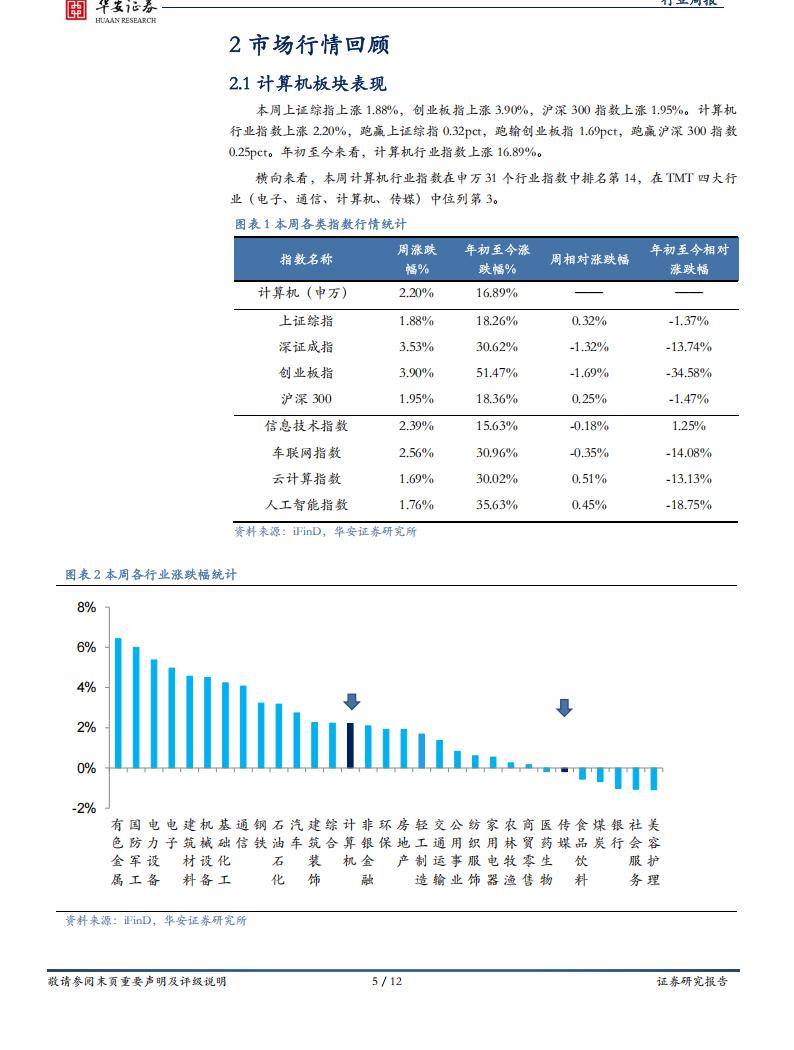
Investment Rating - The industry investment rating is "Overweight" [1] Core Insights - The report highlights that commercial aerospace and 6G are key areas for industrial layout, driven by policy and technology [3][4] - A recent policy from Shanghai supports the construction of a world-class industrial cluster focusing on commercial aerospace and 6G, emphasizing application-based research and key technology breakthroughs [12][13] - The third Commercial Aerospace Development Conference indicated that the industry has entered a new phase of scale and commercialization, with a projected market size to achieve a leap forward [13] - The establishment of a 2 billion yuan fund for commercial aerospace and a talent training program to supply 1,000 skilled workers annually over the next 3-5 years were also announced [13][4] Summary by Sections 1. Industry Perspective - The report discusses the Shanghai policy aimed at supporting the G60 Science and Technology Corridor, focusing on commercial aerospace and 6G industries [12] - It emphasizes the need for collaboration among enterprises, academic institutions, and research organizations to drive innovation and technology development [12] 2. Market Performance Review - The computer industry index increased by 2.20% this week, outperforming the Shanghai Composite Index by 0.32 percentage points [15] - Year-to-date, the computer industry index has risen by 16.89%, ranking 14th among 31 industry indices [15][16] 3. Technology Software Industry News - The report covers various sectors including computing power, low-altitude economy, automotive intelligence, cybersecurity, data elements, and artificial intelligence, highlighting significant developments in each area [23][24][25][26][27][29][30] - For instance, the computing power sector in Yangzhou has reached a scale of 34,000 P, leading the province [23] - The automotive sector is seeing advancements in intelligent driving systems, with companies like Huawei and Audi launching new technologies [26] 4. Company Dynamics - The report mentions several companies involved in stock buybacks and incentive plans, indicating active corporate governance and management strategies [32]