太空算力

Search documents
代表委员聚焦“2+3+6+6”,为打响“上海制造”品牌献策
第一财经· 2026-02-03 01:31
Core Viewpoint - The article discusses Shanghai's strategic initiatives to enhance its industrial framework and position as a global high-end manufacturing hub, focusing on the development of key industries and the integration of traditional sectors with emerging technologies [3][4]. Group 1: Modern Industrial System - Shanghai's "14th Five-Year Plan" aims to establish a "2+3+6+6" modern industrial system, which includes promoting the digital and green transformation of traditional industries, accelerating the development of three leading industries, and focusing on six emerging pillar industry clusters [5][6]. - The three leading industries identified are integrated circuits, biomedicine, and artificial intelligence, with projected manufacturing output growth of 9.6% by 2025, including 15.1% for integrated circuits and 13.6% for AI [5][6]. Group 2: Talent and Financial Support - Attracting high-quality talent is crucial for the success of the leading industries, as they are capital and talent-intensive. Shanghai aims to leverage its advantages to recruit top global tech talent, particularly in AI [6]. - Financial support from various sources, including government and private capital, is essential to stimulate the vitality of the leading industries and create a complete ecosystem for development [6]. Group 3: Robotics Industry Development - Shanghai is positioned to become a global hub for the robotics industry, with recommendations to establish a dedicated "Shanghai Robotics Industry Development Task Force" to coordinate planning and implementation [10]. - The robotics sector is transitioning from technology validation to large-scale application, necessitating a focus on core technology breakthroughs and the establishment of a competitive industrial ecosystem [11]. Group 4: Emerging Industries and Future Focus - The article highlights the importance of developing six emerging pillar industries and six future key sectors, advocating for a layered approach to advance mature sectors while nurturing growth and identifying frontier sectors [7]. - The low-altitude economy is identified as a new growth point, with a target industry scale of approximately 800 billion yuan by 2028, emphasizing innovation and application in this area [12][13]. Group 5: AI and Data Security - The rapid development of the AI industry is underscored, with a focus on the three elements of AI: computing power, algorithms, and data. The article notes the need for standardized systems in GPU and software development to support this growth [15][16]. - The integration of blockchain technology with AI is proposed as a means to ensure data security and compliance, highlighting potential opportunities in data processing services and compliance auditing tools [16].

太空算力、人形机器人、低空经济,上海市人大代表提了哪些建议
第一财经· 2026-02-02 15:50
Core Viewpoint - The article discusses the development of Shanghai's industrial value and the potential for the city to become a hub for the robotics industry, emphasizing the need for strategic planning and collaboration among stakeholders to overcome existing challenges and seize opportunities [2][3]. Group 1: Robotics Industry Development - Shanghai's industrial added value is projected to grow by 5.0% year-on-year in 2025, indicating a positive trend in emerging industries [2]. - Recommendations include establishing a high-level "Shanghai Robotics Industry Development Task Force" to coordinate planning and implement a four-phase cultivation plan for the robotics sector [2][3]. - The cultivation plan consists of four stages: seed stage for innovation, growth stage for market entities, unicorn stage for scaling, and chain master stage for ecosystem development [3]. Group 2: Human-shaped Robots - The human-shaped robot industry in Shanghai is transitioning from "technology validation" to "scale application," facing challenges in core technology, industry collaboration, and standardization [3]. - Suggestions include focusing on key technologies, enhancing the industrial ecosystem, and promoting large-scale applications through scenario-driven approaches [3][4]. Group 3: Low-altitude Economy - The Shanghai government aims for the core industry of the low-altitude economy to reach approximately 80 billion yuan by 2028, with plans to develop it into a "world eVTOL capital" [6]. - The city plans to focus on low-altitude economy, commercial aerospace, embodied intelligence, biomanufacturing, and smart terminals as new growth points during the 14th Five-Year Plan [6]. - Recommendations include accelerating the establishment of standards and applications in low-altitude communication, navigation, and safety operations, leveraging Shanghai's strengths in high-end manufacturing and technology innovation [7]. Group 4: Space Computing - The global space computing industry is at a critical point of transitioning from technology validation to large-scale deployment, with significant implications for Shanghai's status as a technology innovation center [7]. - Suggestions include establishing a "National Key Laboratory of Space Computing (Shanghai)" and a technology verification platform to support research and development in space edge computing and distributed computing [7].
太空算力、人形机器人、低空经济,上海市人大代表提了哪些建议
Di Yi Cai Jing· 2026-02-02 12:55
Group 1: Shanghai's Modern Industrial System - Shanghai's industrial added value is expected to grow by 5.0% year-on-year by 2025, indicating a positive development trend for emerging forces [1] - Multiple representatives at the Shanghai Municipal People's Congress have proposed suggestions for building a modern industrial system [1] Group 2: Robotics Industry Development - The chairman of Shanghai Taimi Robot Co., Ltd. suggested establishing a higher-level "Shanghai Robot Industry Development Task Force" to coordinate planning and implement a four-stage cultivation plan for the robotics industry [1] - The cultivation plan includes phases for seed growth, rapid growth, unicorn development, and leading industry development, focusing on innovation and market cultivation [1] - Another representative emphasized the need for breakthroughs in humanoid robot technology and the establishment of a competitive humanoid robot industry system in Shanghai [2] Group 3: Low-altitude Economy - The Shanghai government aims for the core industry scale of the low-altitude economy to reach approximately 80 billion yuan by 2028, positioning Shanghai as a "world eVTOL capital" [3] - The city plans to focus on low-altitude economy, commercial aerospace, embodied intelligence, biomanufacturing, and smart terminals as new growth points during the 14th Five-Year Plan [3] - Recommendations include accelerating the establishment of standards and applications in key areas such as low-altitude communication and navigation [4] Group 4: Space Computing Industry - The chairman of Yike Cloud proposed accelerating research and industrial layout in space computing technology, highlighting its strategic significance for Shanghai's global tech innovation center [5] - Suggestions include establishing a "National Key Laboratory of Space Computing (Shanghai)" and a technology verification platform to support research and development in space edge computing and distributed computing [5] - The focus is on nurturing leading enterprises and industry clusters, particularly encouraging local aerospace companies to extend into the space computing field [5]

晚报 | 2月2日主题前瞻
Xuan Gu Bao· 2026-02-01 14:34
Group 1: Energy Storage - The National Development and Reform Commission and the National Energy Administration have issued a notice to improve the capacity pricing mechanism for power generation, including coal, gas, pumped storage, and new energy storage [1] - Experts indicate that energy storage is a bottleneck in the current power system, and independent energy storage construction can effectively address this issue [1] - Dongguan Securities believes that the flexible adjustment capabilities of new energy storage in China are increasingly prominent, enhancing the development of renewable energy and improving the stability of the power system [1] Group 2: Transformers - Research in Guangdong and Jiangsu shows that many transformer factories are operating at full capacity, with some orders for data center-related transformers extending to 2027 [2] - The global demand for AI computing power is driving the transformer industry, with delivery times in the U.S. increasing from 50 weeks to 127 weeks [2] - By 2025, China's transformer export value is expected to reach 64.6 billion yuan, a nearly 36% increase from 2024 [2] Group 3: AI Applications - Tencent's AI assistant product, Yuanbao, has topped the free app rankings in the Apple Store, indicating strong competition in the AI social networking space [3] - Open-source securities suggest that domestic large model manufacturers are enhancing user and revenue scales through frequent model iterations and leveraging social effects from the Spring Festival [3] Group 4: Space Computing - SpaceX is applying to launch and operate a constellation of up to 1 million satellites with unprecedented computing capabilities to support advanced AI [4] - The satellite deployment aims to operate in narrow orbital shells and will utilize solar power and optical links to connect with existing networks [4] Group 5: Quantum Computing - A team from Germany has successfully demonstrated a high-quality single-photon source operating in the communication C-band, achieving a nearly 92% visibility in two-photon interference [5] - The global quantum technology financing is projected to reach approximately 34.9 billion yuan by Q3 2025, surpassing the total of the previous two years [5] - The quantum computing market is expected to grow from $5 billion in 2024 to over $800 billion by 2035, with a compound annual growth rate exceeding 55% [5] Group 6: Macro and Industry News - The manufacturing purchasing managers' index in China for January 2026 is reported at 49.3%, a decrease of 0.8 percentage points from the previous month [6] - The Beijing Economic and Technological Development Zone has issued a plan to accelerate the construction of an AI city from 2026 to 2027 [6] - The National Health Commission has approved a pilot program for internet diagnosis and treatment in Beijing [6] Group 7: Market Performance - Several companies have reached historical highs, including Zhishang Technology (20% increase), Sikan Technology (20% increase), and Kexin Technology (19.99% increase) [10][11] - The performance of companies in sectors such as optical communication, 3D printing, and storage has shown significant growth, indicating strong market interest [10][11]
顺灏股份(002565) - 顺灏股份投资者关系活动记录表--2026年1月27日
2026-01-27 09:34
Group 1: Industry Overview - The company is optimistic about the space computing industry, which involves deploying powerful computing capabilities in space, such as installing high-performance computing units on satellites to process vast amounts of data locally [2][3] - The global demand for computing power is experiencing exponential growth, driven by advancements in artificial intelligence, big data, and cloud computing [2][3] - Training an advanced AI model consumes electricity equivalent to the annual usage of thousands of households, highlighting the significant energy demands of large data centers [2][3] Group 2: Investment and Strategic Moves - In June 2025, the company invested 110 million RMB in Beijing Orbit Chuangguang Technology Co., Ltd., which focuses on deploying computing satellites in the Earth's dawn-dusk orbit to create space data centers [3][4] - Following the investment, the company's stake in Orbit Chuangguang increased from 19.30% to 28.68% after a capital increase of approximately 74.98 million RMB [6] Group 3: Technological Developments - Orbit Chuangguang's technology aligns with global trends in space computing, utilizing 24/7 solar power and advanced cooling technologies to address energy supply and heat dissipation challenges [4] - Recent advancements include the successful launch of the Starcloud-1 satellite by Starcloud, which conducted the first data center-level GPU operations in space [5] Group 4: Future Prospects and Challenges - The first experimental satellite "Chuangguang-1" has been developed but is yet to be launched due to various factors affecting launch schedules [7] - The company anticipates steady operational performance in 2025, with its specialty anti-counterfeiting paper and printing businesses being the main revenue contributors [8]

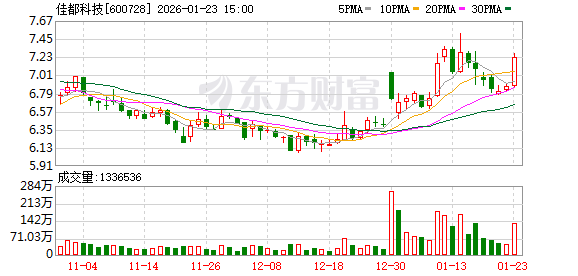
广东省政协常委、佳都科技集团董事长兼执行总裁陈娇:建设具有全球竞争力的“科创特区”
Zheng Quan Ri Bao· 2026-01-25 14:09
Group 1 - The Guangdong Provincial Two Sessions have commenced, with representatives focusing on high-quality development and enhancing public welfare [2] - Chen Jiao, Chairman and CEO of Jiadu Technology Group, presented multiple proposals aimed at fostering innovation and competitiveness in various sectors [2][3] Group 2 - The proposal titled "Innovative Institutional Supply to Activate Industry Ecosystem Construction with Global Competitiveness in Sci-Tech Innovation Special Zones" suggests establishing a Sci-Tech Innovation Special Zone in the Guangdong-Hong Kong-Macao Greater Bay Area, focusing on modern industries like AI and biomedicine [3] - The proposal "Strengthening the Autonomous and Controllable Digital Foundation to Empower Modern Industrial System Construction with Harmony Ecosystem" emphasizes leveraging the Harmony operating system to create a robust digital foundation and promote its application across industries [3][4] - The proposal "Promoting the Global Expansion of the Greater Bay Area Rail Transit Industry" aims to enhance international competitiveness by forming industry alliances and providing comprehensive solutions for rail transit [4] - The proposal "Strategic Layout of Space Computing Infrastructure to Explore New Intelligent Space Tracks" advocates for integrating space computing into new infrastructure planning, focusing on satellite manufacturing and intelligent computing [4]

广发证券:太空算力远期市场空间广阔 太阳翼或为最优通胀环节
智通财经网· 2026-01-20 08:43
Group 1 - The core viewpoint is that the industry has a vast long-term market space due to the active layout of space computing by China and the US, combined with the cost and performance advantages of space computing itself [3][4] - Space computing is transitioning from a "ground-based calculation" model to a "space-based calculation" model, allowing for direct data processing in space [1][3] Group 2 - Space computing has operational cost advantages, with a significant focus on marginal energy costs, which are the core factor in overall operational expenses [2] - For example, a single space-based 40MW computing cluster can operate for 10 years at a total cost of $8.2 million, saving approximately $159 million compared to traditional computing clusters, with over $130 million saved in marginal energy costs [2] Group 3 - The demand for solar wings is expected to increase due to the expansion of power and area requirements driven by space computing, leading to the adoption of flexible technology routes [4] - Flexible solar wings can achieve a weight reduction of 20%-40%, a storage volume reduction of over 60%, and improved performance, making them a key component in the power system [4] Group 4 - Investment recommendations include focusing on companies related to space photovoltaics, such as: - Maiwei Co., Ltd. (300751.SZ), which is expected to become a core equipment supplier for space computing photovoltaic segments [5] - Gaomei Co., Ltd. (688556.SH), which aligns with the cost reduction route for space photovoltaics [5] - Jiejia Weichuang (300724.SZ), which is positioned to benefit from the expansion of flexible solar wings in the space computing sector [5]




利空也砸不下大A
虎嗅APP· 2026-01-15 00:29
Core Viewpoint - The A-share market is experiencing extreme enthusiasm, prompting regulatory measures to cool down the market, indicating a shift towards a "slow bull" market rather than a "crazy bull" market, emphasizing the need for investors to focus on fundamentals rather than emotions [5][6]. Market Sentiment and Regulatory Response - On January 14, the exchange announced an increase in the minimum margin ratio for financing from 80% to 100%, leading to an immediate market downturn [5]. - The regulatory stance is clear: the market can rise, but it should not be driven solely by emotions, and investors must return to fundamentals [6]. Investment Opportunities and Risks - The focus should be on identifying key sectors that are likely to perform well while avoiding those that may pose risks [7][8]. - The analysis will cover 13 high-interest sectors to provide insights on potential investment opportunities [9]. AI Computing Power - The rise of AI infrastructure is supported by increased investments from cloud vendors, with companies like "易中天" (New Yizhong, Zhongji Xuchuang, Tianfu Communication) showing significant stock price increases [11]. - However, the current high valuations may be unsustainable, and without new positive developments, there is a risk of a bubble burst in this sector [11]. Space Computing Industry - The space computing industry is expected to emerge as a significant market, with technologies deploying data centers in space to address ground-based limitations [13][15]. - China's advancements in space computing are supported by government initiatives, with plans for a comprehensive deployment strategy by 2025 [17][18]. Humanoid Robots - The humanoid robot sector is anticipated to see differentiation by 2026, with industrial applications being the primary focus, while household robots remain underdeveloped [20][22]. - Companies like 优必选 (UBTECH) are ramping up production, with expectations of significant output increases in the coming years [22][23]. Semiconductor Equipment - Domestic wafer fabs are planning expansions to meet AI chip demand and enhance production capacity, which will benefit semiconductor equipment suppliers [25][26]. Controlled Nuclear Fusion - The commercialization of controlled nuclear fusion is accelerating, with multiple technological pathways being explored [28][30]. - China is making significant strides in fusion energy, with projects like EAST and BEST expected to lead to practical applications by 2027 [32][33]. Commercial Aerospace - The commercial aerospace sector is experiencing a surge, driven by fears of missing out on investment opportunities, although there are concerns about the sustainability of this growth [41][42]. - China's satellite deployment is rapidly increasing, positioning the country as a major player in the global space race [44]. Photovoltaics - The photovoltaic sector is expected to reach a turning point in 2026, driven by supply-side adjustments and improved fundamentals [47][51]. - The cancellation of export tax rebates is likely to increase costs for exporters, benefiting larger firms with economies of scale [51][52]. Consumer Sector - The consumer sector is seen as a safe haven during market volatility, with specific focus areas including media, service consumption, and premium goods like liquor [66][70]. - The overall consumer demand is expected to recover gradually, but structural changes may lead to a lack of strong support for broad-based growth [67]. Banking Sector - The banking sector has shown resilience despite fundamental pressures, with attractive dividend yields drawing in long-term investors [72][73]. - However, the sector is unlikely to lead the market due to its lower growth potential compared to technology and growth stocks [74]. Insurance Sector - The insurance sector has outperformed banks, benefiting from stock market recovery and expected growth in both asset and liability sides [76]. - The aging population is likely to increase the importance of insurance companies in key areas like healthcare and retirement [76]. Brokerage Firms - Brokerage firms have seen strong earnings growth but face challenges in maintaining investor interest due to perceived volatility and lack of long-term growth [77].
太空算力:打开AI应用场景新空间
Xi Niu Cai Jing· 2026-01-14 11:29
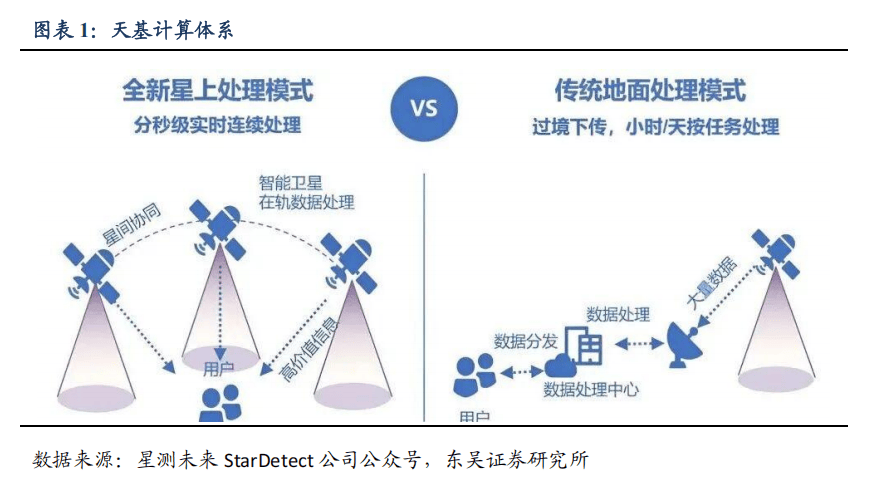
Core Insights - Space computing is an innovative result of the deep integration of aerospace technology and artificial intelligence, leading to a shift in computing paradigms from ground-based to space-based applications [1][2] - The global space computing industry has moved from planning to substantial verification and initial deployment, with China focusing on a self-controlled and systematic approach to build a complete industrial chain [2][10] Group 1: Overview of Space Computing - Space computing is a systematic orbital-level distributed AI architecture that deploys computing resources in space to achieve data collection, processing, storage, and output directly in orbit [3] - Applications of space computing are categorized into "space-based computing" and "ground-based computing," with the former involving autonomous data processing in orbit and the latter relying on ground-provided data for model training in space [3] Group 2: Economic Viability - Space computing is expected to address the long-standing economic loop challenges in commercial aerospace, with lifecycle operating costs potentially reduced to one-twentieth of ground facilities [6] - The cost structure for space data centers is significantly lower than that of ground facilities, with total costs estimated at $0.08 billion for space compared to $0.97 billion for China and $1.67 billion for the U.S. [7] Group 3: Industry Chain Analysis - The space computing industry chain consists of three core segments: upstream manufacturing and launching, midstream operation and ground access, and downstream data empowerment and application [8] - The downstream applications have expanded from traditional fields like remote sensing and navigation to include smart cities and edge intelligence [8] Group 4: Market Potential - The space computing industry is accelerating, with its strategic value becoming increasingly prominent as a solution to global computing resource bottlenecks [10] - According to Research and Markets, the global market for orbital data centers is projected to reach $39.09 billion by 2035, with a compound annual growth rate of 67.4% [10] Group 5: Company Profiles - Qianzhao Optoelectronics (300102) has seen significant growth in sales driven by its strategic focus on gallium arsenide solar cells, with a revenue increase of 46.4% year-on-year to $2.75 billion in the first three quarters of 2025 [11] - Putian Technology (002544) is transitioning to a provider of aerospace information infrastructure, reporting a revenue of $3.152 billion in the first three quarters of 2025, a decrease of 7.82% year-on-year [13] - Maiwei Co., Ltd. (300751) specializes in solar cell manufacturing equipment and has signed contracts for perovskite/silicon heterojunction battery production lines, with a revenue of $6.204 billion in the first three quarters of 2025, down 20.13% year-on-year [15]
太空光伏与"轨道数据中心": 为什么下一代能源与算力的战场,会在800km的高空?
Hua Er Jie Jian Wen· 2026-01-12 04:12
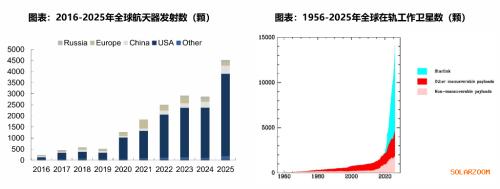
Core Viewpoint - Space photovoltaic technology is evolving from being merely "solar panels on satellites" to becoming a crucial component for the next generation of computing power (space computing/orbital data centers) [1][2] Group 1: Industry Trends - The application for orbital resources and satellite deployment plans is reshaping the supply-demand dynamics of the space industry, with a significant increase in satellite launches expected [2][3] - The number of global spacecraft launches has surged from 237 in 2016 to over 4,300 expected by 2025, reflecting a compound annual growth rate of approximately 34% [3] - The market for solar wings is transitioning from a niche to a mass production model due to the increasing number of satellites [5][6] Group 2: Cost Comparisons - A comparison of costs shows that deploying a data center in space can be significantly cheaper than on the ground, with a projected total cost of approximately $8.2 million in space versus $167 million on the ground over ten years [16] - The primary cost difference arises from energy expenses, where ground energy costs are estimated at $140 million over ten years, while space energy costs are nearly zero after initial deployment [16] Group 3: Technological Developments - The demand for solar wings is driven by the increasing power requirements of satellites, with examples showing significant growth in solar wing area from 22.68 m² to 256.94 m² for different satellite versions [9][12] - The report indicates a shift in technology from gallium arsenide (GaAs) to silicon-based technologies, particularly HJT (Heterojunction Technology), which offers advantages in weight, cost, and flexibility [25][27] Group 4: Market Potential - The solar wing market could reach approximately 200 billion yuan if annual satellite launches reach 10,000, with prices expected to decrease from 1,200 yuan/W to 622 yuan/W [10][11] - The space computing market is defined as deploying modular server nodes on low/mid-orbit satellites, transforming them into orbital data centers with significant computational capabilities [12][14] Group 5: Competitive Landscape - The competition for orbital resources is intensifying, with a total of over 100,000 low-orbit satellites planned globally, including approximately 45,000 from the U.S. and 53,000 from China [6][18] - The choice of technology and materials for solar wings will be influenced by launch costs, with SpaceX's lower costs allowing for different material choices compared to higher-cost Chinese rockets [22][23]