AI代理服务

Search documents
大摩闭门会:关于AI资本开支、应用落地等的简要观点
2026-03-09 05:18
Summary of Conference Call Industry Focus - The conference primarily focused on the Technology, Media, and Telecommunications (TMT) sector, with a strong emphasis on Artificial Intelligence (AI) applications and their implications across various industries [1][2]. Key Insights and Arguments - **AI as a Dominant Theme**: AI has emerged as the central theme in discussions, evolving from basic applications to more complex integrations across multiple business functions and regions [2][3]. - **Efficiency Gains from AI**: Companies like Visa reported significant efficiency improvements, with tasks that previously took months now being completed in days due to AI integration [2][3]. - **Financing Trends**: There was a notable focus on construction financing announcements, with high-rated investment-grade tenants seeing bond pricing below 6%, while weaker tenants faced spreads of about 200 basis points higher [3][4]. - **Tenant Quality**: The quality of tenants is becoming a critical focus for investors, with a shift towards multi-tenant models being discussed by companies like Galaxy Digital and Digital Reality [5][6]. - **Chip Financing**: Discussions highlighted the importance of chip financing, with over 50% of expenditures related to chips, raising questions about how companies will finance their expansion projects [6][7]. - **Supply Chain Challenges**: The supply chain for data center components and funding is under pressure, with large enterprises and NVIDIA committing over $600 billion in leasing and procurement agreements to support suppliers [8][9]. Additional Important Points - **AI's Impact on Workforce**: There was limited discussion on the negative impacts of AI on employment, with companies suggesting that AI could enable growth without increasing headcount [13][18]. - **Non-linear Growth of AI Capabilities**: The rapid, non-linear advancement of AI capabilities was emphasized, with expectations for new models to exceed current capabilities significantly [17][18]. - **Long-term Contracts for Computing Power**: Companies are considering extending computing power contracts from three to six years, indicating confidence in the longevity of older generation GPUs [15][18]. - **Investor Sentiment**: There is growing interest in the potential for leveraged stock buybacks among credit-focused investors, particularly in the context of AI-related themes [16][17]. This summary encapsulates the key discussions and insights from the conference, highlighting the transformative role of AI in various sectors and the evolving landscape of financing and investment strategies.
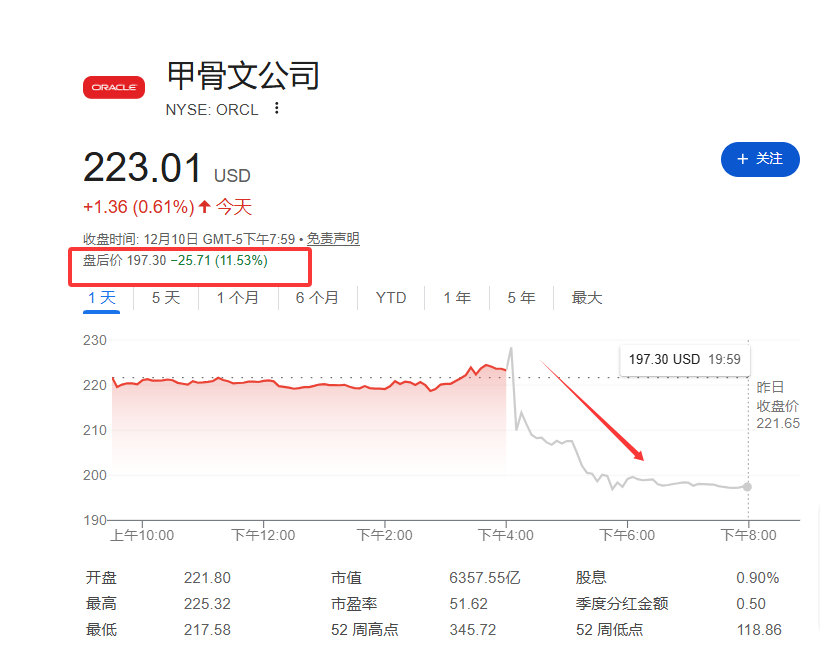
天价支出吓崩股价?甲骨文电话会紧急救火:“客户自带芯片”将拯救现金流,“我们没有疯狂举债”
Hua Er Jie Jian Wen· 2025-12-11 01:24
Core Insights - Oracle reported a 13% year-over-year revenue growth and a staggering 66% increase in cloud infrastructure (OCI) revenue, but the market was primarily focused on the company's aggressive capital expenditure plan, which requires an additional $15 billion investment [1][5][23] - The company has a remarkable $523.3 billion in remaining performance obligations (RPO), which has increased by 433% year-over-year, driven by contracts from major clients like Meta and NVIDIA [5][23] - Oracle's management defended the capital expenditure increase, stating it is driven by real demand from large clients and not blind expansion, introducing a "Bring Your Own Chips" model to alleviate cash flow pressure [4][5][6] Financial Performance - OCI revenue reached $4.1 billion, growing 66% year-over-year, with GPU-related revenue surging by 177% [5][23] - Total revenue for the quarter was $16.1 billion, reflecting a 13% increase compared to the previous year [23] - The company expects a significant increase in RPO, with a projected 40% growth in the next 12 months, compared to 25% in the previous quarter [23] Capital Expenditure and Financing - Oracle's capital expenditure for FY2026 is now expected to be $50 billion, an increase of $15 billion from previous forecasts, causing a post-earnings stock drop of over 10% [5][10] - The management emphasized that the actual borrowing needs will be significantly lower than analysts' predictions of $100 billion, thanks to innovative financing models [4][5][10] - The "Bring Your Own Chips" model allows clients to provide their own hardware, reducing Oracle's upfront capital expenditures and improving cash flow synchronization [6][10] Market Position and Strategy - Oracle's unique approach in the cloud industry, allowing clients to bring their own chips, is seen as unprecedented and aims to shift the financial burden of capital expenditures [6][10] - The company is focusing on maintaining an investment-grade credit rating while navigating the capital-intensive AI infrastructure landscape [5][10] - Larry Ellison, Oracle's co-founder, highlighted the future of AI in private data reasoning, positioning Oracle's AI data platform as a key player in breaking down data silos [15][32] Customer and Operational Flexibility - Oracle's AI infrastructure is designed for high flexibility, allowing rapid capacity transfer between clients, which mitigates risks associated with client concentration [14][56] - The company has over 700 AI clients, indicating strong demand and operational capability to quickly allocate resources [14][56] - Oracle's cloud applications and infrastructure are experiencing robust growth, with multi-cloud consumption increasing by 817% [23][30]