AI就绪数据

Search documents
独家洞察 | AI掘金术:从非结构化数据中,挖出金融高见
慧甚FactSet· 2026-01-15 02:13
Core Insights - The article emphasizes the increasing complexity of transforming financial data into actionable intelligence due to the rapid growth of data and the challenges posed by unstructured formats and fragmented systems [1][4]. Group 1: Importance of Unstructured Data - Unstructured data holds significant insights that are often overlooked, as key information is trapped in sources like earnings call transcripts, regulatory filings, and news articles [1][4]. - The ability to access and utilize unstructured content is crucial for overcoming data fragmentation and ensuring readiness for AI applications [4][9]. Group 2: AI Integration and Workflow Automation - Seamless integration of AI is essential for unlocking the value of unstructured data, enabling standardization, vectorization, and information enhancement [3][5]. - The development of an AI-ready financial document corpus is underway, which includes global regulatory filings and earnings call transcripts, enriched with metadata and contextual layers to improve AI performance [4][5]. Group 3: Enhanced Decision-Making Capabilities - The integration of AI-ready data with Snowflake Intelligence allows users to conduct semantic searches and retrieve relevant documents, enhancing decision-making processes [5][9]. - By combining structured market data, proprietary holdings, and unstructured content into a unified view, deeper insights can be gained, leading to faster and more informed decisions [7][9]. Group 4: Flexibility and Interoperability - An open ecosystem enables financial institutions to access and leverage AI-ready content flexibly, whether within the Snowflake platform or through API integrations [9]. - The infrastructure's interoperability is vital for scaling data enhancement and ensuring that insight generation keeps pace with the growing volume and complexity of information [9]. Group 5: Real-Time Insights and Automation - Semantic search technology allows for quicker identification of emerging themes in news and text records compared to traditional datasets [11]. - Automated intelligence agents can track peer commentary, regulatory changes, and filing updates in real-time, extracting actionable insights from unstructured content [11].



一年内,42%的公司放弃AI项目:Gartner曲线没告诉你的残酷真相
3 6 Ke· 2025-09-30 07:17
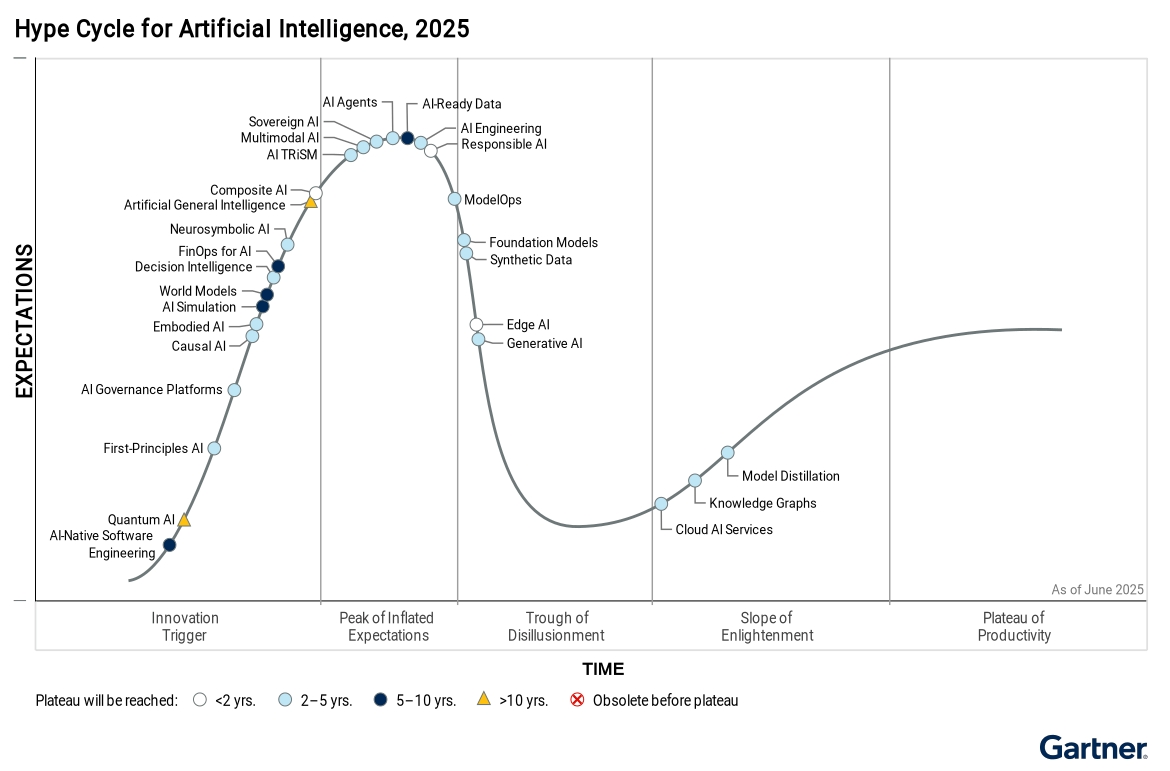
Core Insights - The annual Gartner hype cycle reveals that AI agents and "AI-ready data" are at the peak of the "inflated expectations" phase, while generative AI has fallen into the "trough of disillusionment" [5][11] - Investment in AI remains strong, but the focus has shifted towards operational scalability and real-time intelligence, moving away from generative AI to foundational technologies that support sustainable AI delivery [5][9] Group 1: AI Agents - AI agents are currently seen as powerful tools, but their deployment can lead to systemic errors due to complex task chains, highlighting the need for clear business contexts and use cases [7][8] - A significant percentage of companies (42%) are expected to abandon their AI projects by 2025, up from 17% the previous year, indicating growing disappointment among CFOs and CIOs [7] - While 91% of companies claim to use generative AI, only 25% have successfully integrated it into core workflows, suggesting a gap between enthusiasm and execution [7][9] Group 2: AI-Ready Data - The real revolution in AI is occurring in data management, termed "AI-ready data," which emphasizes the importance of data quality and relevance over flashy models [9][10] - Successful companies are those that understand their data sources, usage, timeliness, and reliability, rather than those with the most advanced models [9][10] Group 3: Organizational Learning - The true curve of technology adoption is about organizational learning, moving from excitement to reality and finally to understanding how to integrate technology into business [11][12] - Companies that approach new technologies with curiosity and realism are more likely to succeed in the long term [12] Group 4: Practical Steps - Companies are advised to focus on small, measurable problems and build robust data infrastructures rather than chasing hype [13][15] - It is crucial to plan for potential failures and establish clear oversight and rollback procedures when deploying AI, treating it as a powerful but imperfect tool [15]