AI科学家

Search documents
刚刚的WISE2025大会上,43位商业大佬用这些关键词解读2025……
3 6 Ke· 2025-11-27 11:16
Group 1: AI and Technology Transformation - AI is evolving from a tool for process optimization to a core productivity driver that reshapes industry logic, moving towards a symbiotic relationship with humans [3][4][5] - The emergence of embodied intelligence signifies a paradigm shift where robots can autonomously learn and operate in diverse environments, integrating AI's value into real-world applications [4][5] - The concept of "Agentic AI" is introduced, where AI transitions from a passive tool to an active collaborator, enhancing decision-making and operational efficiency [11] Group 2: Consumer Behavior and Market Dynamics - The consumer market is undergoing a profound value reconstruction, with consumers balancing rational price-performance assessments and emotional connections to brands [25][27] - Companies are shifting from a focus on mass appeal to creating unique value for specific consumer segments, as seen in the "胖东来模式" and the rise of domestic brands [26][27] - The importance of quality and cultural narratives in consumer choices is emphasized, indicating a trend towards brands that resonate with cultural identity and emotional experiences [25][27][42] Group 3: Innovation and Business Strategy - The focus of innovation is shifting from merely adding features to creating tangible value, with a growing emphasis on effective innovation that simplifies choices for consumers [52] - Companies are encouraged to adopt a long-term perspective, prioritizing sustainable growth and trust-building over short-term gains [39][44] - The integration of AI into business operations is seen as a critical factor for driving efficiency and enhancing customer experiences, marking a transition from traditional practices to data-driven strategies [40][41] Group 4: Health and Biotechnology - The intersection of AI and biology is leading to personalized health solutions, moving towards a model that decodes individual health needs rather than offering generic solutions [33][34] - The concept of "biological intelligence" emerges, highlighting the potential of AI to enhance our understanding of complex biological systems and improve healthcare outcomes [34][37] Group 5: Globalization and Collaboration - The globalization of AI is evolving from a one-way technology transfer to a two-way empowerment ecosystem, fostering collaboration across borders [16] - The narrative of global brands is shifting from competition to co-creation, emphasizing the importance of trust and shared values in building sustainable business relationships [38][39]


跨学科创新远超人类?AI科学家提假设/做实验/发顶会开启科学研究新范式
3 6 Ke· 2025-11-17 08:36
Core Viewpoint - The emergence of AI scientists, such as the one developed by Sakana AI, represents a significant shift in the scientific research landscape, transforming AI from a mere assistant to a collaborative research partner capable of generating research ideas, designing experiments, and writing papers [1][2]. Group 1: Definition and Role of AI Scientists - AI scientists are redefining the traditional role of scientists, which has historically involved hypothesis generation, experimental design, and data analysis [3][4]. - The responsibilities of scientists are becoming more specialized, with AI handling data processing and experimental execution, allowing human scientists to focus on interpreting results and proposing new research directions [4][5]. Group 2: Types and Progress of AI Scientists - AI scientists can be categorized into two main types: augmented research assistants and autonomous scientific discoverers [5][8]. - Augmented assistants, like Stanford's Virtual Lab, support human scientists by integrating cross-disciplinary knowledge and generating experimental ideas [5][6]. - Autonomous discoverers, such as Future House's Robin, can independently conduct research from hypothesis generation to experimental validation, marking a significant advancement in AI's role in scientific discovery [8]. Group 3: Advantages of AI Scientists - AI scientists offer significant advantages in speed, scale, and interdisciplinary innovation [9][12]. - Speed advantage allows research cycles to be reduced from years to hours, exemplified by Sakana AI's system completing the research process in mere hours [9]. - Scale advantage enables AI to handle millions of tasks simultaneously, expanding the scope of scientific exploration beyond human limitations [12][13]. - AI scientists facilitate cross-disciplinary breakthroughs by integrating knowledge from various fields, overcoming traditional academic silos [16][17]. Group 4: Challenges Faced by AI Scientists - The "black box" nature of AI presents challenges in explainability and causal reasoning, which are critical in scientific research [18][19]. - Concerns about the reliability of AI-generated results arise from discrepancies between simulated outcomes and real-world experiments [20][22]. - The rise of AI scientists necessitates a shift in the skill set required for researchers, emphasizing the need for professionals who can work alongside AI technologies [23][24]. Group 5: Future Outlook - The integration of AI into scientific research is an irreversible trend, with a significant majority of researchers believing AI will become a crucial part of their work by 2027 [25]. - The collaboration between AI and human scientists is expected to enhance the efficiency and breadth of scientific discoveries, ultimately accelerating humanity's ability to solve complex problems [26].

OpenAI前副总裁携DeepMind科学家创业:20余精英科学家+3亿美元押注「AI做科学」
3 6 Ke· 2025-10-31 08:28
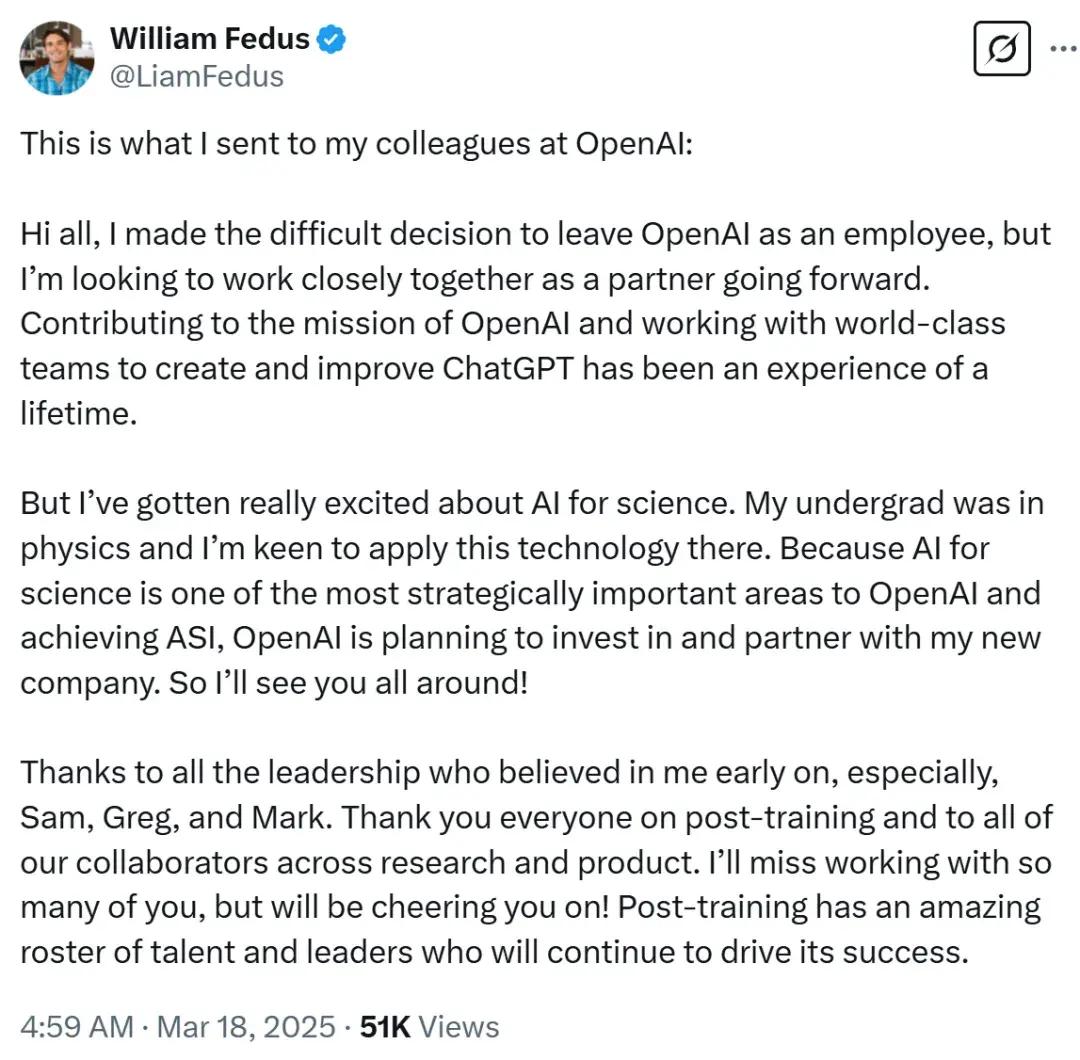
Core Insights - Periodic Labs aims to revolutionize scientific discovery by integrating AI with experimental processes, allowing AI to not only analyze data but also design experiments and discover new materials [6][10][25] Group 1: Founders and Vision - Liam Fedus and Ekin Doğuş Cubuk, both prominent figures in AI research, left their respective positions to establish Periodic Labs, driven by the belief that generative AI can significantly accelerate scientific discovery [1][2][5] - The founders recognized the limitations of current AI applications in science and sought to create a platform that combines AI with physical experimentation to generate new data [5][6] Group 2: Technological Framework - Periodic Labs is developing an "AI-driven scientific platform" that integrates automation, high-fidelity simulations, and large language models to create a closed-loop system for scientific experimentation [6][10][11] - The company emphasizes the value of "failure data," arguing that unsuccessful experiments provide critical insights for training AI models, which contrasts with traditional scientific practices that prioritize successful outcomes [7][11] Group 3: Funding and Market Impact - In September 2025, Periodic Labs raised $300 million in seed funding, setting a record for AI startups and attracting investments from top-tier venture capital firms and notable angel investors [12][15][20] - The funding reflects a broader consensus in Silicon Valley that Periodic Labs has the potential to compress decades of research into a few years, particularly in high-stakes fields like semiconductor materials [15][24] Group 4: Talent Acquisition - Following the funding, Periodic Labs successfully recruited over 20 top researchers from leading tech companies, creating a diverse team that combines expertise in AI and various scientific disciplines [20][21] - The company’s advisory board includes Nobel laureates and experts from prestigious institutions, enhancing its research capabilities and innovative potential [21][24] Group 5: Research Focus - Periodic Labs is initially focusing on discovering new high-temperature superconductors, which could have transformative implications for technology and energy efficiency [24][25] - The company is also collaborating with semiconductor manufacturers to optimize thermal materials, addressing critical challenges in chip design [24][25]