
AI视觉智能体KUKA AI Vision

Search documents
000333 不到九个月完成百亿回购
Shang Hai Zheng Quan Bao· 2025-12-22 12:52
Group 1 - The core point of the article is that Midea Group has successfully completed its share repurchase plan, with a total expenditure of 10 billion RMB, and has also announced a significant dividend plan for its shareholders [2][5]. - Midea Group's share repurchase plan involved repurchasing shares worth up to 10 billion RMB, with 70% of the repurchased shares intended for cancellation, reducing the registered capital [2][3]. - The company has also initiated a secondary share repurchase plan with a target of 1.5 to 3 billion RMB, which has already reached its lower limit of 1.51 billion RMB [4]. Group 2 - Midea Group reported strong financial performance, with a revenue of 364.716 billion RMB for the first three quarters of 2025, representing a year-on-year growth of 13.8%, and a net profit of 37.884 billion RMB, up 19.51% [5]. - The company is diversifying its business, with its B2B segment growing by 18%, outpacing the B2C segment's growth of 13% [6]. - Midea Group is expanding into innovative sectors such as energy and robotics, with notable revenue growth in these areas, including a 21% increase in revenue from new energy and industrial technology [6]. Group 3 - Midea Group has established a new Energy Division to enhance its focus on the energy sector, indicating a strategic upgrade in its business operations [7]. - The company has launched several advanced products in the AI and robotics space, including the KUKA AI Vision and humanoid robots, showcasing its commitment to innovation [6].


000333,不到九个月完成百亿回购
Shang Hai Zheng Quan Bao· 2025-12-22 12:21
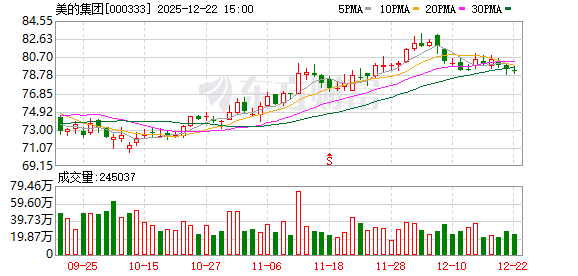
Group 1 - The core point of the article is that Midea Group has successfully completed its share repurchase plan, with a total expenditure of 10 billion RMB, and has also announced a mid-term dividend plan [1][4][5] Group 2 - Midea Group's share repurchase plan involved repurchasing shares worth up to 10 billion RMB, with 70% of the repurchased shares intended for cancellation, reducing the registered capital [1][2] - The repurchase process took less than nine months, with the first repurchase occurring at a price range of 72.02 to 72.89 RMB per share, totaling 1.5 billion RMB for 2.0781 million shares [2] - As of December 8, 2025, Midea Group had repurchased a total of 135 million shares, accounting for 1.76% of the total share capital, with a maximum price of 83.11 RMB and a minimum price of 69.91 RMB [2] - In addition to the 10 billion RMB repurchase plan, Midea Group has also initiated a secondary repurchase plan with a target of 3 billion RMB, having already reached the lower limit of 1.51 billion RMB [3] Group 3 - Midea Group announced a mid-term dividend plan, distributing 5 RMB per 10 shares, amounting to approximately 3.448 billion RMB, based on the adjusted total share capital [4] - The company's strong financial performance supports these initiatives, with a reported revenue of 364.716 billion RMB and a net profit of 37.884 billion RMB for the first three quarters of 2025, reflecting year-on-year growth of 13.8% and 19.51% respectively [4] Group 4 - Midea Group is expanding beyond traditional home appliances, showing significant growth in its B2B business, which grew by 18% year-on-year, outpacing the B2C business growth of 13% [5] - Specific revenue growth in various sectors includes 30.6 billion RMB from new energy and industrial technology (21% growth), 8.1 billion RMB from smart building technology (25% growth), and 22.6 billion RMB from robotics and automation (9% growth) [5] Group 5 - Recently, Midea Group has restructured its organization to establish a new energy division, indicating a strategic upgrade in its focus on the new energy sector [6]

to B业务发力 美的集团前三季度净利增近两成
Shang Hai Zheng Quan Bao· 2025-10-29 17:55
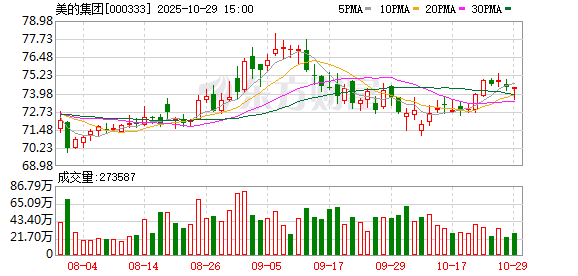
Core Insights - Midea Group reported a revenue of 1119.33 billion yuan in Q3 2025, a year-on-year increase of 10.06%, and a net profit attributable to shareholders of 118.70 billion yuan, up 8.95% [2] - For the first three quarters, total revenue reached 3647.16 billion yuan, reflecting a 13.8% year-on-year growth, while net profit attributable to shareholders was 378.84 billion yuan, marking a 19.51% increase [2] Business Segments - The to B business segment grew by 18% year-on-year, outperforming the to C segment's growth of 13% by 5 percentage points, indicating strong momentum [2] - Revenue from the new energy and industrial technology segment was 30.6 billion yuan, up 21% year-on-year; smart building technology revenue reached 8.1 billion yuan, growing by 25%; and revenue from robotics and automation was 22.6 billion yuan, increasing by 9% [2] Robotics and AI Initiatives - Midea Group is focusing on AI and industrial robotics, with the launch of five strategic intelligent products, including the KUKA AI Vision, aimed at creating a comprehensive intelligent ecosystem [3] - The company introduced its first humanoid robot, "Mei Luo," at its smart washing machine factory and showcased the family humanoid robot "Mei La" at the Berlin International Consumer Electronics Show [3] Energy and Medical Ventures - Midea Energy and Midea Medical made significant strides, with Midea Energy unveiling a "storage + heat pump + AI" strategy and launching the Aqua-C3.0 Pro liquid cooling energy storage system [3] - The virtual power plant platform from HeKang New Energy has integrated over 1.5 GW of distributed photovoltaic resources, covering various commercial users and data centers [3] Smart Home Business - The smart home business saw a 13% year-on-year revenue increase, with overseas OBM (Own Brand Manufacturer) revenue being a key driver, accounting for over 45% of the to C business [4] - In Q3, Midea's Toshiba brand in Japan achieved a market share that rose to second place [4] Global Operations and Collaborations - Midea's Thailand air conditioning factory was recognized as a "lighthouse factory" by the World Economic Forum, marking a significant achievement for the company in the overseas market [4] - A strategic cooperation agreement was signed with Huawei to collaborate on enterprise management, AIGC, ICT infrastructure, and smart home solutions, enhancing product innovation and user experience [4] Shareholder Returns - Midea Group announced a mid-term cash dividend of 5 yuan per 10 shares and has repurchased over 9.3 billion yuan worth of shares, with significant portions of its buyback plans already executed [5]
美的集团前三季度实现营收3647.2亿元
Zheng Quan Ri Bao Zhi Sheng· 2025-10-29 17:09
Core Insights - Midea Group reported a total revenue of 364.72 billion yuan for the first three quarters of 2025, marking a year-on-year increase of 13.8%, with a net profit attributable to shareholders of 37.88 billion yuan, up 19.5% [1] - The third quarter revenue surpassed 100 billion yuan, reaching 112.4 billion yuan [1] - The company's To B business is expected to achieve annual revenue of 100 billion yuan, becoming a key growth driver for the group [1] Business Performance - In the first three quarters, Midea's three major segments—New Energy and Industrial Technology, Smart Building Technology, and Robotics and Automation—performed well, generating revenues of 30.6 billion yuan, 28.1 billion yuan, and 22.6 billion yuan, respectively, with year-on-year growth rates of 21%, 25%, and 9% [1] - The company is focusing on the development of humanoid robots, emphasizing three areas: core components research, integration of robotics and AI in home appliances, and complete robot development [2] Strategic Developments - Midea Group's "Midea Energy" and "Midea Medical" sectors are actively pursuing strategic initiatives in 2025, including the launch of a "storage + heat pump + AI" strategy [2] - The company has introduced innovative products such as the Aqua-C3.0 Pro liquid cooling energy storage system and a high-temperature industrial heat pump to support green industrial transformation [2] Consumer Business - In the To C segment, Midea's smart home business saw a 13% increase in revenue year-on-year, with overseas OBM (Own Brand Manufacturing) being a key growth driver [3] - Midea's Thailand air conditioning factory was recognized as a "Supply Chain Resilience Lighthouse Factory" by the World Economic Forum, marking the company's first overseas lighthouse factory [3] - The company operates in over 200 countries and regions, with 38 R&D centers and 63 major manufacturing bases, including 22 overseas R&D centers and 41 manufacturing bases [3]
库卡2025工博会发布五大智能体 推动制造业全链路数据贯通
Zheng Quan Shi Bao Wang· 2025-09-23 07:41
Core Insights - KUKA, a leading company in industrial automation and robotics under Midea Group, launched five strategic intelligent products at the 25th China International Industry Fair, marking a new phase in intelligent manufacturing with an "ecological collaboration" approach [1][3] Group 1: Product Launches - The five intelligent products include KUKA AI Vision, iiQWorks, KUKA CONNECT IOT, KUKA AI Assistant, and KUKA AMR Fleet, which together create a comprehensive intelligent ecosystem from perception to execution [1][3] - KUKA AI Vision integrates hardware and software, supporting 2D/3D visual recognition and capable of high-precision tasks in various scenarios, already implemented in Midea's Jingzhou washing machine factory [1][2] - iiQWorks provides a full-process visualization support for robot programming, significantly reducing production line preparation time and total cost of ownership (TCO) [2] - KUKA CONNECT IOT connects over 6,000 robots for real-time monitoring and predictive maintenance, with 117 KUKA robots already integrated in the Jingzhou factory [2] - The KUKA AMR Fleet features an intelligent navigation system that enhances delivery efficiency by 30% and has achieved fully automated logistics in the Jingzhou factory [2] Group 2: Ecosystem and Collaboration - The five intelligent products function as a collaborative "digital team," with each product specializing in different aspects: AI Vision for vision, iiQWorks for programming, CONNECT for management, KUKA AI Assistant for training, and AMR Fleet for logistics [3] - This ecosystem facilitates seamless data flow across design, production, operation, and logistics, promoting a transition from localized optimization to a system-level leap in manufacturing [3]