AI / 数据中心 / 电气化篮子(JPAMAIDE 指数)

Search documents
摩根大通 2025 美股策略:AI 仍是核心引擎,短期需警惕通胀与估值风险
贝塔投资智库· 2025-09-12 04:00
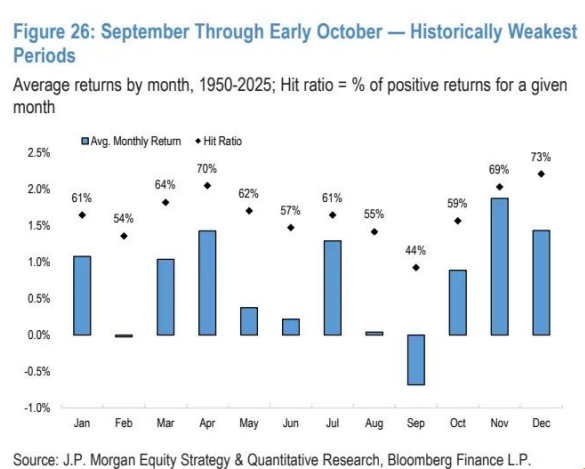
Core Viewpoint - The report from JPMorgan highlights that despite growth challenges from tariffs and immigration, U.S. companies are achieving healthy profit growth driven by rapid AI adoption, strong capital expenditure, and resilient consumer spending. However, short-term risks from inflation rebound and high valuations need to be monitored, while the medium to long-term outlook remains positive due to AI and policy benefits [1]. Group 1: U.S. Stock Market Dynamics - Four main drivers support U.S. stock market profit growth: accelerated AI implementation, strong capital expenditure, resilient consumer spending (with a 4.1% year-on-year increase as of August 29), and a weaker dollar benefiting export companies [1][2]. - Short-term risks include high investor positioning and valuations, inflation rebound pressures, and seasonal weakness in stock performance during September and October [2][5]. Group 2: AI Sector Insights - AI-related stocks constitute approximately 43% of the S&P 500's market capitalization, with around 30 AI stocks contributing nearly all of the index's gains since the launch of ChatGPT in November 2022 [6][9]. - AI companies have invested about $800 billion in capital expenditure and R&D over the past year, with a projected 33% increase in investment spending over the next 12 months [9][14]. Group 3: Consumer and Buyback Trends - U.S. consumers are in a strong financial position, with the debt-to-asset ratio at its lowest since the 1960s, potentially releasing $2 trillion in incremental credit if it returns to historical averages [15][18]. - The S&P 500 has announced stock buybacks totaling $958 billion year-to-date, significantly exceeding the average of $644 billion over the past three years, alongside $700 billion in dividends, indicating strong shareholder returns [18][23]. Group 4: Inflation and Policy Impacts - Inflation risks are rising due to tariffs affecting durable goods, with the August CPI data being a critical risk factor that could disrupt the current favorable market conditions [23][25]. - The "Inflation Reduction Act" (OBBBA) is expected to provide a $373 billion boost in deficit spending focused on AI, data centers, electrification, and defense, supporting growth in these sectors [25][26]. Group 5: Investment Strategy Recommendations - Short-term strategies should focus on avoiding high-beta stocks and favoring low-volatility and inflation-benefiting stocks, while long-term strategies should concentrate on AI as a core driver, with the S&P 500 projected to reach 7000 points by early 2026 [26][27].



摩根大通2025美股策略:AI 仍是核心引擎,短期需警惕通胀与估值风险
智通财经网· 2025-09-11 14:50
Group 1 - The core support for US stock earnings growth comes from four main drivers: accelerated AI adoption, strong capital expenditure, resilient consumer spending, and a weaker dollar [2][3][4] - Consumer spending in the US has increased by 4.1% year-on-year as of August 29, with discretionary spending up by 5.3% and spending from Gen Z and Millennials up by 7.0% [2] - The Inflation Reduction Act (OBBBA) has provided a cushion against growth headwinds from tariffs and immigration issues [3][31] Group 2 - Despite strong fundamentals, short-term risks are evident, including high investor positioning, inflationary pressures, and seasonal weakness in the market [4][24] - The upcoming August CPI data is a critical risk point that could impact market expectations for Federal Reserve interest rate cuts [4][28] Group 3 - AI-related stocks represent approximately 43% of the S&P 500's market capitalization, with around 30 AI stocks contributing nearly all of the index's gains since the launch of ChatGPT in November 2022 [8][10] - AI companies have invested about $800 billion in capital expenditure and R&D over the past year, with a projected 33% increase in investment spending over the next 12 months [10] Group 4 - US consumers are in a strong financial position, with the debt-to-asset ratio at its lowest level since the 1960s, potentially releasing about $2 trillion in incremental credit if it returns to historical averages [16][19] - Stock buybacks for S&P 500 companies have reached $958 billion year-to-date, significantly exceeding the average of $644 billion for the same period over the past three years [20][23] Group 5 - The Inflation Reduction Act is expected to generate an additional $373 billion in deficit spending from 2025 to 2026, focusing on AI, data centers, electrification, and defense [31] - If inflation exceeds expectations, the current favorable market conditions may face adjustments, particularly affecting high-risk assets [24][28] Group 6 - Short-term strategies should focus on low-volatility stocks and inflation beneficiaries, while long-term strategies should prioritize AI and quality growth stocks, with the S&P 500 projected to reach 7,000 points by early 2026 [32][33]
摩根大通 2025 美股策略:AI 仍是核心引擎,短期需警惕通胀与估值风险
Zhi Tong Cai Jing· 2025-09-11 13:58
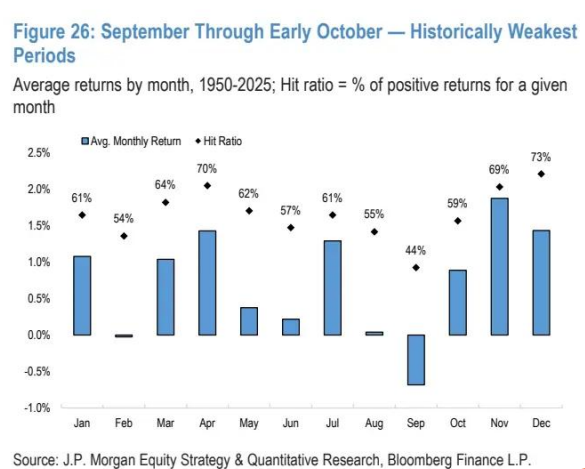
Group 1 - The core viewpoint of the report emphasizes that despite short-term pressures, U.S. equities are supported by strong earnings growth driven by AI adoption, robust capital expenditures, and resilient consumer spending [1][2][31] - The report identifies four key drivers of U.S. stock performance: accelerated AI implementation, strong capital expenditures, resilient consumer spending with a 4.1% year-over-year increase as of August 29, and a weaker dollar benefiting export companies [2][3] - The "Inflation Reduction Act" (OBBBA) is noted for its early spending, which helps mitigate growth obstacles posed by tariffs and immigration issues [3][27] Group 2 - Short-term risks highlighted include high investor positioning and valuations, inflation rebound pressures, and seasonal weakness in the market during September and October [4][25] - The report suggests that investors can hedge against CPI risks using options strategies, with a potential leverage of nearly six times [6][28] Group 3 - AI stocks dominate the S&P 500, accounting for approximately 43% of its market capitalization, and have contributed nearly all of the index's gains since the launch of ChatGPT in November 2022 [7][11] - AI-related companies have invested around $800 billion in capital expenditures and R&D over the past year, with a projected 33% increase in investment spending over the next 12 months [11][29] Group 4 - U.S. consumers are in a strong financial position, with the debt-to-asset ratio at its lowest since the 1960s, potentially releasing about $2 trillion in incremental credit if it returns to historical averages [15][18] - Stock buybacks have reached a record $958 billion year-to-date, significantly exceeding the average of $644 billion over the past three years, which supports U.S. stock valuations [20][24] Group 5 - The report warns of inflation risks due to tariffs affecting durable goods, with the upcoming August CPI data being a critical risk point [25][26] - The OBBBA Act is expected to generate an additional $373 billion in deficit spending from 2025 to 2026, focusing on AI, data centers, electrification, and defense, providing direct benefits to these sectors [27][29] Group 6 - The investment strategy suggests a defensive approach in the short term, favoring low-volatility and inflation-benefiting stocks, while maintaining a long-term focus on AI and quality growth stocks [28][29] - The S&P 500 is projected to reach 7,000 points by early 2026, driven by AI's continued impact on earnings, policy support, and structural high valuations [29][30]