AIREC机器人

Search documents
中国牵头制定首个养老机器人国际标准——养老机器人产业 迈入规范化智能化新阶段(科技前沿)
Ren Min Ri Bao· 2025-04-29 22:13
Core Viewpoint - The aging population globally is driving significant growth opportunities in the eldercare robotics industry, with the first international standard for eldercare robots being established, marking a new phase of standardization and intelligence in the sector [1][2]. Industry Development - By 2050, the global population aged 60 and above is expected to reach 2.1 billion, with those aged 80 and above at 426 million, highlighting the urgent need for eldercare solutions [1]. - The eldercare robotics market is diversifying, with countries like China, Japan, Germany, the USA, and Italy leading in technology development and product application [1][2]. - The international standard for eldercare robots, initiated by China, provides benchmarks for design, manufacturing, testing, and certification, addressing the lack of unified performance specifications in the market [2][3]. Technological Advancements - New information technologies such as 5G, AI, IoT, and big data are enhancing the capabilities of eldercare robots in areas like mobility assistance, health care, and emotional companionship [1][2]. - Advanced sensors are crucial for eldercare robots, enabling real-time monitoring of elderly individuals' activities and responding to emergencies [2][3]. Market Potential - The establishment of international standards is expected to improve product quality and performance, increase consumer trust, and expand market demand for eldercare robots [3]. - China is well-positioned for rapid development in the eldercare robotics sector, supported by government policies and innovations from local companies [3]. Product Innovations - The GARMI robot from Germany is designed for daily living assistance, medical care, and social interaction, showcasing high levels of human-robot interaction [5][6]. - Japan's AIREC robot utilizes deep neural networks for complex tasks, demonstrating the potential of technology to address challenges posed by an aging population and a shortage of caregivers [8][9]. Future Outlook - The eldercare robotics industry is expected to evolve, with advancements leading to more diverse functionalities and improved quality of life for the elderly [3]. - The collaboration between research teams and healthcare institutions is crucial for the acceptance and effectiveness of eldercare robots [7][10].

人形机器人空间广阔,月狐数据判断三大应用场景或将率先落地
Huan Qiu Wang· 2025-04-27 02:48
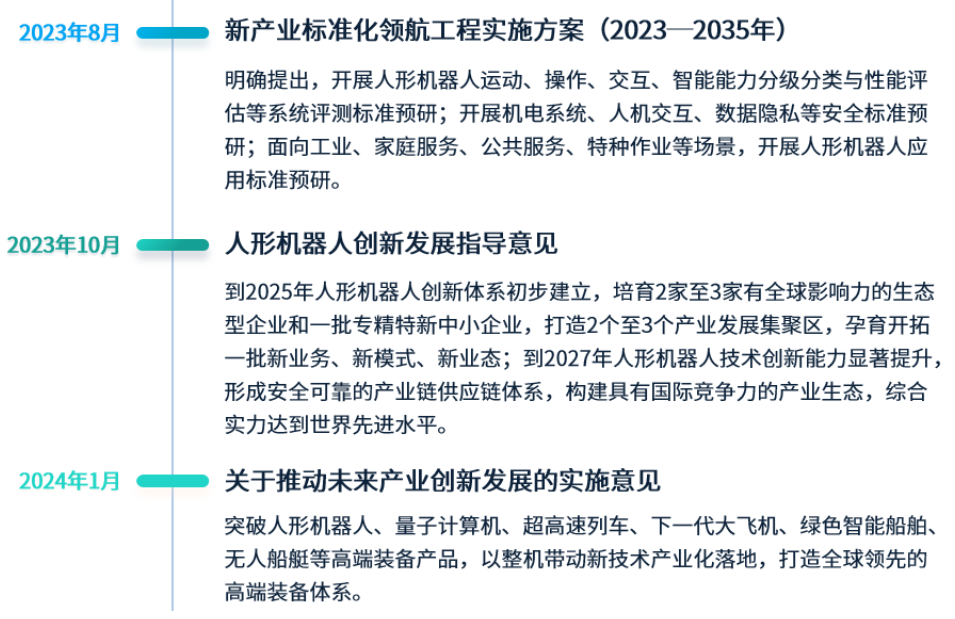
Group 1 - The humanoid robot industry is still in the early stages of mass production, revealing various issues that will drive industry optimization and upgrades [1] - Humanoid robots are considered the best carriers of embodied intelligence and represent a key battleground in the competition for AI technology among major countries, with significant long-term potential [1] Group 2 - The application of artificial intelligence in the industrial sector is seen as groundbreaking, enabling robots to achieve decentralized control and autonomous environmental recognition to complete complex tasks [2] - The automotive manufacturing sector is identified as a potential early adopter for large-scale applications of humanoid robots [2] - Humanoid robots are expected to quickly find applications in elder care and emergency management, with several countries developing specialized humanoid robots for these purposes [2] Group 3 - Emergency scenarios require robots that can navigate various terrains and perform precise operations, which necessitates the involvement of humanoid robots [3] - In 2025, Nanjing Tianchuang Electronic Technology Co., Ltd. is set to release the world's first explosion-proof humanoid robot, "Tian Kui No. 1," capable of high-precision operations in complex industrial environments [3]