AMOLED手机面板

Search documents
OPPO、vivo宣布涨价
WitsView睿智显示· 2026-03-16 08:43
Price Adjustments - OPPO has announced price adjustments for certain released products, indicating a trend of rising prices in the smartphone industry due to the memory price surge [2] - Following OPPO and OnePlus, vivo and iQOO have also announced adjustments to the suggested retail prices of some products, effective March 18, 2026, due to the significant increase in global semiconductor and storage costs [3] Market Impact - According to TrendForce's latest survey, the shortage and rising prices of memory, which constitute a significant portion of smartphone costs, are impacting brand shipment plans for 2026 and weakening panel shipment momentum [5] - Global smartphone panel shipments are projected to decline to approximately 2.14 billion units in 2026, a decrease of about 7.3% from 2.31 billion units in 2025, marking the end of a growth cycle that began in 2023 [6] - The share of AMOLED smartphone panels is expected to increase from 41.2% in 2025 to 43.2% in 2026, while the share of LTPS LCD is projected to shrink from 4.4% to 2.5%, with a-Si LCD maintaining around 54.4% market share [6] Cost Management Strategies - In response to rising costs driven by memory prices, smartphone brands may pass some costs onto consumers while also engaging in aggressive supply chain cost management, including negotiating for lower prices with key component suppliers such as panel manufacturers [6]


存储涨价,2026年全球手机面板出货预估年减7.3%
WitsView睿智显示· 2026-03-06 05:58
Core Viewpoint - The smartphone panel market is expected to decline in 2026 due to high memory costs and supply shortages, marking the end of a growth cycle that began in 2023, with a projected shipment of 2.14 billion units, down approximately 7.3% from 2.31 billion units in 2025 [4]. Group 1: Market Dynamics - The procurement of smartphone panels in 2026 will be negatively impacted by weak new device shipment momentum and high memory costs, which hinder the supply of second-hand devices [5]. - The demand in the repair market remains stable but is insufficient to fill the gap left by the new device market due to conservative consumer sentiment [5]. - The smartphone panel market is experiencing a trend where high-end products are strengthening, mid-range products are transforming, and low-end products are stabilizing [5]. Group 2: Technology and Specifications - The share of AMOLED smartphone panel shipments is expected to increase from 41.2% in 2025 to 43.2% in 2026, while the share of LTPS LCD is projected to shrink from 4.4% to 2.5% [5]. - The a-Si LCD, targeting low-end models, is expected to maintain a market share of approximately 54.4% [5]. Group 3: Pricing and Cost Management - Smartphone brands may pass some of the increased costs onto consumers while also engaging in aggressive cost control measures across the supply chain, particularly for LCD panels used in mid to low-end models [6]. - The price decline for LCD panels is expected to be significant due to weak demand and inventory adjustments, while even AMOLED panels may face pricing challenges due to conservative procurement strategies and price wars among panel manufacturers [6]. - The soaring memory prices are identified as the biggest variable affecting the smartphone panel market in 2026, with future industry trends dependent on how brands adjust their product mix and inventory levels, as well as consumer acceptance of price increases [6].

研报 | 存储器涨价冲击供应链,预估2026年全球手机面板出货年减7.3%
TrendForce集邦· 2026-03-05 09:57
Core Insights - The article highlights a significant decline in global smartphone panel shipments for 2026, projected at approximately 2.14 billion units, a decrease of about 7.3% from 2.31 billion units in 2025, marking the end of a growth cycle that began in 2023 [2][4]. Group 1: Market Dynamics - The smartphone panel procurement in 2026 is adversely affected by weak new device shipment momentum, with second-hand market support limited due to high storage costs and difficulties in acquisition [4]. - The market is experiencing a shift in competition, with high-end panels becoming stronger, mid-range transitioning, and low-end remaining stable. AMOLED panel shipments are expected to increase from 41.2% in 2025 to 43.2% in 2026, while LTPS LCD's market share is forecasted to shrink from 4.4% to 2.5% [4]. Group 2: Pricing and Cost Management - Smartphone brands may pass some of the increased costs from storage components to consumers while also engaging in aggressive supply chain cost management, including negotiating lower prices with panel suppliers [6]. - The pricing trend for LCD panels, particularly for mid to low-end models, is expected to decline significantly due to weak demand and inventory adjustments, while even AMOLED panels may face pricing challenges due to conservative procurement strategies and price wars among manufacturers [6].
CINNO Research:12月手机面板结构分化延续 价格普遍承压
Zhi Tong Cai Jing· 2025-12-18 05:45
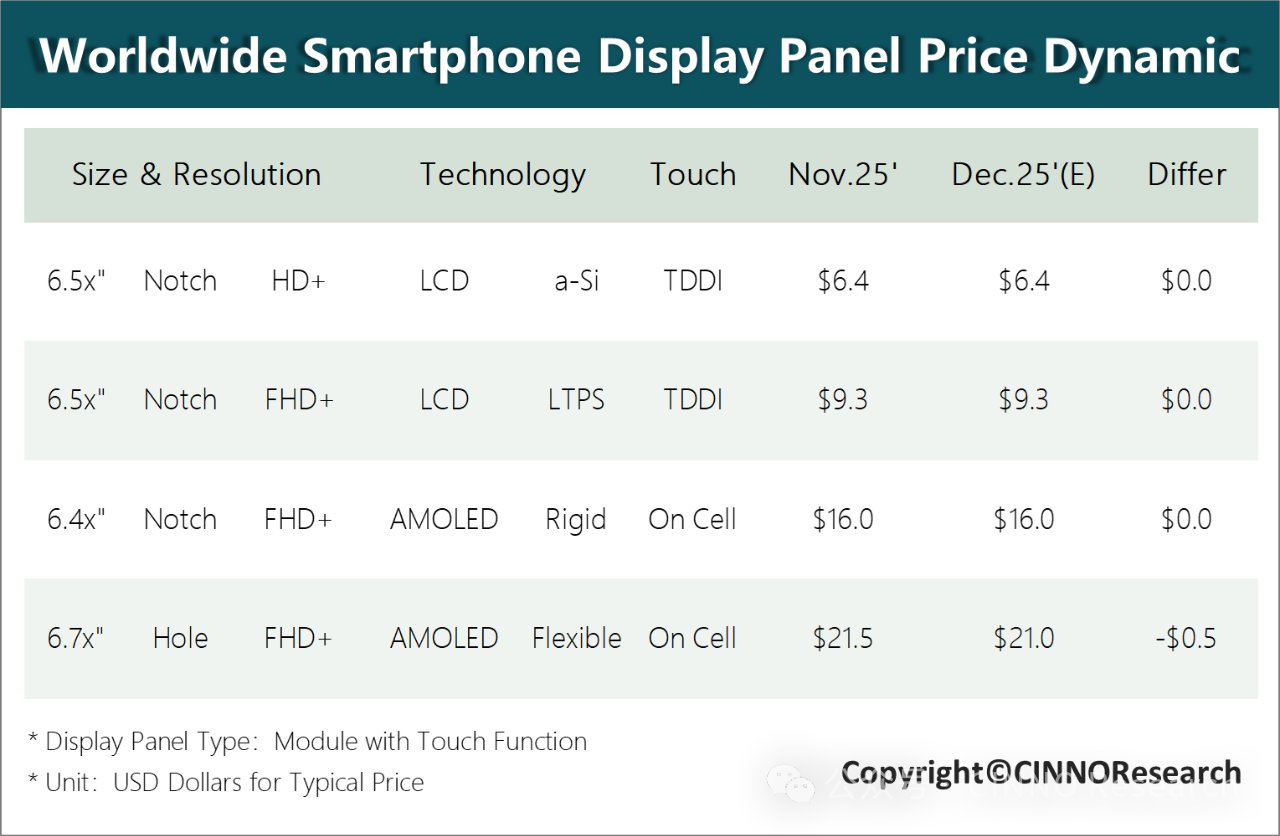
Core Insights - The mobile panel market is experiencing structural differentiation despite high overall utilization rates as the year-end promotional season approaches [1] Group 1: a-Si Panels - a-Si modules maintain full production due to stable demand in the low-end mobile and repair markets, but face intense competition leading to price pressure [2] - Prices for a-Si modules are expected to remain stable until the end of the year, with potential slight declines in early 2026 as demand weakens and supply pressures increase [2][3] Group 2: LTPS Panels - LTPS production rates remain high due to strong demand from non-mobile applications such as automotive, laptops, and tablets, despite weak smartphone demand [3] - Prices for LTPS panels are expected to remain flat in December, with new project prices anticipated to decrease in 2026 as manufacturers adopt competitive pricing strategies [3] Group 3: AMOLED Panels - Rigid AMOLED panels are facing demand shrinkage due to competition from flexible technologies, leading to price stabilization at low levels [3] - Flexible AMOLED manufacturers are experiencing slight declines in utilization rates due to slowed production rhythms, with aggressive pricing strategies being employed to secure orders for the upcoming year [3] - Prices for flexible AMOLED panels are projected to continue a downward trend into December and January 2026 [3]
研报 | 新机带动需求回温,2025年第三季度全球智能手机面板出货量季增8.1%
TrendForce集邦· 2025-11-10 07:09
Core Insights - The global smartphone panel shipment reached 586 million units in Q3 2025, with a quarter-on-quarter increase of 8.1% and a year-on-year increase of 5.3%, driven mainly by the iPhone 17 series and new releases from other major brands [2] - The total smartphone panel shipment for 2025 is projected to be 2.243 billion units, representing a year-on-year growth of 3.4%, marking a recent peak [2] AMOLED Panel Performance - AMOLED panel shipments in Q3 2025 reached 246 million units, with a quarter-on-quarter increase of 9.9%, benefiting from increased adoption in mid-range models [5] - SDC maintained a dominant position in the mid-to-high-end market with a 40% shipment share, while BOE continued to supply iPhones and other major brands [5] - Visionox expanded its market share by leveraging cost advantages [5] LCD Panel Performance - LCD panel shipments increased by 6.9% quarter-on-quarter to 340 million units in Q3 2025, with BOE accounting for over 30% of shipments [6] - The demand for low-end a-Si LCD panels remains stable due to cost advantages and after-sales market needs, while LTPS LCD demand continues to decline [6] - The overall smartphone panel market is expected to be dominated by AMOLED and a-Si LCD technologies moving forward [6] Market Outlook - The growth momentum for the smartphone panel market in 2025 is primarily driven by the rising penetration of AMOLED technology and close collaboration between Chinese panel manufacturers and brands [6] - By 2026, it is anticipated that AMOLED panel shipments will exceed 45% of the market, while LCD panels will maintain around 55% [6] - Korean suppliers will continue to dominate the high-end market, while Chinese manufacturers will accelerate their penetration into the mid-to-high-end market through cost and brand collaboration advantages [6]

专利互诉多年后 京东方、三星或迎和解
Zhong Guo Jing Ying Bao· 2025-04-29 21:58
Core Viewpoint - After years of patent disputes, leading companies in the panel (semiconductor display) industry, BOE and Samsung, may be approaching a reconciliation due to narrowing differences over advertising fees and potential collaboration opportunities in the LCD market [2][6][7]. Group 1: Patent Disputes and Market Dynamics - The patent litigation between Samsung and BOE has been ongoing for several years, with a notable deterioration in their relationship since 2022, primarily due to disputes over advertising fees and patent infringements [3][4]. - In 2021, BOE ranked second in the LCD market for Samsung's television screens, but the relationship soured in 2022 when BOE refused to pay the advertising fees demanded by Samsung, leading to a significant reduction in BOE's supply of LCD screens to Samsung [3][4]. - As of April 2023, Samsung Display initiated a new lawsuit against BOE in the U.S., marking the third legal action against BOE in two years, while BOE has also counter-sued Samsung for patent infringement [3][4]. Group 2: Competitive Landscape and Technological Advancements - The competition between BOE and Samsung in the OLED sector has intensified, with BOE's rapid development posing a significant challenge to Samsung's dominance in the OLED market [4][5]. - As of 2023, Samsung holds nearly 30,000 OLED-related patents, while BOE closely follows with approximately 28,000 patents, indicating a narrowing gap in technological capabilities [4][5]. - BOE has surpassed LG Display in the automotive OLED shipment volume and has successfully entered the supply chains of major smartphone manufacturers like Xiaomi, Huawei, and Apple [5]. Group 3: Potential Reconciliation and Future Collaboration - With major Korean panel manufacturers exiting the LCD market, Samsung and LG may become key customers for BOE's LCD products, prompting discussions of potential reconciliation [6][7]. - Samsung's strategy includes diversifying its LCD supply chain and improving its business relations in China, making reconciliation with BOE a priority [6][7]. - The upcoming discussions between BOE and Samsung are expected to address not only patent fee negotiations but also how to manage marketing costs associated with television sales, which could lead to a more collaborative relationship [6][7].