
存储器价格上涨

Search documents
研报 | 存储器涨价冲击供应链,预估2026年全球手机面板出货年减7.3%
TrendForce集邦· 2026-03-05 09:57
Core Insights - The article highlights a significant decline in global smartphone panel shipments for 2026, projected at approximately 2.14 billion units, a decrease of about 7.3% from 2.31 billion units in 2025, marking the end of a growth cycle that began in 2023 [2][4]. Group 1: Market Dynamics - The smartphone panel procurement in 2026 is adversely affected by weak new device shipment momentum, with second-hand market support limited due to high storage costs and difficulties in acquisition [4]. - The market is experiencing a shift in competition, with high-end panels becoming stronger, mid-range transitioning, and low-end remaining stable. AMOLED panel shipments are expected to increase from 41.2% in 2025 to 43.2% in 2026, while LTPS LCD's market share is forecasted to shrink from 4.4% to 2.5% [4]. Group 2: Pricing and Cost Management - Smartphone brands may pass some of the increased costs from storage components to consumers while also engaging in aggressive supply chain cost management, including negotiating lower prices with panel suppliers [6]. - The pricing trend for LCD panels, particularly for mid to low-end models, is expected to decline significantly due to weak demand and inventory adjustments, while even AMOLED panels may face pricing challenges due to conservative procurement strategies and price wars among manufacturers [6].


TrendForce:2026 全球手机产量恐衰退 10% 至 11.35 亿台
Huan Qiu Wang· 2026-02-12 03:27
Core Insights - The global smartphone production is expected to decline significantly in 2026 due to soaring memory prices, with a projected drop of 10% to 1.135 billion units [1] - If memory prices continue to rise, the decline in production could exceed 15%, potentially bringing annual capacity down to a minimum of 1.061 billion units [1] Industry Impact - The surge in memory prices has directly increased the manufacturing costs of smartphones, with the estimated contract price for a mainstream configuration of 8GB RAM and 256GB storage rising nearly 200% compared to the same period in 2025 [1] - The share of memory costs in the overall smartphone production has escalated from the previous range of 10%-15% to 30%-40% [1] Manufacturer Strategies - The significant increase in costs has compelled smartphone manufacturers to adjust their production and operational strategies, including raising retail prices, restructuring product mix, or optimizing hardware configurations to cope with cost pressures [1]
TrendForce集邦咨询:存储器涨势加剧终端售价压力 2026年全球手机产量或降至约11.35支
Zhi Tong Cai Jing· 2026-02-11 09:13
Group 1 - The estimated contract price for mainstream memory capacity of 8GB+256GB is expected to rise nearly 200% in Q1 2026 compared to the same period in 2025 [1] - The BOM cost share of memory in smartphones has increased from approximately 10-15% to 30-40% [1] - TrendForce suggests that raising terminal prices has become a necessary choice for maintaining operations, prompting brands to adjust product mix or configurations in response to the ongoing surge in memory prices [1] Group 2 - Samsung, as the leading smartphone brand and a major player in the memory industry, is expected to see a decline in production volume due to overall market weakness, although the reduction will be less severe [1] - Apple, with a higher proportion of high-end models, is better positioned to absorb rising memory costs and has a consumer base more accepting of price adjustments, providing some support for its production performance [1] - Transsion, with a higher proportion of low-end models, is expected to face significant production cuts due to its sensitivity to cost fluctuations and the price sensitivity of its target customers [1] Group 3 - Vivo, Oppo, Xiaomi, and Honor will face not only memory cost pressures in 2026 but also competition from Huawei, which is focusing on promoting its HarmonyOS platform and has a relatively flexible pricing strategy [2] - TrendForce predicts that Huawei may experience the smallest production adjustment among brands and could even see growth despite the challenges [2] - The current decline in terminal sales, triggered by rising memory prices, is compounded by the fact that most electronic devices are sufficiently functional to meet consumer needs, leading to decreased replacement demand and extended upgrade cycles [2]
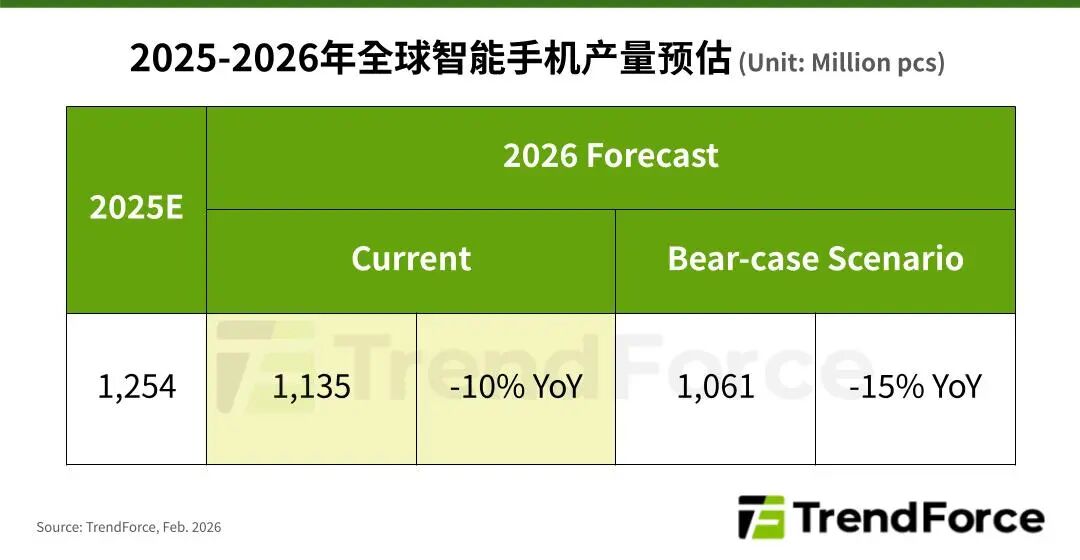
研报 | 存储器涨势加剧终端售价压力,2026年全球手机产量恐面临下行风险
TrendForce集邦· 2026-02-11 09:01
Core Insights - The global smartphone production is expected to decline by 10% in 2026 due to rising storage prices, with total production estimated at approximately 1.135 billion units [2] - In a bearish scenario, the decline could extend to 15% or more, affecting various brands differently based on their product structure and regional presence [2] Group 1: Storage Price Impact - The estimated contract price for mainstream storage (8GB + 256GB) in Q1 2026 has surged nearly 200% compared to the same period in 2025 [5] - The BOM cost share of storage in smartphones has increased from approximately 10-15% to 30-40% [5] - Brands are likely to raise terminal prices to maintain operations and may need to adjust product configurations in response to ongoing storage price increases [5] Group 2: Brand-Specific Production Outlook - Samsung, as the leading smartphone brand and a major player in the storage industry, is expected to see a decline in production, but the drop will be less severe due to its vertical integration advantages [6] - Apple, with a higher proportion of high-end models, is better positioned to absorb rising storage costs and has a consumer base more accepting of price adjustments, providing some support for its production performance [6] - Xiaomi and Transsion, which focus on low-end models, are more sensitive to cost fluctuations and are expected to experience significant production cuts in 2026 [6] Group 3: Competitive Landscape and Market Dynamics - Brands operating primarily in the Chinese market, such as Vivo, Oppo, Xiaomi, and Honor, face not only storage cost pressures but also competition from Huawei, which is expected to have a more flexible pricing strategy [6] - Huawei is projected to have the smallest production adjustment among brands and may even experience growth despite the challenging environment [6] Group 4: Consumer Behavior and Market Trends - The current decline in terminal demand is triggered by rising storage prices, but the overall functionality of electronic devices has reached a level that satisfies most consumers' daily needs, leading to longer replacement cycles [7] - Even if storage prices stabilize in the future, the underlying structural changes in consumer behavior may not reverse in the short term [7]

TrendForce集邦咨询:新机调价影响销售需求 2026年第二季度起智能手机生产承压明显
智通财经网· 2026-01-15 08:17
Core Insights - The smartphone market is expected to face dual pressures of tight memory supply and soaring prices starting in the second half of 2025, leading to increased terminal product prices and weakened demand [1] - Despite a conservative outlook from various smartphone brands, there has been no significant reduction in memory procurement, as brands prioritize resource locking to avoid higher future costs [1] - The first half of 2026 will be a critical period for brands to adjust production and product structure, with major production plan adjustments anticipated between the second and third quarters of 2026 [2] Group 1 - The smartphone production forecast for 2026 has been revised downwards by TrendForce, with a year-on-year reduction expected to increase from 2% to 7% compared to previous estimates [2] - Brands are adjusting specifications and pricing strategies to mitigate the impact of earlier price increases, although the effects on production schedules will not be immediate [2] - The increase in finished goods inventory due to various factors, including the diminishing effects of subsidy policies in the Chinese market and the impact of price adjustments on sales, may lead some brands to curtail future production plans starting in the first quarter of 2026 [1]
CINNO Research简评1月手机面板行情:存储成本高企叠加淡季效应 价格全面承压
Zhi Tong Cai Jing· 2026-01-09 06:32
Core Insights - The mobile panel market is entering a traditional off-season as of January 2026, with upstream memory prices rising for several months, leading terminal brands to reduce shipment targets to manage operational risks, resulting in a significant weakening of overall demand for mobile panels [1] Group 1: a-Si Panels - The overall demand contraction has led to a significant reduction in order visibility at the module level, while new production lines are gradually releasing capacity, exacerbating the oversupply pressure in the market [1] - The competitive landscape for a-Si panels is intensifying due to the supply-demand imbalance, with a high likelihood of continued downward price trends for a-Si modules [1] Group 2: LTPS Panels - Despite some demand support in non-mobile applications such as automotive displays, laptops, and tablets, the LTPS panel market is experiencing a contraction in overall demand due to rising memory prices and varying performance across segments, particularly in laptops and tablets [1] - In January, a slight price softening for LTPS panels used in smartphones is expected, with panel manufacturers likely to adopt competitive pricing strategies to secure new project orders [1] Group 3: AMOLED Panels - Rigid AMOLED panels are facing low demand due to substitution effects, maintaining low price fluctuations, while flexible AMOLED panels are under dual pressure from both demand and supply sides [1] - Terminal brands are becoming cautious in panel procurement due to cost control and shipment adjustments, while panel manufacturers are adopting more aggressive pricing strategies in negotiations to maintain utilization rates and market share [1] - CINNO Research anticipates that flexible AMOLED panel prices will continue to decline in January, influenced by previous capacity releases from some panel manufacturers aiming to meet annual shipment targets [1]
全球半导体开年集体大涨,存储再战C位,或进一步推动半导体设备需求
Xuan Gu Bao· 2026-01-04 23:31
Group 1 - The global semiconductor sector is experiencing a strong start to the year, with major storage companies seeing stock price increases of over 10% [1] - In the US market, SanDisk surged nearly 16%, Micron Technology rose over 10%, and ASML increased by over 8%, while TSMC hit a historical high with a rise of over 5% [1] - In the Korean market, Samsung Electronics' stock jumped 7.2% due to the recognition of its HBM4 products by customers [1] Group 2 - Morgan Stanley has raised its 2026 average price expectations for DRAM by 62% and for NAND by 75%, citing a tightening memory market driven by manufacturing constraints and stronger demand [1] - Winbond, a Taiwanese storage manufacturer, announced a 100% price increase for NAND products and a 50% increase for NOR products in Q1 2026 [1] Group 3 - Changxin Technology, as China's first and the world's fourth-largest DRAM manufacturer, is expected to achieve revenues of 55-58 billion yuan in 2025, with a gross margin exceeding 40% in Q4 2025 [2] - The company plans to raise 29.5 billion yuan through its IPO to fund production line upgrades, DRAM technology enhancements, and forward-looking research and development [2] Group 4 - Zhaoyi Innovation holds a 1.88% stake in Changxin Technology, having invested 2.3 billion yuan [3] - Jingzhida offers a full range of DRAM testing equipment, including wafer testers, aging repair equipment, and FT testers [4]
存储器涨价预期强 手机笔电开年要调价
Shen Zhen Shang Bao· 2025-12-17 17:33
Core Insights - The consumer electronics market, particularly smartphones and laptops, is facing a new wave of price increase expectations due to anticipated significant rises in memory prices in Q1 2026, leading to cost pressures on global terminal products [3][7] - Major brands are likely to adjust product prices and specifications, with sales forecasts being revised downward, resulting in resource advantages concentrating among a few leading brands [3][7] Price Adjustments and Promotions - Despite strong price increase expectations, major consumer electronics brands are implementing significant discounts to maintain market interest, such as Apple's recent price cut on iPhone 17 Pro models shortly after their release [4] - Lenovo has also offered substantial discounts on older models, with reductions reaching up to 9,200 yuan for certain products [4] - Xiaomi's Redmi Book Pro 16 and K90 series have seen price reductions, with the former being offered at 6,499 yuan after a discount from 6,799 yuan [5] Market Dynamics and Cost Structure - TrendForce indicates that the impact of memory components on the bill of materials (BOM) cost for smartphones and PCs is rapidly increasing, necessitating a reevaluation of pricing strategies by brands like Apple [7] - Android brands, which typically target the mid-to-low price market, will likely need to raise new product prices and adjust old product pricing or supply cycles due to rising memory costs [7][8] - The high-end lightweight laptop segment is expected to experience the most significant price pressure due to the integration of mobile DRAM on motherboards, limiting cost control options [7][8] Consumer Behavior and Market Outlook - TrendForce suggests that consumers may not need to rush to purchase devices in anticipation of price increases, as there is still inventory support for profitability in the consumer laptop market [8] - However, a long-term trend towards specification reductions or price adjustments is expected, with a notable pricing adjustment period anticipated in the PC market by Q2 2026 [8]




集邦解析 明年第1季存储器显著涨价效应 智能机、NB 销量恐下修
Jing Ji Ri Bao· 2025-12-11 23:29
Core Insights - TrendForce forecasts a significant increase in memory prices by Q1 2026, leading to cost challenges for global end products, which will force smartphone and laptop industries to raise product prices and lower specifications, resulting in a downward revision of sales outlook [1] - The impact of memory on the bill of materials (BOM) for consumer electronics like smartphones and PCs is rapidly expanding, with Apple's iPhone series also expected to see a notable increase in BOM cost share, prompting a reassessment of new device pricing [1] - The rise in memory prices will lead laptop brands to adjust their product mix, procurement strategies, and regional sales layouts, particularly affecting high-end lightweight laptops that cannot easily change specifications due to design constraints [1] - The consumer laptop market, while sensitive to changes in specifications and pricing, currently benefits from existing inventory of finished products and low-cost memory, allowing for short-term price stability, but a price adjustment period is anticipated in the PC market by Q2 2026 [1] Industry Adjustments - "Specification reduction" or "postponing upgrades" has become a necessary strategy for smartphone and laptop brands to balance costs [2]
集邦咨询:预计2026年第一季度存储器涨势持续强劲,智能手机、笔电品牌启动价格上修与规格降级
Zheng Quan Shi Bao Wang· 2025-12-11 11:32
Core Insights - The latest survey by TrendForce indicates that significant price increases for memory chips are expected in Q1 2026, leading to cost challenges for global end products [1] - As a result, smartphone and laptop industries are likely to raise product prices and lower specifications, with sales outlooks being further downgraded [1] - Resource advantages are expected to concentrate among a few leading brands [1]