Amazon Bedrock平台

Search documents
亚马逊2000亿美元投资计划“炸场”,折叠着AI时代资本逻辑的惊天变局
Sou Hu Cai Jing· 2026-02-06 09:26
Core Viewpoint - Amazon reported a significant increase in revenue for Q4 2025, reaching $213.39 billion, exceeding market expectations, while announcing a massive investment plan of approximately $200 billion for 2026, primarily focused on AI infrastructure and logistics upgrades [1][3]. Group 1: Financial Performance - Amazon's AWS business generated $35.58 billion in revenue for Q4 2025, marking a 24% year-over-year growth and achieving a new high in 13 quarters [1]. - The company's operating cash flow for the past year was $139.5 billion, a 20% increase, while free cash flow dropped to $11.2 billion, a significant decline of 70.7% year-over-year [9]. Group 2: Investment Plans - The $200 billion investment plan will focus on four key areas: AI infrastructure, proprietary chip development, logistics and robotics, and low Earth orbit satellite networks [3][4]. - Amazon aims to deploy over 100,000 new robots to reduce order processing time by 30% and expand its same-day and next-day delivery capabilities [3]. Group 3: AI Strategy - Amazon is advancing its AI infrastructure project "Rainier," with nearly 500,000 proprietary Trainium2 chips deployed, targeting 30% of AI computing tasks to be handled by in-house chips by the end of 2026 [3]. - The company’s proprietary AI chip portfolio, including Trainium and Graviton, has generated over $10 billion in annual revenue, reflecting a growth of over 300% [5]. Group 4: Workforce Changes - Amazon announced a layoff of 16,000 employees as part of a restructuring effort to enhance organizational efficiency and redirect resources towards AI-related fields, with total layoffs expected to reach around 30,000 [5]. - The layoffs are seen as a strategic move to optimize traditional business structures while investing in future AI capabilities [5]. Group 5: Market Reactions - Following the announcement of the aggressive investment plan, Amazon's stock fell nearly 10% in after-hours trading, indicating market concerns over the sustainability of such high capital expenditures [1][8]. - Analysts suggest that the tech industry may be entering a "over-investment" phase as capital expenditures outpace revenue growth [8].



“模型祛魅”的AI拐点时刻:从“追逐AGI幻想”转向“理性落地应用” 亚马逊云科技4万个Agent能否跑通落地逻辑?
Mei Ri Jing Ji Xin Wen· 2025-12-23 15:23
Core Insights - The global AI industry is transitioning from a "model competition" phase to a "deep water zone" of practical application, with companies like MiniMax accelerating their IPO processes and major domestic internet firms intensifying their investments in AI Agents [2][3] - The demand for AI has shifted from "whether to use" to "how to use," emphasizing the importance of organizational process restructuring and tool empowerment for successful implementation [2][5] Industry Trends - AI Agents are now recognized as key vehicles for bridging the gap between vast data and actionable knowledge, addressing engineering challenges such as security, compliance, and memory support [3][4] - A significant 57.3% of surveyed organizations are already running AI Agents in production environments, with adoption rates as high as 67% among large organizations with over 10,000 employees [3] Strategic Approaches - Amazon Web Services (AWS) is employing a dual strategy in the Chinese market, offering both global access to local models through Amazon Bedrock and tailored solutions for local clients using proprietary and third-party models [6] - The focus on "decentralized" tool delivery directly to business units is seen as crucial for meeting efficiency demands, with ongoing upgrades aimed at transforming prototypes into production-level code [4][5] Market Dynamics - The shift in corporate attitudes towards AI reflects a maturation in understanding, moving from chasing AGI fantasies to practical applications that integrate technology into business processes [5][7] - The rise of AI Agents is breaking traditional ERP system constraints, allowing for dynamic work organization without pre-set processes, which is essential for navigating complex business scenarios [5] Future Outlook - The relationship between AWS and independent software vendors (ISVs) is evolving towards mutual benefit, highlighting that the core of the AI turning point lies in the maturity of industry recognition and the enhancement of implementation capabilities [7] - The emphasis on human skills such as communication and critical thinking remains vital, as AI is expected to take over repetitive tasks while human value persists in strategic roles [7]

大家忙着卖算力时,亚马逊云科技在帮客户跑“数十亿个Agent”
Xin Lang Cai Jing· 2025-12-04 09:50
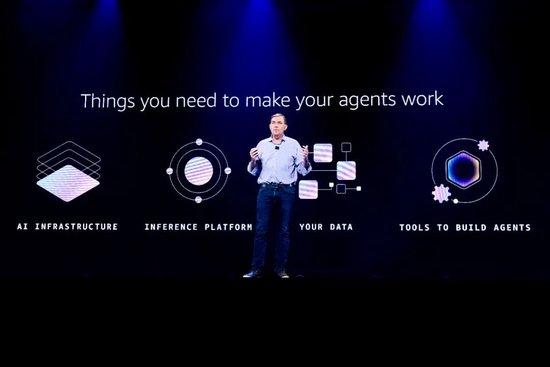
Core Insights - Amazon Web Services (AWS) is focusing on making computing power truly usable and enabling Agents to operate effectively, rather than chasing short-term profits from selling computing power [2][38] - AWS maintains a leading position in the global cloud market with a market share of 37.5%, significantly ahead of its closest competitor [2][39] - The annual recurring revenue (ARR) for AWS is projected to reach $132 billion by December 2025, reflecting a 20% year-over-year growth [2][39] Competitive Landscape - AWS faces intense competition from Microsoft Azure, Google Cloud GCP, Oracle OCI, and CoreWeave, which are securing long-term contracts with major clients through investments and computing power collaborations [3][39] - The concept of "computing power financialization" is creating short-term pressure on AWS's stock and public perception [3][39] Technological Trends - The integration of full-stack AI, including chips and models, is becoming increasingly important for attracting enterprise clients [3][40] - The rise of Agentic AI is identified as a new battleground, with billions of Agents expected to emerge in the future [3][40] AWS's Strategic Response - At the re:Invent 2025 conference, AWS announced new products aimed at helping enterprise clients quickly implement Agents [4][40] - CEO Matt Garman emphasized that valuable Agents require four core components: AI infrastructure, AI inference platforms, data, and Agent development tools [4][40] Cost Efficiency Initiatives - AWS is developing its own AI chips to reduce the total cost of ownership (TCO) for computing infrastructure [8][44] - The newly launched Trainium 3 chip, built on a 3nm process, can produce five times more Tokens per megawatt compared to its predecessor and reduce training costs by up to 50% [9][45] Product Development - AWS has deployed over 1 million Trainium chips, which are expected to generate billions in revenue annually [11][47] - The Amazon Nova 2 series of self-developed models aims to provide cost-effective solutions for enterprises, with a focus on low-cost processing of simpler tasks [12][51] Market Positioning - Amazon Bedrock, AWS's model platform, integrates models from various vendors, allowing enterprises to utilize multiple models efficiently [16][52] - The company is positioning Amazon Bedrock as a significant growth driver, with expectations of it matching the revenue contribution of EC2 in the long term [19][55] Agent Development Tools - AWS launched Amazon Bedrock AgentCore, a standardized toolset for developing and deploying Agents, which has seen over 200,000 SDK downloads shortly after its release [20][56] - The company is also introducing official Agent tools, such as Security Agent and DevOps Agent, to enhance internal operations and customer offerings [23][59] Long-term Vision - AWS is focused on solving current customer pain points rather than pursuing speculative short-term gains, reflecting a pragmatic approach to technology development [32][34] - The company aims to build a comprehensive Agent infrastructure that can drive exponential growth in computing power consumption through user interactions with Agents [26][29]