AtomGit

Search documents
一文看清AI、开源与商业的真正博弈,GOBI 2025圆满收官!
AI科技大本营· 2025-12-22 03:44
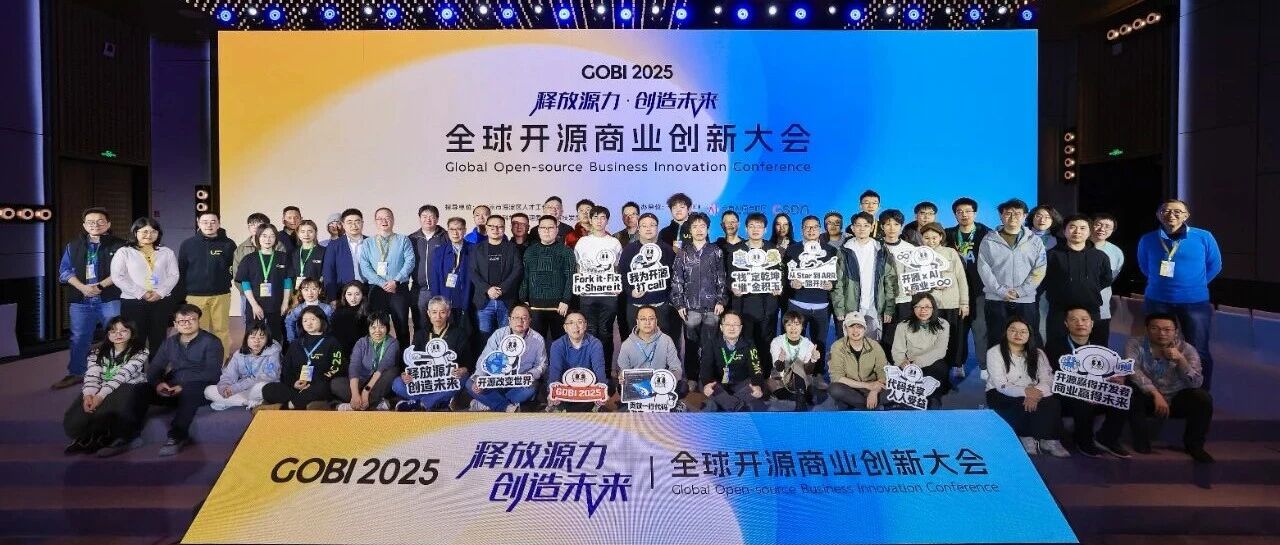
Core Insights - The article discusses the significance of open-source in the AI era, emphasizing the need for sustainable business models while maintaining openness in the industry [1][3]. Group 1: Conference Overview - The GOBI 2025 Global Open-source Business Innovation Conference gathered over 500 leaders from various sectors to discuss the intersection of open-source, business, and AI [1]. - The conference theme, "Releasing Source Power, Creating the Future," aimed to explore how open-source innovation can translate into sustainable industrial value [1]. Group 2: AI and Open-source Development - Du Yingfen highlighted the necessity of a robust institutional environment for the sustainable development of open-source [4]. - The evolution of open-source from a software development model to a complex industrial ecosystem is driven by the rise of AI, which now encompasses data, algorithms, models, and computing power [6]. - China is transitioning from being a "user" to a significant contributor in the global open-source ecosystem, with projects like openEuler and openHarmony gaining traction [6][7]. Group 3: Entrepreneurial Opportunities - Wang Hua identified the current period as a "golden window" for entrepreneurship in AI and open-source, driven by favorable technological and market conditions [8]. - Entrepreneurs are encouraged to focus on global perspectives and rapid open-source implementation to seize emerging opportunities in AI [11]. Group 4: Commercialization of AI - Jiang Tao discussed the generational leap in the global open-source industry, moving from service-centric models to AI-driven commercial opportunities [12]. - The demand for AI is shifting from pilot projects to core business applications, with a growing preference for domestic models in China [12][14]. - The commercialization speed of AI startups is significantly faster than previous SaaS companies, with a 3-5 times increase noted in the U.S. market [12]. Group 5: Community and Collaboration - The importance of community engagement in open-source projects is emphasized, with contributors encouraged to actively participate and share knowledge [35][37]. - The challenges of maintaining code quality and project coherence in rapidly evolving open-source environments are acknowledged [35][36]. Group 6: Future Trends and Challenges - The article concludes with insights on the future of AI and open-source, highlighting the need for continuous adaptation and collaboration to harness the full potential of AI technologies [23][24].

中国开源迎来“成熟时刻”:开源鸿蒙和开源欧拉毕业,新一代“开源+AI”基础设施AtomGit正式上线
Feng Huang Wang· 2025-11-26 03:23
Core Insights - The 2025 Open Atom Developer Conference held in Beijing highlighted the graduation of two significant open-source projects, Open Harmony and Open Euler, marking a pivotal moment in China's open-source ecosystem [1][2] - The graduation signifies not a departure but a maturation of these projects, indicating their stability and readiness for broader application in the industry [2][3] - The emergence of AtomGit as a new generation "open-source + AI" infrastructure platform represents a significant advancement in the integration of AI development processes [1][9] Group 1: Graduation of Open Source Projects - The graduation of Open Harmony and Open Euler reflects their successful evolution over the past 4-5 years, transitioning from exploration to maturity [3][8] - Open Harmony has undergone 10 major iterations since its contribution to the foundation in September 2020, attracting over 9,700 core code contributors and producing more than 130 million lines of code [3] - Open Euler has completed 12 major iterations since its open-source launch in 2019, gathering 23,000 code contributors and serving over 5.5 million users across various industries [3][5] Group 2: Value Creation in Real-World Applications - Open Harmony has expanded beyond consumer devices into critical industry applications, including micro-satellites, industrial control systems, and banking services, establishing itself as a "universal language" across sectors [4][6] - Open Euler's strength lies in its deep integration within key sectors such as government cloud services and energy management, creating high switching costs and strong industry ties [5][6] - Both projects are not merely single-point replacements but are generating scalable and replicable value in real-world applications [6][7] Group 3: Advancements in AI Infrastructure - AtomGit addresses the structural gap in AI deployment by integrating code, models, data, and computing power into a unified engineering process [9][10] - This platform aims to lower the barriers to AI commercialization in China, facilitating faster model iterations and easier delivery of industry solutions [10][11] - The developments signify a shift towards a more cohesive and mature technological ecosystem in China, with a focus on foundational stability and platform unification [11]
AtomGit正式上线,中国开源AI雏形已现
Tai Mei Ti A P P· 2025-11-25 03:12
Core Insights - The Chinese open-source industry is experiencing significant developments, with OpenHarmony and openEuler graduating as the first projects under the OpenAtom Open Source Foundation, indicating their maturity in technology, community governance, and ecological development [2] - The newly upgraded AtomGit platform has officially launched, accelerating the empowerment of China's open-source and AI ecosystem [2] - According to GitHub's 2024 Octoverse report, the global developer count has surpassed 150 million, with active developers reaching 22.8 million, and over 3 million new active developers added in 2024 alone [2] Market Growth - The global open-source software market is projected to maintain an 8.5% compound annual growth rate (CAGR) from 2025 to 2030, potentially exceeding $150 billion by 2030, driven by cloud computing, AI, and IoT [3] - In the AI sector, open-source models like Qwen and DeepSeek have achieved over 300 million downloads globally, with derivative models exceeding 100,000, capturing over 30% of the Hugging Face community [3] Structural Characteristics - China's open-source landscape shows a structural characteristic where projects like Qwen, DeepSeek, and PaddlePaddle are leading in AI large models, while there is still a lack of influence in foundational technology areas such as operating system kernels and databases [3] - The GitHub 2024 technical influence ranking indicates that AI large models are the primary engine of global technological innovation, with a significant cross-disciplinary and cross-national "super innovation network" effect [3] Value Realization Challenges - Despite the growth in scale, the average commercial lifespan of Chinese open-source projects is less than 18 months, with 70% of projects seeing a drop in activity within a year, and only 3% achieving sustainable profit models [4] - In comparison, international counterparts like RedHat and Canonical have established stable revenue streams, with RedHat's OpenShift generating over $3 billion annually [4] AI Open Source Imbalance - The imbalance in the AI open-source sector is evident, with Gartner predicting the global open-source software market to reach $150 billion by 2025, while Nvidia reports that China holds 80% of the world's open-source large models, yet their commercial value conversion efficiency is low [5] - The Chinese AI open-source community faces three systemic challenges: the disconnection between computing power, frameworks, and models; the dual-track collaboration between code and models; and the gap from demo to production delivery [6][7] AtomGit Platform Development - The AtomGit platform aims to integrate code, models, datasets, and computing resources, creating a unified infrastructure for AI development [8] - The platform faces challenges in merging diverse computing resources, system architecture, and ensuring a consistent user experience [9][10] Future Outlook - The development of open-source AI is transitioning from a hobbyist phase to becoming a foundational enterprise infrastructure, with predictions that by 2027, 70% of enterprise AI applications will be built on open-source models [11] - AtomGit's future business model will focus on basic services and value-added operations, supporting the growth of open-source projects and facilitating commercialization [11] Integration Strategy - AtomGit employs an integrated design for underlying storage, a unified account and permission management system, and resource scheduling mechanisms to enhance platform stability and performance [12]