BCB

Search documents
X @Chainlink
Chainlink· 2026-02-04 13:08
Morph has exclusively integrated Chainlink CCIP to power cross-chain transfers of $2.1B+ Bitget Token (BCB).Using CCIP, Morph Foundation is moving 50% of the total BCB supply to @MorphNetwork.https://t.co/laBSgzYaRN https://t.co/UuWwbjmsUOMorph (@MorphNetwork):Unified cross-chain settlement is here.@chainlink CCIP is now live on Morph, enabling secure, unified cross-chain movement for #BGB, the network’s gas and settlement token.Smoother transfers. Reliable liquidity. Consistent settlement across networks.L ...
1300+份新材料报告下载:做新材料领域的「攻坚者」
材料汇· 2026-01-21 15:30
Core Viewpoint - The article discusses the rapid growth and investment opportunities in the advanced packaging materials sector, highlighting the potential for domestic companies to replace foreign imports in critical areas of technology [7][8]. Market Overview - The global market for advanced packaging materials is projected to reach $2.032 billion by 2028, with the Chinese market expected to grow to 9.67 billion yuan by 2025 [8]. - Specific materials such as PSPI and Al-X photoresist are identified as key growth areas, with PSPI's market size in China estimated at 7.12 billion yuan in 2023 [8]. Investment Opportunities - The article outlines various advanced packaging materials and their projected market sizes, indicating significant growth potential in sectors like conductive adhesives, chip bonding materials, and epoxy encapsulants [8]. - For instance, the conductive adhesive market is expected to reach 3 billion yuan by 2026, while the epoxy encapsulant market is projected to grow to 99 million USD by 2027 [8]. Competitive Landscape - The article lists both domestic and international players in the advanced packaging materials market, emphasizing the competitive dynamics and the potential for domestic companies to capture market share from established foreign firms [8]. - Companies such as 鼎龙股份, 国风新材, and 三月科 are highlighted as key domestic players in the PSPI segment, while international competitors include Fujifilm and Toray [8]. Investment Strategies - Different investment stages in the new materials industry are discussed, with a focus on the varying risk levels and investment strategies appropriate for each stage, from seed funding to pre-IPO [10]. - The article emphasizes the importance of thorough industry and team assessments at each investment stage to mitigate risks and maximize returns [10].


Yole:先进封装材料,增速显著
半导体行业观察· 2025-11-08 02:10
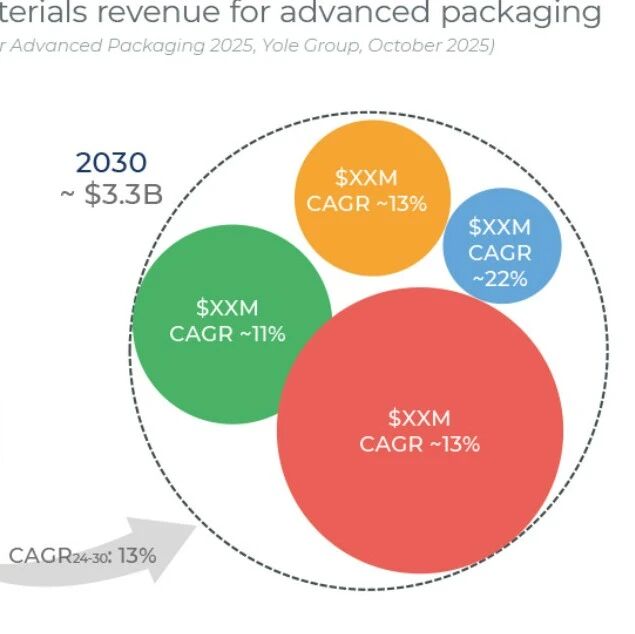
Core Insights - The advanced packaging polymer materials market is projected to reach $1.6 billion by 2024, with a compound annual growth rate (CAGR) of 13% [3] - The semiconductor industry trends, including automotive/ADAS, high-performance computing (HPC), generative AI, AR/VR, mobile and edge AI, and IoT, are reshaping advanced packaging and increasing material requirements for high-performance devices [3] - The revenue from polymer materials for advanced packaging is expected to grow to approximately $3.3 billion within five years, with a CAGR of 13.2% [3] - The mobile and consumer electronics sectors lead in sales and revenue, while the telecom and infrastructure sectors are experiencing the fastest growth due to the demand for high-performance packaging driven by HPC and generative AI [3] - System-in-package (SiP) remains the dominant platform for polymer materials, with 2.5D and 3D packaging being the fastest-growing segments, projected to achieve a CAGR of 35% in sales and 28% in revenue from 2024 to 2030 [3] Material Requirements - Advanced materials are essential for achieving finer spacing, higher reliability, and sustainable packaging [7] - The demand for higher computing power, faster I/O, improved energy efficiency, and superior thermal management is reshaping semiconductor and advanced packaging technologies [7] - Key materials such as polyimide (PI), PBO, BCB, epoxy, and acrylic resin composites are widely used in advanced packaging as dielectric materials, molding compounds, underfill materials, and temporary bonding materials [7] - A significant challenge for materials is to reduce the coefficient of thermal expansion (CTE) mismatch, as polymers expand more than silicon, leading to stress, warping, and defects [7] - Solutions require developing specific formulations tailored to particular applications to balance performance trade-offs for each customer and packaging architecture [7] Market Dynamics - The advanced packaging polymer materials market has a diverse yet highly concentrated supply chain, with the top five manufacturers (Resonac, Henkel, Panasonic, Sumitomo, and HD Microsystems) accounting for over 50% of global revenue [10] - Japan dominates the market, holding approximately 80% of total revenue in dielectric materials, molding compounds, underfill materials, and temporary bonding solutions [10] - Germany follows with a market share of about 10%, primarily driven by Henkel, while the U.S. holds around 5% market share led by 3M (temporary bonding materials) and Qnity (DuPont) (dielectric materials) [10] - The Chinese market accounts for approximately 4%, mainly led by Huahai Chengke (molding compounds) and Sanxin (temporary bonding materials) [10] - Suppliers are adjusting their product portfolios to meet AI/high-performance computing-driven packaging demands while adhering to requirements for PFAS-free materials [10] - Collaboration among material, equipment, and packaging suppliers is crucial for driving innovation in the advanced semiconductor packaging sector [10]