Baleno

Search documents
Stocks in news: Vodafone Idea, Hindustan Zinc, Vedanta, Marico, Vishal Mega Mart, Maruti and L&T
The Economic Times· 2026-01-28 00:41
Company Performance - Vodafone Idea narrowed its consolidated losses to Rs 5,286 crore in Q3FY26 from Rs 6,609 crore in the same period last year, with revenue from operations at Rs 11,323 crore, a 2% increase from Rs 11,117 crore [10][11] - Motilal Oswal Financial Services reported a slight increase in Q3 consolidated net profit to Rs 566 crore compared to Rs 565 crore a year ago, with total revenue from operations rising 6% to Rs 2,112 crore [6][11] - Marico's consolidated net profit reached Rs 447 crore in Q3FY26, up 12% year-on-year, with revenue from operations at Rs 3,537 crore, a 27% increase from Rs 2,794 crore in Q3FY25 [7][11] - Vishal Mega Mart reported a consolidated net profit of Rs 313 crore in Q3FY26, up 19% year-on-year, with revenue from operations at Rs 3,670 crore, a 17% increase from Rs 3,136 crore in Q3FY25 [8][11] Market Expectations - Maruti Suzuki is expected to report a strong performance for the December quarter, with net profit growth estimated between 24% and 35%, amounting to Rs 4,540 crore to Rs 5,696 crore, and revenue growth projected at 32% to 37%, reaching Rs 50,765 crore to Rs 52,706 crore [9][10][11] - Larsen & Toubro is anticipated to show a robust December-quarter performance, with net profit growth expected between 20% and 35%, estimated at Rs 4,038 crore to Rs 4,548 crore, alongside double-digit growth in revenue and EBITDA [9][10][11] Stake Sale - Vedanta approved the sale of up to 1.59% stake in Hindustan Zinc Limited, representing up to 6.7 crore equity shares, with a floor price set at Rs 685 per share for the offer for sale (OFS) [4][11] - The two-day OFS is scheduled to open on January 28, 2026, for non-retail investors and on January 29, 2026, for retail investors [5][11]


印度电动车政策濒死,铃木为何疯狂扩张
汽车商业评论· 2026-01-13 23:07
Core Viewpoint - Suzuki is strategically expanding its production capacity in India by investing approximately $550 million to increase annual production capacity by up to 1 million units, responding to rising domestic demand for vehicles [4][5][6]. Group 1: Production Expansion - Maruti Suzuki has announced plans to add a new plant in Gujarat, which will be its second passenger vehicle factory in the state, to address the current pressure on production capacity [8][12]. - The company currently has a total installed capacity of about 2.4 million vehicles, with peak capacity nearing 2.6 million, which is fully utilized [8][9]. - The new plant is part of a broader strategy where Suzuki aims to invest $8 billion in India over the next five to six years, positioning the country as a global production hub for electric vehicles [5][12]. Group 2: Market Demand and Sales Growth - Maruti Suzuki reported a record monthly sales figure of 178,646 units in December 2025, reflecting a year-on-year increase of 37% [4]. - The Indian automotive market is experiencing significant growth, with a 26.8% year-on-year increase in vehicle shipments to dealers in December 2025, marking the highest monthly growth for that year [8]. - The demand for entry-level models is strong, with an order backlog of approximately one and a half months, indicating robust consumer interest [4][8]. Group 3: Electric Vehicle Market Dynamics - Despite the growth in electric vehicle sales, which exceeded 270,000 units in 2025 (an 86% increase from 2024), the overall penetration rate of electric vehicles in the Indian passenger car market remains low at only 4% [15][16]. - The Indian government's electric vehicle manufacturing promotion plan has faced challenges, with no car manufacturers responding to the initiative, leading to its characterization as "nominally existent" [16][17]. - The uncertainty surrounding the government's electric vehicle policies has prompted Suzuki to focus on expanding production capacity and export capabilities to stabilize output and meet domestic and international demand [17].

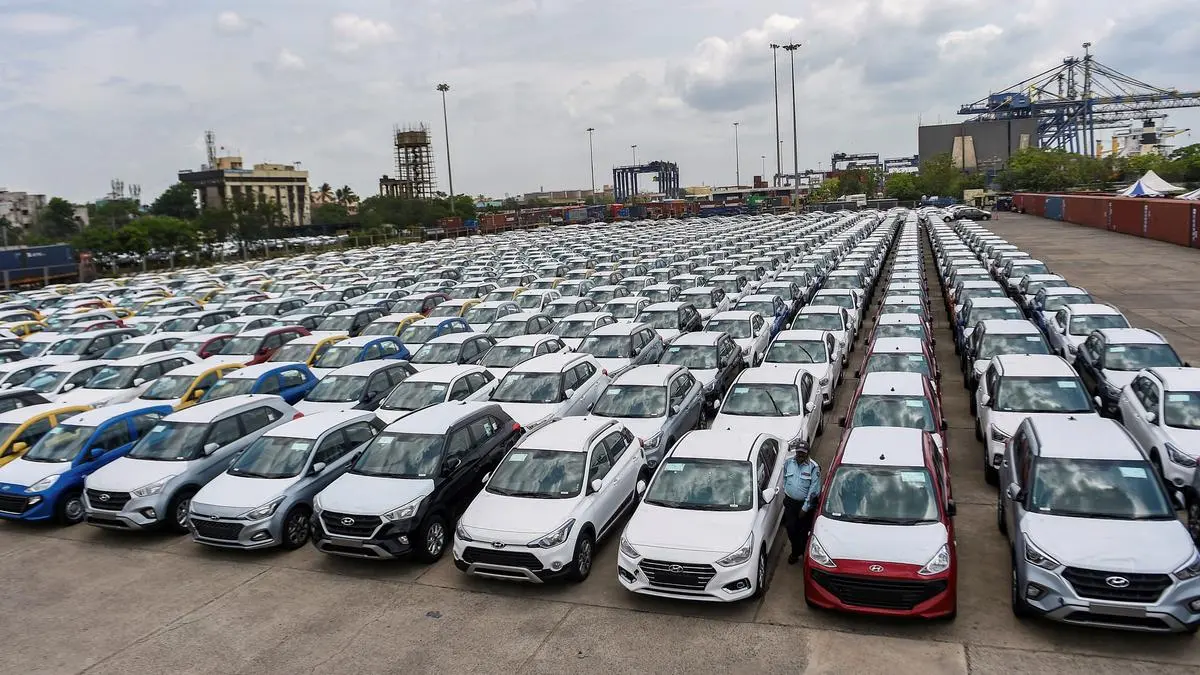
Auto exports firing on all cylinders in September, Q2 and H1 2025 with double digit growth
BusinessLine· 2025-10-16 07:45
Core Insights - Indian automobile exports have shown significant growth in September, Q2, and the first half of the financial year for both passenger vehicles (PVs) and two-wheelers (2Ws) [1][2][3] Passenger Vehicles (PVs) - Total PV exports in September increased by 30.3% year-on-year to 87,762 units compared to 67,379 units in September 2024 [1] - In Q2, total PV exports grew by 23% year-on-year to 241,554 units, up from 196,196 units in Q2 2024 [2] - For the first half of the financial year, total PV exports rose by 18.4% year-on-year to 445,884 units, compared to 376,679 units in April-September 2024 [3] Two-Wheelers (2Ws) - Total 2W exports in September grew by 15.3% year-on-year to 429,562 units, up from 372,481 units in September 2024 [2] - In Q2, total 2W exports increased by 25% year-on-year to 1,295,468 units, compared to 1,035,997 units in the same period last year [2] - For the first half of the financial year, total 2W exports grew by 24.2% year-on-year to 2,432,410 units, compared to 1,959,145 units in H1 2024 [7] Company Performance - Maruti Suzuki India (MSIL) achieved its highest-ever monthly exports of 42,204 units, growing by 52.2% year-on-year [5] - MSIL has already crossed 210,000 units in the first half of the year and aims to reach a target of 400,000 units for the fiscal year [6] - Hyundai Motor India has set a target of achieving 30% of its production as exports by 2030, focusing on markets in the Middle East and Latin America [6][7]