DeepSeek AI聊天机器人

Search documents
别被华尔街“轮动牛市”噪音带偏 Mag7“领涨神话”仍是美股主线
智通财经网· 2025-12-26 09:01
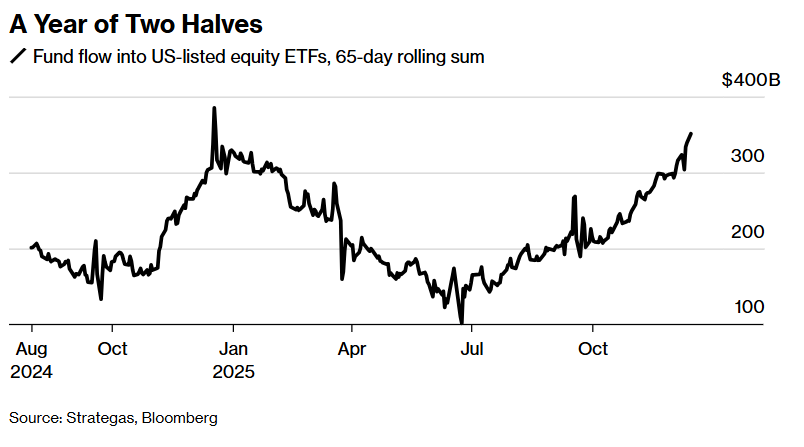
Core Viewpoint - Wall Street analysts predict that 2026 will be characterized as a "rotation bull market," with institutional investors believing that the current rotation will not last long, and that the "Magnificent Seven" tech giants will significantly outperform other sectors, leading the S&P 500 and Nasdaq 100 to new highs [1][2]. Group 1: Market Trends and Predictions - The S&P 500 index is expected to close 2025 at a historical high, paving the way for further gains in 2026 [1]. - The market leadership has shifted from AI-related tech and growth stocks to undervalued sectors such as value, healthcare, and materials [1]. - The S&P 500 index has seen a cumulative increase of approximately $30 trillion over the past three years, largely driven by major tech giants and companies investing in AI infrastructure [3]. Group 2: The Magnificent Seven - The "Magnificent Seven" (Mag 7) includes Apple, Microsoft, Google, Tesla, Nvidia, Amazon, and Meta Platforms, which collectively account for about 35% of the S&P 500 and are viewed as key drivers of market performance [4]. - Analysts expect the Mag 7 to achieve a profit growth of approximately 22.7% in 2026, compared to 12.5% for the remaining 493 companies in the S&P 500 [15]. Group 3: AI Infrastructure and Investment Themes - AI infrastructure and the Mag 7 theme remain central to market dynamics, with companies driving long-term value expansion [3]. - The ongoing AI investment narrative is expected to continue as a strong theme throughout 2026, despite some market rotation towards other sectors [2][9]. - The market is currently experiencing a capital reallocation, shifting focus from growth to value and from tech to non-tech sectors [6]. Group 4: Economic Indicators and Market Sentiment - The S&P 500's overall profit estimates have been revised upward, with analysts not anticipating significant risks of a downturn due to a dovish Federal Reserve outlook [14]. - The potential for a "melt-up" phase exists, which could lead to a larger market peak, supported by strong earnings from the Mag 7 [15]. - The current market environment is not seen as an extreme bubble compared to the internet bubble of the early 2000s, with tech valuations being more reasonable [17][18].

?关税惊魂、AI狂热与“过山车式剧烈波动”! 六张图回顾美股“狂野的2025年”
Zhi Tong Cai Jing· 2025-12-22 08:54
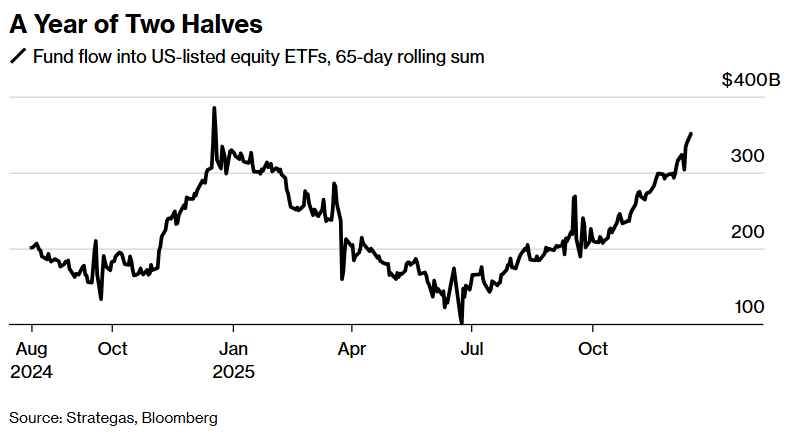
Core Viewpoint - The year 2025 has been characterized by extreme volatility in the U.S. stock market, driven by Trump's tariff policies, AI investment frenzy, and ongoing Federal Reserve monetary policy debates [1][2][3]. Group 1: Market Volatility - The S&P 500 index experienced a significant drop in April, nearing bear market territory due to Trump's aggressive tariff policies, followed by a rapid rebound as these policies were eased [1][2]. - The Cboe Volatility Index (VIX) surged above 50 in April, marking the highest level since the COVID-19 pandemic, before dropping back below 20 as market conditions stabilized [2][3]. - The S&P 500 index has risen approximately 16% year-to-date, recovering from a 15% decline in April, indicating a strong performance despite earlier volatility [3]. Group 2: Investment Trends - The market saw a significant outflow from ETFs in April, particularly from the Invesco QQQ Trust, which experienced its first net outflow in seven months, reflecting investor concerns over tariff impacts [4]. - Following the easing of tariff pressures, inflows into the Invesco QQQ Trust surged in May, indicating a recovery in investor sentiment [4]. - Wall Street's predictions for the S&P 500 index have fluctuated significantly throughout the year, with major banks adjusting their forecasts in response to changing market conditions [6]. Group 3: AI Investment and Market Dynamics - The AI investment wave, particularly around companies like Nvidia and Oracle, has led to unprecedented infrastructure spending, contributing to market highs [1][10]. - Concerns about an "AI bubble" have emerged, with some investors warning of potential risks associated with inflated valuations in the tech sector [7][8]. - The concentration of market capitalization among the top 10 stocks in the S&P 500 has reached nearly 40%, raising concerns about market risk and the sustainability of this concentration [9][11]. Group 4: Active Management Challenges - Active fund managers have struggled to outperform the S&P 500, with only 22% of large-cap active ETFs beating the index, the lowest rate since 2016 [12]. - The difficulty in managing portfolios amid high concentration in tech stocks has led to a significant underweighting of these sectors by active managers [12]. - Analysts predict that as market conditions become more favorable, active managers may find better opportunities for stock selection in 2026 [12]. Group 5: International Market Performance - Despite a strong rebound in the U.S. market, it has underperformed compared to international indices, highlighting a shift in investor sentiment towards global markets [14][15]. - The "American exceptionalism" narrative is showing signs of strain, as U.S. policies and economic uncertainties have led to a decline in the attractiveness of U.S. assets [15]. - International markets, including those in Canada, the UK, and Germany, have outperformed the U.S. benchmark indices, suggesting a potential shift in investment flows [15].






关税惊魂、AI狂热与“过山车式剧烈波动”! 六张图回顾美股“狂野的2025年”
Zhi Tong Cai Jing· 2025-12-22 08:27
Core Viewpoint - The year 2025 has been marked by extreme volatility in the U.S. stock market, driven by factors such as Trump's tariff policies, AI investment enthusiasm, and ongoing Federal Reserve monetary policy debates [1][2][3]. Group 1: Market Volatility and Trends - The S&P 500 index experienced a significant drop in April due to Trump's aggressive tariff policies, nearly entering a bear market, but rebounded sharply as these policies were relaxed, leading to new highs driven by AI-related investments [1][2]. - The Cboe Volatility Index (VIX) spiked above 50 in April, marking the highest level since the COVID-19 pandemic, before falling back below 20 as market conditions stabilized [2][3]. - The S&P 500 index has risen approximately 16% year-to-date, recovering from a 15% drop in April, indicating a strong performance despite earlier volatility [3]. Group 2: Fund Flows and ETF Activity - April 2025 saw significant net outflows from ETFs, particularly those tracking the Nasdaq 100, as investors reacted to tariff concerns, marking the fastest withdrawal pace in over two years [4][7]. - Following the easing of tariff pressures, inflows into the Invesco QQQ ETF surged in May, indicating a recovery in investor sentiment [7]. Group 3: Analyst Predictions and Market Adjustments - Wall Street analysts rapidly adjusted their year-end targets for the S&P 500, initially lowering them due to tariff fears, then raising them again as market conditions improved [8][11]. - The historical context of such rapid adjustments was noted, with comparisons to the early days of the COVID-19 pandemic [12]. Group 4: Bubble Concerns and Valuation Levels - Concerns about an AI bubble emerged early in 2025, with notable investors warning of inflated valuations in tech stocks, particularly those benefiting from AI advancements [13][16]. - The S&P 500's current price-to-earnings ratio is among the highest levels seen this century, raising alarms about potential overvaluation [16]. Group 5: Market Concentration Risks - The top 10 stocks in the S&P 500 account for nearly 40% of the index, raising concerns about market concentration risks and the potential for increased volatility [17][21]. - The "Magnificent Seven" tech giants have driven significant market gains, but their dominance poses risks for diversified investment strategies [18][21]. Group 6: International Market Performance - Despite a strong rebound in the U.S. market, it has underperformed compared to international indices, highlighting a shift in investor sentiment towards global markets amid U.S. policy uncertainties [25][28]. - The narrative of "American exceptionalism" is weakening, as international markets have outperformed the U.S. due to concerns over domestic economic policies and rising deficits [28][29].


关税惊魂、AI狂热与“过山车式剧烈波动”! 六张图回顾美股“狂野的2025年”
智通财经网· 2025-12-22 08:23
Market Overview - The year 2025 has been characterized by extreme pricing trajectories in the U.S. and global stock markets, with the S&P 500 index experiencing significant volatility due to Trump's tariff policies and subsequent AI investment enthusiasm [1][2] - The S&P 500 index has risen by 16% year-to-date, recovering from a 15% drop in April, driven by strong corporate earnings and expectations of Federal Reserve interest rate cuts [3] Tariff Impact - Trump's aggressive tariff policies initially led to a rare market downturn, pushing the Nasdaq into a technical bear market, but a reversal in these policies allowed for a rapid recovery [2][3] - The Cboe Volatility Index (VIX) spiked above 50 in April due to tariff fears, marking the highest level since the COVID-19 pandemic, before dropping back below 20 as the situation stabilized [2] AI Investment Surge - The AI infrastructure investment wave, led by tech giants like Google, Microsoft, and Meta, has created unprecedented demand for AI computing capabilities, contributing to the stock market's recovery [1][2] - Concerns about an "AI bubble" have emerged, with some investors warning of potential risks associated with inflated valuations in the tech sector [13][16] Market Concentration Risks - The top 10 stocks in the S&P 500 now account for nearly 40% of the index, raising concerns about market concentration risks and the potential for increased volatility [17] - The "Magnificent Seven" tech giants, including Apple, Microsoft, and Nvidia, have been pivotal in driving the S&P 500 to new highs, but their dominance poses risks for diversified investment strategies [18][21] Active Management Challenges - Active fund managers have struggled to outperform the S&P 500, with only 22% of large-cap active funds beating the index, the lowest rate since 2016 [23] - The concentration of returns among a few tech stocks has made it difficult for active managers to achieve diversification and manage risk effectively [21][23] International Market Performance - The U.S. stock market has underperformed compared to international indices, with several countries' benchmarks significantly outperforming the S&P 500 in 2025 [25][28] - The narrative of "American exceptionalism" is showing cracks as U.S. policy uncertainty and rising deficits have led to a decline in the attractiveness of U.S. assets [28][29]